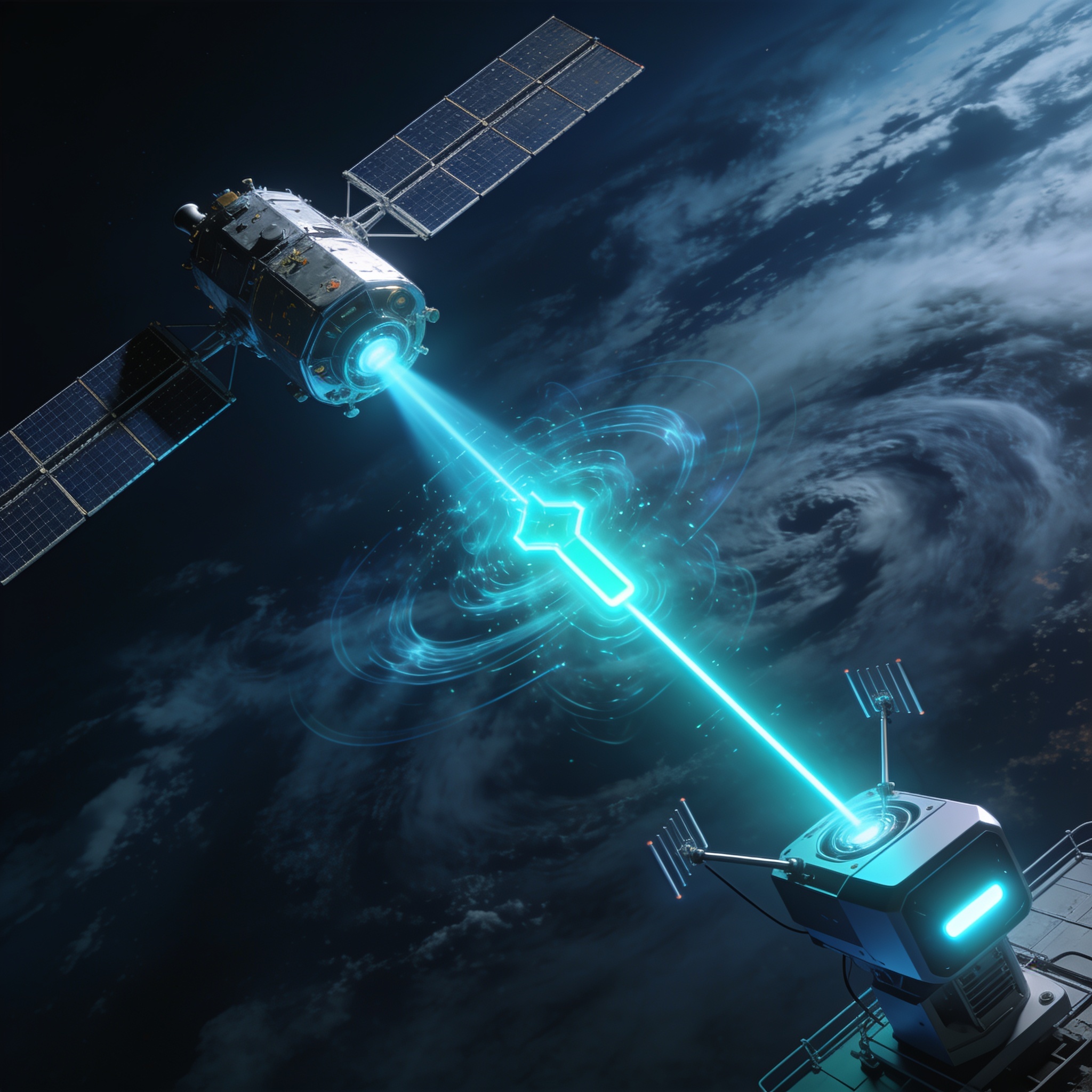
On September 9, 2026, npj Quantum Information published a paper detailing a new satellite-to-ground quantum key distribution model that explicitly accounts for time-evolving atmospheric turbulence. The model, developed by researchers affiliated with the Chinese Academy of Sciences and other institutions, addresses a long-standing mismatch between static theoretical predictions and the measured performance of real-world quantum links.
This is not a product announcement or a funding round. It is a research contribution that could sharpen the engineering of future satellite QKD constellations—including those planned by China, Europe, and the United States—by providing more accurate link budget estimates under realistic turbulence conditions.
What the Model Actually Does
Satellite-to-ground QKD requires the transmission of single photons through the turbulent atmosphere. Turbulence causes beam wander, scintillation, and wavefront distortion, all of which degrade the quantum bit error rate and the secure key rate. Existing models typically treat turbulence as a static statistical ensemble, using a frozen-in-time Kolmogorov spectrum. The new model introduces a time-evolving turbulence spectrum based on the temporal dynamics of refractive-index fluctuations. This allows it to capture the fade statistics that govern the availability of a quantum channel over seconds-to-minutes timescales.
The paper derives a closed-form expression for the time-averaged secure key rate that depends on the turbulence coherence time, the satellite pass geometry, and the receiver aperture. Numerical simulations show that the time-evolving model can reduce the predicted key rate by up to 40% compared to static models for low-elevation passes, because it correctly penalizes periods of high fading. This is a more pessimistic but more realistic picture. For a typical LEO satellite pass at 400 km altitude, the model suggests that key material generation is viable only during the central 30% of the pass, where the line-of-sight zenith angle is below 30 degrees.
“The time-evolving turbulence model sharpens key rate predictions by capturing the temporal dynamics that static models miss. It tells operators when a link is truly usable, not just potentially usable.”
Winners and Losers
If the model gains traction, the immediate beneficiaries are systems engineers and mission planners at organizations building satellite QKD networks. QuantumCTek, the Hefei-based company that supplies the Micius program and follow-on satellites, could incorporate the model into its link budget software to improve ground station placement and scheduling. European quantum communication infrastructure projects, such as the EuroQCI satellite segment, and the Canadian QEYSSat mission, face similar atmospheric challenges and would benefit from more accurate performance forecasting.
The losers are the proponents of oversimplified static models that have been used to justify overly optimistic coverage claims. Satellite QKD startups that have raised funds based on static link budgets may face tougher questions from investors once the time-evolving framework becomes a standard validation tool. This paper does not invalidate the feasibility of satellite QKD, but it forces a more honest accounting of the achievable duty cycle.
For adjacent markets, the model indirectly strengthens the case for hybrid terrestrial-backbone QKD networks, where satellites serve only as occasional trusted relays rather than continuous key sources. It also reinforces the argument that post-quantum cryptography, which is not bound by atmospheric loss, will remain an essential complement to QKD for decades.
The Bigger Picture
Satellite QKD has advanced from the 2016 Micius demonstration to a growing list of operational and planned missions. China’s quantum constellation now includes three satellites, with more expected. The European Space Agency’s SECOQC successor and the U.S. Department of Energy’s QUICK intelligence program are pushing for space-based entanglement distribution. All these efforts require a precise understanding of the atmosphere as a quantum channel.
The paper arrives at a time when the conversation around QKD has shifted from proof-of-concept to operational reliability. In 2025, a joint experiment between the University of Vienna and the Chinese Academy of Sciences demonstrated a record 1.2 Mbps key rate over a 1,200 km intercontinental link using a single satellite pass, but the link was stable only during the high-elevation segment—consistent with the new model’s predictions. In 2026, the U.S. Air Force Research Laboratory launched a cubesat testing QKD components, and the first results are expected in 2027.
Government funding continues to flow: the EU’s Quantum Flagship allocated €650 million for the 2021–2027 period, and China’s 14th Five-Year Plan earmarked an estimated $15 billion for quantum technologies. Better channel models are a force multiplier for these investments.
The Signal
This paper is a genuine, if incremental, step forward. It does not claim a new hardware milestone or a higher key rate. Instead, it provides a tool that makes existing hardware expectations more realistic. The signal here is that the satellite QKD community is maturing enough to grapple with the messy physics of the real atmosphere, rather than retreating to idealized models. The next test will be experimental: does the model’s predicted pass-segment availability match measured data from operational satellites? If a team publishes a validation using Multi-Protocol Label Switching (MPLS) data from Micius or a European satellite, the model will cross from theoretical curiosity to engineering standard.
In short: satellite QKD modeling is entering the time domain, and the results are sobering for anyone who assumed that a single overhead pass guarantees a continuous key stream.
FAQ
Q: What does the paper’s model improve compared to previous satellite QKD models?
Previous models used a static Kolmogorov turbulence spectrum, which treats the atmosphere as a frozen phase screen. The new model introduces a time-evolving spectrum that captures the temporal fluctuations of beam wander and scintillation. This leads to a more accurate prediction of the secure key rate during a satellite pass, especially at low elevation angles where fading is severe. It shows that the usable key-generation window is narrower than static models suggest.
Q: How does this affect the commercial viability of satellite QKD?
It makes the business case more precise. Operators can now plan the number of satellites and ground stations needed to achieve a target global key distribution rate, rather than relying on optimistic assumptions. The model may reduce the claimed duty cycle of a single satellite, which could increase the required constellation size and cost. However, it also reduces the risk of overpromising and underdelivering, which is critical for enterprise adoption.
Q: Who are the main competitors in satellite QKD right now?
China’s QuantumCTek, in partnership with the Chinese Academy of Sciences, operates the Micius satellite and follow-on missions. In Europe, a consortium led by Thales Alenia Space and supported by ID Quantique is developing the Eagle-1 satellite for ESA’s EuroQCI. The United Kingdom’s Arqit Quantum originally planned a satellite QKD network but pivoted to terrestrial symmetric key generation. Several startups—SpeQtral (Singapore), QEYSSat (Canada), and others—are also in the mix.
Q: Is quantum key distribution ready for enterprise use?
Terrestrial QKD over fiber is commercially available from ID Quantique, Toshiba, and others, and is used in some financial and government networks. Satellite QKD is still in the demonstration phase, with operational services likely 5–7 years away. The main barriers are the high cost of satellite launches, the need for a network of optical ground stations, and the limited key generation rate per pass. This new model helps address the rate barrier by enabling better pass scheduling.
Q: What quantum computing milestones matter most in 2026?
For QKD, the key milestones are not in quantum computing but in quantum communication: a demonstration of an intercontinental all-optical QKD backbone, a photon-counting detector with efficiency above 95% at telecom wavelengths, and a satellite that can distribute entanglement between two ground stations simultaneously. The time-evolving turbulence model supports the first by providing the link budget accuracy needed for optical relay nodes.