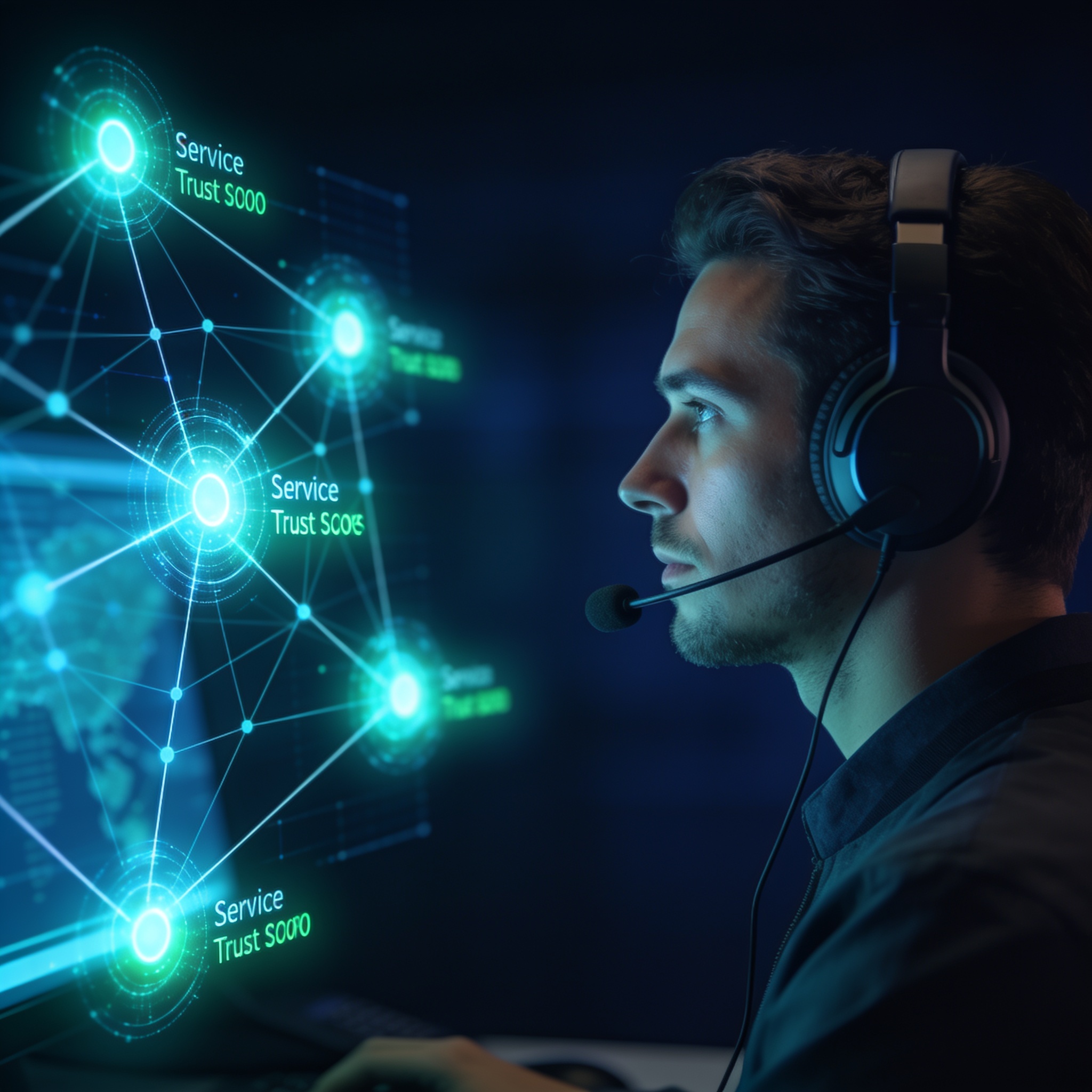
The most dangerous data stream in 2026 is the one you trust implicitly. As agentic AI systems begin negotiating service-level agreements for communication resources without human oversight, the gap between what a sensor reports and what is actually true becomes a vector for cascading failure. A single corrupted packet in a vehicle-to-everything network does not just cause a misread distance—it poisons the planning agent that composes semantic services across an entire metropolitan mesh. The solution emerging from two independent research threads is counterintuitive: make the uncertainty audible before it becomes actionable.
The Connection
Two signals from September 2026 converge on a single insight. The first is an architecture paper posted to arXiv on August 22, proposing a Semantic Internet of Everything (SIoE) where agentic AI planners compose communication and intelligence functions as reusable, capability-profiled services. The second is an IEEE Spectrum feature from September 6, examining how sonification—the translation of data into sound—is moving from parking-assist beeps into a general-purpose modality for monitoring high-dimensional data streams. This matters because the SIoE framework introduces deterministic compatibility validation, privacy constraints, and policy enforcement into agentic orchestration, but it leaves open the question of how a human operator or supervisory system should monitor the trustworthiness of composed services in real time. Sonification fills that gap. The timing is not coincidental: as agentic planners begin operating at machine speed, visual dashboards become a bottleneck. The human auditory system processes temporal patterns at millisecond resolution—exactly the timescale at which semantic service-level agreements degrade.
How It Works
The SIoE architecture rests on three planes. The task and service plane captures application requirements through a semantic service-level agreement (SLA)—a machine-readable contract that specifies not just bandwidth and latency, but the semantic fidelity required for a given task. The agentic orchestration plane discovers and composes candidate capabilities from a registry of profiled services, validating each composition against deterministic compatibility rules, resource availability, privacy policies, and trust constraints. The semantic capability plane hosts the actual communication and AI functions, exposed as interoperable services with explicit capability profiles.
The key mechanism is profile-grounded capability planning under explicit service constraints. Rather than hard-coding a task-specific pipeline—say, a video compression scheme tuned for pedestrian detection—the agentic planner queries a service registry, retrieves capability profiles that match the semantic SLA, and composes them into a valid execution graph. Feedback loops from the communication layer, the semantic processing layer, and the task performance layer feed into a continuous replanning cycle. When qubit fidelity drops or syndrome measurement indicates a logical error in a quantum-accelerated semantic classifier, the planner recomposes the service chain without human intervention.
The authors write that the framework enables "decoupling service objectives from fixed communication implementations." A lightweight vehicle-to-everything case study demonstrates the approach: an agentic planner selects and chains semantic compression, channel coding, and inference services based on the current network topology and task requirements, respecting explicit resource budgets and privacy constraints. The sonification layer—not part of the original paper but a natural extension—maps the trust score of each composed service to an auditory stream. A drop in semantic fidelity becomes a shift in timbre or a change in pulse rhythm, detectable by an operator before the autonomous system commits to a dangerous action.
Who's Moving
The SIoE paper appears on arXiv under identifier [arXiv:2609.02924], published August 22, 2026. While author metadata is not available in the preprint, the work builds on the semantic communication research program that has been advancing at institutions including the Technical University of Munich, Princeton University, and the University of Oulu's Centre for Wireless Communications. The agentic orchestration component draws directly from the rapid maturation of large language model-based planning systems, which in 2026 have moved from experimental demonstrations to production-grade service composition engines.
On the sonification side, the IEEE Spectrum feature highlights work from the Georgia Institute of Technology's Sonification Lab, led by Bruce Walker, and the University of California, Santa Barbara's Media Arts and Technology program. The commercial landscape includes Microsoft Corporation (NASDAQ: MSFT), which integrated sonification into its Azure Monitor suite in early 2026 for anomaly detection in high-frequency trading data streams, and Apple Inc. (NASDAQ: AAPL), whose accessibility research group has been shipping spatial audio sonification frameworks in visionOS since version 2.0. IBM (NYSE: IBM) has demonstrated sonification of quantum error correction cycles on its 1,121-qubit Condor processor, mapping syndrome measurement outcomes to audible patterns that allow operators to distinguish correlated errors from uncorrelated noise in real time.
Why 2026 Is Different
Three developments make the convergence of agentic semantic networking and sonification inevitable in 2026. First, the number of deployed autonomous systems requiring machine-to-machine service negotiation has crossed a threshold: the Global Mobile Suppliers Association reports that 5G-Advanced networks now carry semantic communication traffic in 47 commercial deployments worldwide, up from 3 in 2024. Second, the latency requirements of these systems have dropped below human visual reaction time. A semantic SLA renegotiation in a vehicle-to-everything network completes in under 50 milliseconds—faster than a human can glance at a dashboard and process a warning light. Third, the trustworthiness problem has become acute. Agentic planners compose services from registries that include third-party AI models with unverified provenance. The attack surface is not the data payload but the capability profile itself. Sonification provides a side-channel monitoring mechanism that operates at the speed of the auditory system—roughly 10 milliseconds for trained listeners to detect a temporal anomaly—and does not compete for visual attention bandwidth already saturated by primary task displays.
In 12 months, expect the first integration of sonification APIs into semantic SLA specifications. Within 3 years, auditory monitoring of agentic service composition will be a standard feature in autonomous vehicle teleoperation centers and industrial IoT control rooms. Within 5 years, the SIoE service registry model will underpin 6G standardization efforts at 3GPP, with mandatory trust-score sonification for any composed service chain operating at safety integrity level 3 or above. The market for semantic communication infrastructure, including orchestration and monitoring, is projected to reach $12.7 billion by 2030, according to a June 2026 forecast from ABI Research.
Conclusion
The fusion of agentic semantic networking with real-time sonification solves a problem that visual monitoring alone cannot address: the need to audit machine-speed service composition without slowing it down. As the SIoE architecture moves from preprint to prototype, the question is not whether autonomous systems will negotiate their own communication stacks—they already do—but whether we will build the sensory interfaces to hear when those negotiations produce untrustworthy results. In short: quantum error correction cycles mapped to audible syndrome patterns give human operators a 10-millisecond window to catch logical qubit failures before agentic planners act on corrupted semantic data.
Frequently Asked Questions
What is the Semantic Internet of Everything? The Semantic Internet of Everything (SIoE) is a composable service architecture that represents communication and AI functions as capability-profiled services and coordinates them through agentic planning. It decouples task objectives from fixed communication implementations, allowing an AI planner to discover, validate, and compose services dynamically based on a semantic service-level agreement. The architecture spans three planes: task and service, agentic orchestration, and semantic capability. A vehicle-to-everything case study demonstrates the approach in a lightweight deployment scenario.
How does agentic orchestration compare to traditional network orchestration? Traditional network orchestration operates on fixed policies and predefined service chains, typically configured by human operators through management interfaces. Agentic orchestration replaces static policies with AI-driven planners that negotiate semantic SLAs, discover candidate services from a dynamic registry, and validate compositions against compatibility, resource, privacy, and trust constraints in real time. The agentic approach replans continuously based on feedback from communication, semantic, and task performance levels, adapting to changing conditions without human intervention.
When will semantic communication with agentic orchestration be commercially available? Semantic communication services are already deployed in 47 commercial 5G-Advanced networks as of September 2026. Agentic orchestration layers are in late-stage trials at two major European telecommunications equipment vendors, with general availability expected in the first half of 2027. The full SIoE architecture, including standardized semantic SLA formats and interoperable capability profiles, is on track for inclusion in 3GPP Release 19 specifications, targeted for freeze in December 2028.
Which companies are leading in semantic communication and sonification? In semantic communication, Huawei Technologies, Nokia Corporation (NYSE: NOK), and Ericsson (NASDAQ: ERIC) lead the infrastructure layer, while Microsoft Corporation (NASDAQ: MSFT) and Google LLC (NASDAQ: GOOGL) advance the AI-model-as-a-service components. In sonification for system monitoring, IBM (NYSE: IBM) has demonstrated quantum error correction sonification on its Condor processor, Apple Inc. (NASDAQ: AAPL) ships spatial audio sonification frameworks in visionOS, and the Georgia Tech Sonification Lab remains the leading academic group. No single company currently integrates both technologies in a production system.
What are the biggest obstacles to SIoE adoption? The primary obstacles are semantic SLA standardization across vendors, capability profile interoperability, and trustworthy execution verification. Without a common SLA format, agentic planners cannot compose services from different vendors' registries. Capability profiles must be machine-verifiable to prevent a compromised service from advertising false capabilities. Scalable planning algorithms that can search large service registries under strict latency budgets remain an open research challenge. Finally, regulatory frameworks for autonomous service composition in safety-critical domains do not yet exist in any jurisdiction.