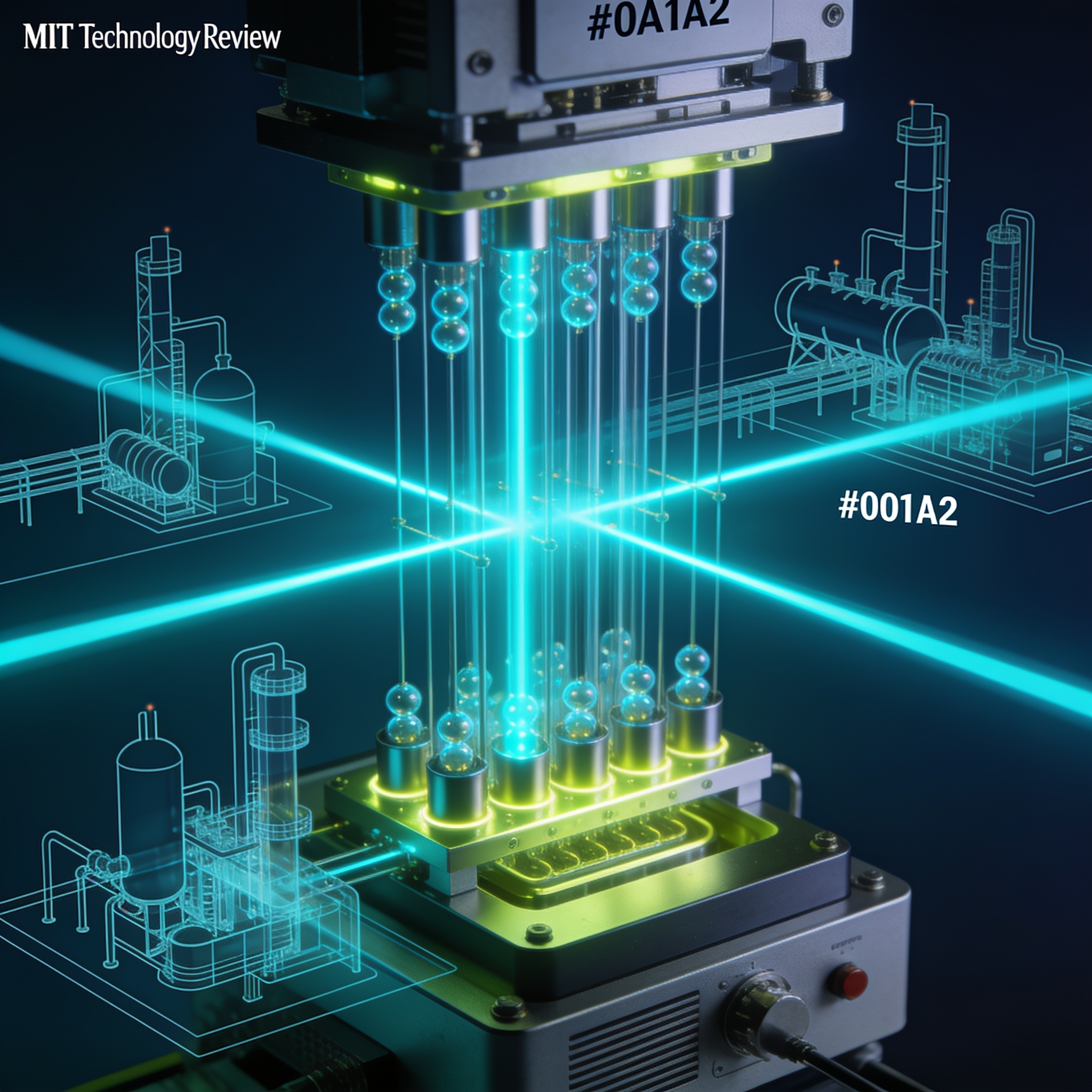
Quantinuum (NASDAQ: QNT), the trapped-ion quantum computing company, and Saudi Arabia’s integrated energy giant Aramco have executed a non-binding Memorandum of Understanding (MoU) at the LEAP 2026 technology conference in Riyadh. The agreement establishes a framework for technical onboarding, knowledge exchange, and benchmarking of quantum computing modalities to identify industrial use cases across energy production and digital transformation workflows. No financial terms were disclosed, and the MoU does not commit either party to a paid engagement.
What They're Actually Building
Quantinuum’s hardware is based on trapped ytterbium ions, which serve as qubits. These ions are held in a linear Paul trap and manipulated with precisely timed laser pulses. The H2 system, commercially available since 2023, offers 56 physical qubits with single-qubit gate fidelities of 99.997% and two-qubit gate fidelities of 99.8%, as measured by randomized benchmarking. All-to-all connectivity—a hallmark of trapped-ion architectures—eliminates the need for swap gates, reducing circuit depth for complex algorithms. The system is accessible via Quantinuum’s cloud platform and through Microsoft Azure Quantum, giving enterprise users a pathway to experiment without on-premise hardware.
In 2025, Quantinuum achieved a critical error-correction milestone: it used 20 physical qubits to encode two logical qubits with a distance-3 surface code, demonstrating a logical error rate of 0.03% per cycle, below the physical qubit error rate of 0.2%. This was the first time a logical qubit outperformed its physical constituents on a commercial platform. The demonstration used real-time quantum error correction with mid-circuit measurement and feed-forward control, a capability that remains rare among competing platforms. Google’s Willow chip achieved a similar logical qubit milestone in late 2024, but with a different error-correcting code and lower physical qubit fidelity. Quantinuum’s roadmap targets 100 logical qubits by 2029, enabled by a modular “racetrack” architecture that shuttles ion chains between trapping zones. Competitor IonQ’s Forte system, with 36 algorithmic qubits, has demonstrated similar gate fidelities but has not yet published logical qubit results. IBM’s superconducting Condor processor packs 1,121 qubits but with median two-qubit gate fidelities around 99.0%, and Google’s Willow chip has 105 qubits with 99.5% fidelity, both requiring extensive error mitigation for useful computations.
For the energy sector, Quantinuum’s platform is particularly suited to quantum chemistry simulations. Its InQuanto software package allows researchers to model molecular ground states and reaction dynamics for applications like carbon capture solvent design and catalyst optimization. Refinery optimization problems, such as crude oil blending and supply chain logistics, are NP-hard and could benefit from quantum heuristics. Seismic imaging inversion, which involves solving large linear systems, is another candidate. Aramco’s digital transformation unit has previously explored quantum annealing with D-Wave, but this MoU signals a shift toward gate-model quantum computing. The MoU will benchmark these capabilities against classical high-performance computing and potentially against other quantum modalities. However, no specific technical milestones or use cases have been publicly tied to the agreement.
Winners and Losers
This MoU does not shift competitive dynamics in the quantum computing industry. Quantinuum gains a high-profile logo for its marketing materials, but the non-binding nature means no revenue is recognized. Aramco, which has a dedicated digital transformation fund and a history of scouting emerging tech, is almost certainly running parallel evaluations with IBM, IonQ, and possibly neutral-atom player Pasqal. No single vendor is threatened. The real beneficiaries could be quantum software middleware companies—such as QC Ware, Classiq, or Zapata Computing—that provide hardware-agnostic tools for optimization and chemistry, as any eventual pilot would likely involve such layers. Quantinuum’s competitive moat lies in its high-fidelity logical qubits, essential for the deep circuits required in quantum chemistry. However, scaling trapped-ion systems to thousands of qubits requires advances in ion shuttling and photonic interconnects, areas where IonQ is also investing heavily. The MoU does not change the technical race, but it does give Quantinuum a foothold in a lucrative vertical where chemical simulation is a killer app.
From an investment perspective, the announcement is a sentiment signal, not a financial catalyst. Quantinuum’s stock (QNT) may see a temporary uptick, but the company’s $3.2 billion market capitalization (as of September 2026) still rests on the promise of fault-tolerant quantum computing, not on near-term service revenue. The company reported $14.2 million in revenue in Q2 2026, primarily from quantum computing access and cybersecurity products. Wall Street analysts remain cautious, with a median price target of $8.50, reflecting skepticism about near-term revenue growth. An MoU without a dollar figure does not alter that trajectory.
The Bigger Picture
Energy companies have been among the earliest industrial explorers of quantum computing. ExxonMobil has collaborated with IBM since 2019, focusing on optimization of shipping routes and molecular simulation for carbon capture. Shell’s quantum team has published research on using variational algorithms for subsurface modeling. BP has invested in quantum sensing for pipeline monitoring. Aramco’s move aligns with Saudi Arabia’s Vision 2030, which earmarks $1.2 billion for emerging technology R&D, including quantum. Saudi Arabia has been building its quantum workforce through KAUST’s Quantum Computing Research Group and the NEOM smart city project, which includes a quantum innovation lab. Yet, the sector remains firmly in the pre-revenue phase. A 2025 McKinsey survey found that only 12% of energy companies had moved beyond proof-of-concept quantum projects, and none had deployed a production application.
Non-binding MoUs are a common tool for corporate innovation teams to signal interest without committing budget. IonQ signed a similar agreement with Hyundai Motor in 2022 for battery chemistry, which later evolved into a paid pilot, but the majority of such agreements do not convert. In 2024, Pasqal announced an MoU with Aramco for quantum machine learning, which has not yet resulted in a commercial contract. The pattern suggests that while energy giants are curious, quantum computing’s value proposition remains unproven at scale. The global quantum computing market in energy is projected to reach $2.3 billion by 2035, but that forecast assumes fault-tolerant hardware that does not yet exist. The announcement at LEAP 2026, a conference that drew over 200,000 attendees, underscores the kingdom’s ambition to be seen as a tech hub, but the quantum industry still awaits a deal with measurable ROI.
The Signal
The signal here is that energy incumbents are kicking tires on quantum, but a non-binding MoU is a long way from a production deployment. The milestone that would validate this announcement is a contracted proof-of-concept with measurable KPIs—for example, demonstrating a quantum speedup on a specific refinery optimization problem compared to classical solvers. Until then, this is a handshake, not a deal.
Quantinuum's non-binding MoU with Aramco underscores the energy sector's growing curiosity about quantum computing, but without a financial commitment, it remains a handshake rather than a deal.
In short: Quantinuum’s MoU with Aramco is a marketing milestone, not a commercial one. The energy sector’s quantum curiosity is real, but the industry still awaits a contract with teeth.