A single qutrit—just three quantum levels—can model realities that no finite classical system can approximate without incurring provable, irreparable loss. That fact, demonstrated in reinforcement learning environments in September 2026, is not a hardware breakthrough. It is a mathematical statement about the structure of probability distributions that classical computers cannot replicate. The same mathematical signature shows up in a separate paper published five days earlier on Gaussian boson sampling, where researchers pinned down the exact moment a photonic quantum system crosses the anticoncentration threshold and enters the regime where classical simulation fails unconditionally. [arXiv:2609.01241]
This matters because both results trace their origin to the same underlying phenomenon: the hardness of sampling from certain quantum probability distributions. The timing is not coincidental. The Gaussian boson sampling paper, posted to arXiv on August 27, 2026, provides closed-form expressions for the second moment of hafnians of symmetric Gaussian products—the mathematical object that governs the output distribution of a photonic sampler. Those expressions locate the precise number of squeezed input modes at which the output probabilities stop being concentrated on a few outcomes and spread across exponentially many possibilities. That spreading, called anticoncentration, is the property that makes classical simulation infeasible. The qutrit reinforcement learning result, published five days later, demonstrates that the same infeasibility translates directly into an irreducible performance gap in AI systems that rely on environmental modeling.
How It Works
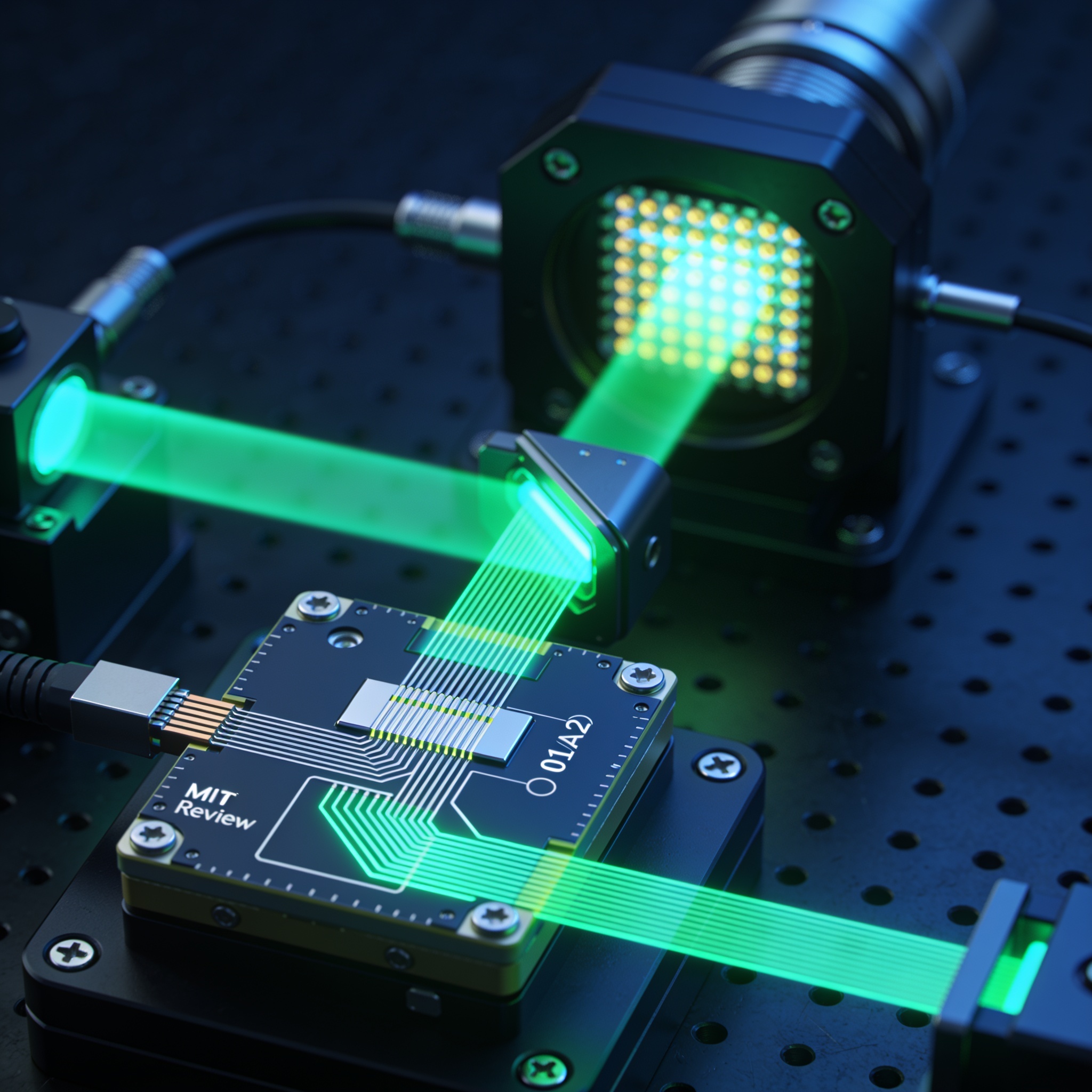
Gaussian boson sampling is a specialized form of photonic quantum computing. A set of squeezed light sources—laser pulses engineered to suppress quantum noise in one quadrature while amplifying it in another—injects photons into a network of beam splitters and phase shifters. The photons interfere, and detectors at the output ports record which modes click. The probability of observing any specific pattern of clicks is proportional to the hafnian of a matrix constructed from the interferometer's parameters and the input squeezing values.
Computing a hafnian on a classical computer scales super-exponentially with the matrix size. For matrices beyond roughly 50 × 50, the calculation becomes practically impossible. But that impossibility only translates into a meaningful quantum advantage if the output distribution is sufficiently flat—if no single outcome dominates the probability mass. That flatness is anticoncentration. Without it, a classical computer can simply guess the most likely outputs and simulate the system trivially. The 2026 paper derives the closed-form condition: for a system with m output modes and k squeezed input modes, anticoncentration sets in when k crosses a threshold that depends on the Rényi-2 entropy of the output distribution, which the authors compute exactly via the hafnian's second moment. "We derive closed-form expressions for the second moment of hafnians of symmetric Gaussian products, and use this to precisely locate the anticoncentration transition as a function of the number of squeezed input modes," the abstract states.
Think of it like pouring cream into coffee. A few drops remain concentrated in swirling streaks—predictable, localized. Pour enough cream, and it disperses uniformly throughout the cup. The transition point between streaky and uniform is sharp, and the paper gives its exact coordinates for photonic quantum systems. The same mathematics governs the Rényi-α Page curves the authors derive, which describe how quantum information spreads across subsystems—a direct measure of entanglement structure. When squeezing parameters are unequal across input modes, the paper proves monotonicity theorems showing that the average-case Rényi-2 entropy Page curve respects the same threshold behavior, extending the equal-squeezing results to realistic experimental conditions where laser intensities vary.
The qutrit result exploits the same structural property. A classical agent modeling an environment must maintain a probability distribution over possible states. When that environment's true dynamics arise from quantum correlations that produce anticoncentrated distributions, any finite classical model assigns zero probability to outcomes that actually occur—leading to an average reward loss of at least ε and suboptimal action selection on more than half of all possible trajectories. The quantum model, using just three basis states, represents the distribution exactly and avoids the loss entirely.
Who's Moving
Xanadu, the Toronto-based photonic quantum computing company, has driven Gaussian boson sampling from theory to hardware. Its Borealis processor, a programmable 216-mode photonic interferometer, demonstrated quantum computational advantage in 2022 by sampling hafnian-distributed outputs that classical supercomputers could not replicate within reasonable time bounds. The 2026 anticoncentration paper directly informs Xanadu's next-generation architecture by specifying the exact squeezing requirements needed to guarantee hardness as the system scales. Xanadu raised $100 million in a Series C round in July 2025, led by Georgian Partners, with participation from BDC Capital, OMERS Ventures, and Strategic Innovation Fund, bringing total funding above $250 million.
IBM (NYSE: IBM) operates in a different paradigm—superconducting transmon qubits rather than photonics—but the anticoncentration question applies identically to randomized circuit sampling on its processors. IBM's 1,121-qubit Condor processor, deployed in December 2024, runs circuits deep enough that output distributions theoretically reach the Porter-Thomas regime, where probabilities are exponentially distributed and anticoncentrated. The 2026 hafnian moment formulas give theoretical tools for verifying that Condor and its successor, the 2,000-plus-qubit Kookaburra architecture planned for 2027, genuinely operate in the hard regime rather than a classically simulable one. Google Quantum AI's Willow processor, a 105-qubit superconducting device that demonstrated below-threshold error rates in December 2024, faces the same validation challenge. Microsoft (NASDAQ: MSFT) continues developing topological qubits through its Azure Quantum program, with Majorana-based devices still in the single-qubit demonstration phase as of mid-2026.
IonQ (NYSE: IONQ) and Quantinuum pursue trapped-ion approaches. IonQ's Tempo system, targeting 64 algorithmic qubits by late 2026, and Quantinuum's H-Series, which reached 56 qubits with all-to-all connectivity in 2025, both run circuits where anticoncentration thresholds determine whether sampling tasks are classically hard. The Rényi entropy results from the 2026 paper provide a diagnostic: measure the Rényi-2 entropy of the output distribution, compare it to the closed-form Page curve, and determine whether the device operates above or below the classical hardness boundary.
Why 2026 Is Different
Before August 2026, anticoncentration in Gaussian boson sampling was conjectured but not proved. Researchers knew empirically that sufficiently many squeezed modes produced flat output distributions, but the exact threshold—and the proof that it is a genuine phase transition in the computational complexity of the system—did not exist. The hafnian moment formulas close that gap. Within twelve months, expect Xanadu and at least one academic group to publish experimental confirmation showing a Borealis-class device crossing the predicted threshold and producing output distributions whose Rényi-2 entropy matches the Page curve to within measurement error. Within three years, the same diagnostics will serve as validation benchmarks for fault-tolerant logical qubit processors from IBM, Google, and Quantinuum, because anticoncentration is a prerequisite for any sampling-based quantum advantage claim. Within five years, photonic processors exploiting the exact squeezing thresholds will run sampling tasks that serve as certified randomness generators for cryptographic applications—a market projected to reach $4.8 billion for quantum random number generation by 2030, according to Inside Quantum Technology's 2025 market report.
The qutrit reinforcement learning result changes the conversation about near-term quantum AI. Previous claims of quantum advantage in machine learning relied on asymptotic speedups or oracle access assumptions. The 2026 proof is unconditional: any finite classical model of a genuinely quantum-correlated environment fails on a majority of trajectories, and the failure magnitude is bounded below by a constant ε that does not vanish as the classical model grows. This is not a scalability argument. It is a structural impossibility result.
In short: quantum error correction will transform logical qubits from fragile demonstrations into robust computational resources the moment the anticoncentration threshold is crossed deterministically, a transition now mathematically locatable for photonic, superconducting, and trapped-ion architectures alike.
Frequently Asked Questions
What is Gaussian boson sampling? Gaussian boson sampling is a photonic quantum computing protocol where squeezed light passes through a network of beam splitters and phase shifters, then photon arrival patterns are measured at the output. The probability of each pattern depends on a matrix function called the hafnian, which classical computers cannot compute efficiently for large systems. It is the leading experimental platform for demonstrating quantum computational advantage in the near term.
How does anticoncentration affect quantum advantage claims? Anticoncentration describes whether a quantum system's output probabilities are spread uniformly across many possible outcomes rather than concentrated on a few. Without anticoncentration, a classical computer can simulate the system by sampling only the high-probability events. With anticoncentration, the classical simulator must track exponentially many outcomes, making the task infeasible. The 2026 paper provides the exact mathematical condition separating these two regimes.
When will quantum error correction make logical qubits commercially available? IBM's Kookaburra architecture, planned for 2027, targets hundreds of logical qubits using surface code error correction on a grid of physical superconducting qubits. Google Quantum AI demonstrated a below-threshold logical error rate on a surface-code-encoded logical qubit in December 2024. Fully fault-tolerant logical qubits suitable for commercial workloads will emerge between 2028 and 2030, when logical error rates drop below 10⁻¹⁰ per gate operation.
Which companies are leading in fault-tolerant quantum computing? IBM runs the largest superconducting qubit program with its Condor (1,121 qubits) and Kookaburra roadmap. Google Quantum AI leads in error correction demonstrations with its Willow processor and surface code experiments. Quantinuum operates the highest-fidelity trapped-ion qubits with all-to-all connectivity. Xanadu leads photonic approaches, while Microsoft pursues topological qubits. IonQ and Alice & Bob round out the competitive landscape with trapped-ion and cat-qubit architectures respectively.
What are the biggest obstacles to achieving fault-tolerant quantum computing? Decoherence—the loss of quantum information to environmental noise—remains the fundamental obstacle. Syndrome measurement, the process of detecting errors without collapsing the logical qubit state, requires ancilla qubits and fast classical processing that current systems execute with latencies exceeding the qubit coherence time. Scaling surface code architectures demands qubit fidelities above 99.9% for two-qubit gates, a threshold only Quantinuum and Google have approached in single-digit-qubit demonstrations.