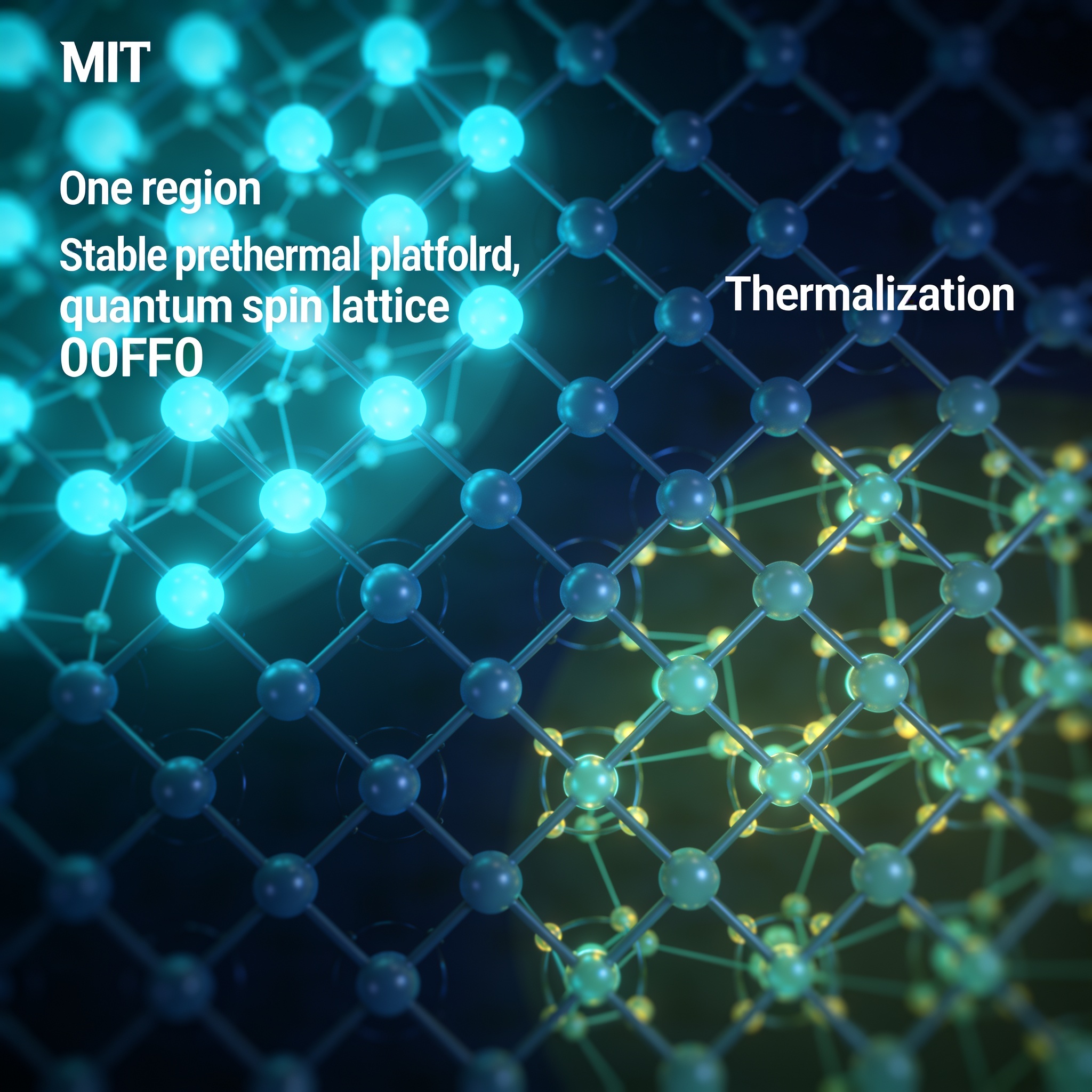
For years, many-body physicists treated a separation of spectral energy scales as a promise: if a quantum system has fast and slow degrees of freedom, it should get stuck in a long-lived prethermal plateau before reaching true equilibrium. But experimental data kept showing a more stubborn pattern: under the same Hamiltonian, one measurement looks frozen while another relaxes. That discrepancy has been hard to address because it requires tracking the Hamiltonian, the initial quantum state, and the chosen observable all at once. A study posted to the arXiv preprint server in September 2026, with author affiliations not listed in the metadata, now identifies the mechanism behind this selectivity. The question it answers is what actually decides which observables prethermalize under a given Hamiltonian and initial state. [arXiv:2609.01606]
This matters because prethermalization can dominate experimentally accessible dynamics in quantum simulators, cold-atom platforms, and solid-state spin systems. If one observable plateaus while another relaxes, an experimenter may see a false equilibrium or miss a protected regime entirely. The paper reframes a phenomenon often treated as a property of the energy spectrum into a property of the measurement and the state. That shift is directly relevant to how quantum devices are characterized.
The Core Finding
The authors prove that a clean separation of spectral energy scales, despite creating a hierarchy of dynamical timescales, does not by itself guarantee a prethermal plateau. Under the same Hamiltonian, some observables may exhibit prethermal behavior while others relax directly toward equilibrium. The mechanism governing this selectivity depends on the observable and the initial state, not only on the Hamiltonian. The result applies broadly to systems close to a fully permutation-symmetric limit, and the paper illustrates it with a long-range interacting spin model.
the emergence of a prethermal plateau depends not only on the Hamiltonian, but also on the observable and the initial state.
Think of it like a spinning top: whether you see long-lived stable motion depends on whether you watch the top's tilt or its wobble. In this view, prethermalization is a relational property, not a phase of matter. The authors also prove that the Loschmidt echo—a measurable overlap between forward and reversed quantum dynamics—provides a lower bound on the prethermal lifetime of any bounded observable whenever the prethermal and exact dynamics are unitary. That is a rigorous improvement over the common assumption that a large spectral gap automatically protects all slow observables. It gives experimentalists a concrete quantity to measure when testing prethermal behavior.
The State of the Field
Earlier work by Dmitry Abanin, Wojciech De Roeck, Wen Wei Ho, and François Huveneers established rigorous prethermalization bounds in periodically driven many-body systems. Related work by Takashi Mori, Tatsuhiko Ikeda, Eriko Kaminishi, and Masahito Ueda described prethermalization in isolated systems with large spectral gaps. Those approaches generally tied the existence of a plateau to Hamiltonian features such as effective conserved quantities or slow heating rates. The new preprint differs by treating the observable and initial state as explicit variables rather than as passive witnesses.
The broader landscape in 2026 makes this distinction experimentally urgent. Quantum processors from IBM and Google now track many-body dynamics with enough resolution to see whether a specific observable plateaus. The same logic matters for quantum error correction: a logical qubit is protected only if the relevant error observables remain in a long-lived regime. If protection is observable-selective, then not all error channels are equally controlled. That has consequences for surface code designs, where different stabilizer measurements may thermalize at different rates.
From Lab to Reality
For scientists, the result provides design rules for choosing initial states and measurement observables that maximize prethermal protection in quantum simulation. It also sharpens the interpretation of time-resolved experiments, where a plateau in one observable does not mean the whole system is prethermalized. For engineers, it could improve calibration and control of long-range interacting spin models in trapped ions and Rydberg atoms, where a prethermal plateau can be mistaken for true equilibrium. Those platforms may see practical benefits within five to ten years for sensing and simulation tasks.
For investors, the quantum error correction market—projected by some analysts to exceed $1 billion by 2030—depends on understanding decoherence channels. Observable-selective prethermalization offers a new lens on error avoidance, though direct commercial impact on fault tolerant quantum computing remains a decade away. The near-term value lies in quantum simulation and precision metrology, not in a sudden leap to logical qubits. Companies building quantum hardware will need to incorporate these dynamical constraints into their control software.
What Still Needs to Happen
Two specific challenges remain. First, the selectivity mechanism is derived for systems close to a fully permutation-symmetric limit; extending it to generic many-body Hamiltonians without that near-symmetry requires new mathematical tools. Second, the Loschmidt echo lower bound may be conservative, and tighter bounds that match experimentally observed lifetimes are still missing. Experimental groups building long-range spin simulators, including those led by Mikhail Lukin at Harvard and Christopher Monroe at Duke, are well positioned to test these predictions, but verifying them in noisy platforms will take years.
No one should expect near-term commercial deployment. The path from rigorous prethermalization bounds to fault tolerant quantum computing requires at least a decade of work on platform-specific decoherence and control. In the meantime, the immediate challenge is to build experimental protocols that can distinguish a prethermal plateau from true equilibrium in a single observable. Without those protocols, claims of protected quantum dynamics will remain hard to evaluate.
Conclusion
The paper changes how prethermalization should be interpreted: it is not a universal phase of a Hamiltonian but an observable- and state-selective phenomenon. In short: quantum error correction and quantum simulation must treat prethermalization as observable-selective, not as a universal consequence of separated energy scales.