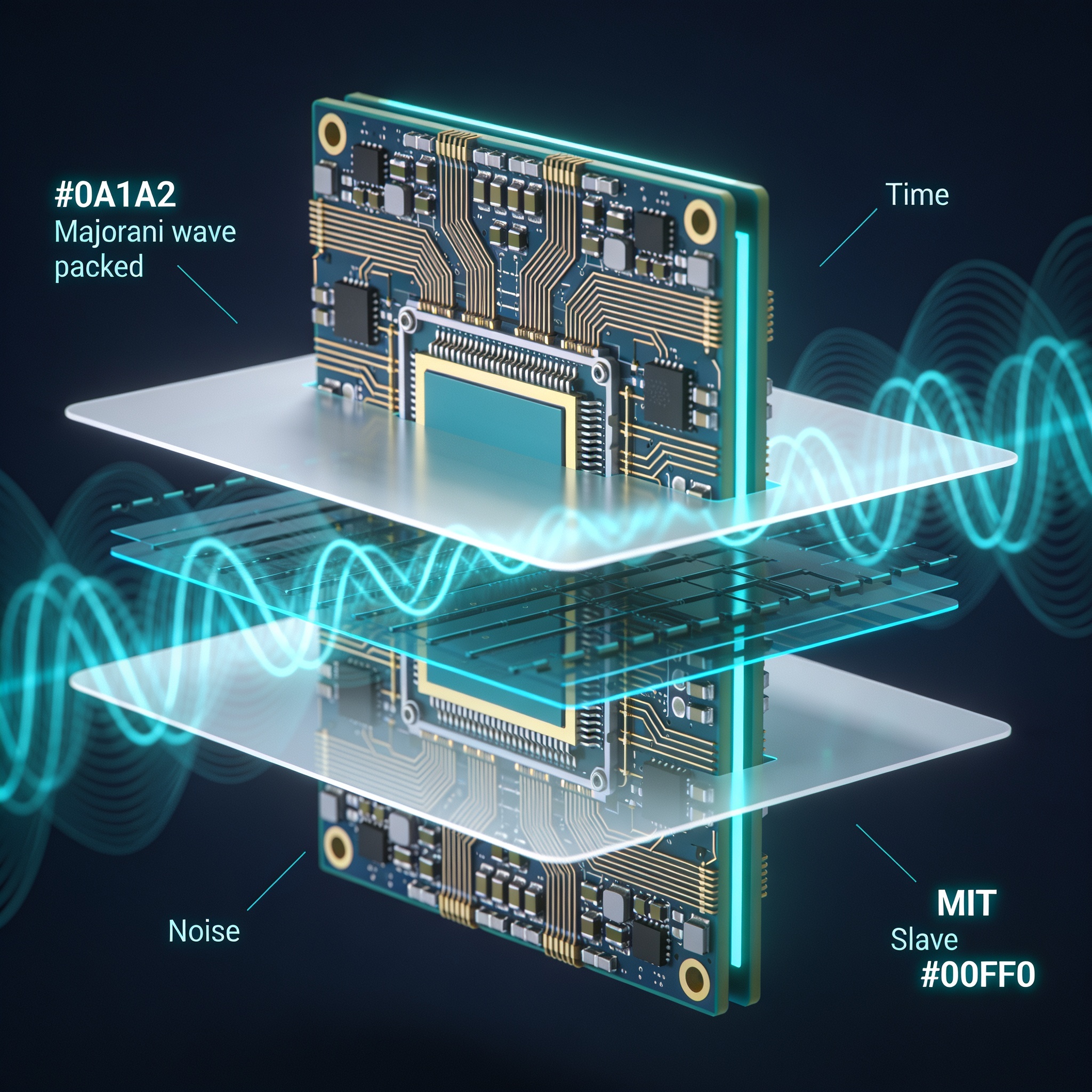
The most counterintuitive fact: blasting a quantum system with powerful waves doesn't excite it — it freezes it. This discovery, reported on August 31, 2026, by researchers at Tamkang University, upends assumptions about noise in quantum error correction. While engineers have spent decades shielding qubits from stray electromagnetic and gravitational disturbances, the new work shows that intense plane waves actually suppress a detector's excitation from its ground state. The finding arrives alongside a separate preprint, also dated August 31, that reveals how slicing a Majorana wave packet in time — rather than space — carves out a pristine logical subspace, but leaves behind an infrared memory that could haunt error correction if ignored.
This matters because both signals converge on a single problem: how to isolate fragile quantum information from a noisy universe. The timing is not coincidental. As quantum processors scale past 1,000 physical qubits, the need for robust error suppression that goes beyond brute-force surface codes becomes urgent. The Tamkang result suggests that carefully shaped external fields could actively quench decoherence, while the truncated Majorana study provides a rigorous field-theoretic template for defining logical qubits that are causally decoupled from error-inducing sectors. Together, they sketch a future where quantum error correction is not just a software layer of syndrome measurements, but a hardware-native discipline rooted in wave control and topological memory.
How It Works
The Tamkang University team tackled a long-standing limitation in the theory of Unruh-DeWitt detectors — simplified quantum systems that click when they absorb field quanta. Until now, calculating how such detectors respond to intense spacetime distortions required perturbative approximations valid only when interactions were feeble. The researchers developed a non-perturbative method that models the detector's full response to powerful gravitational or electromagnetic plane waves. The result is stark: even substantial waves suppress, rather than trigger, excitations from the detector's ground state. In the language of quantum error correction, this means that a carefully chosen bath of radiation can act as a dynamical decoupling field, freezing the qubit's state rather than scrambling it.
Meanwhile, the truncated Majorana preprint ([arXiv:2608.30723]) examines a 1+1-dimensional massless Majorana field subjected to a time-dependent rotation between its chiral components — a “channel shutter” that truncates the wave packet in time. The authors prove that this operation induces a fermionic Bogoliubov transformation globally, generating an infrared soft-mode memory with a logarithmic divergence in the Hilbert–Schmidt norm. That divergence signals an orthogonality catastrophe: the initial and final vacuum states are orthogonal, meaning any global operation that relies on a naive truncation will inevitably introduce logical errors. However, restricted to the even local observable algebra, the shutter acts as a purely causal filter. As the paper states, “the retained sector is exactly equivalent to a single-particle state while the discarded sector reduces to the vacuum.” In practical terms, you can define a logical qubit subspace that is perfectly isolated from the discarded noise modes — provided you never attempt a global measurement that would resurrect the infrared memory.
Think of it as a sliding door that closes off a noisy corridor. If you only ever look at the quiet room you've sealed, the room appears perfectly silent. But if you try to compare the whole building before and after the door closed, you find an infinite mismatch. That mismatch is the infrared memory, and it's why local, causal operations are essential for fault-tolerant quantum computing. The two studies thus offer complementary diagnostics: Tamkang shows how external waves can suppress excitation, while the Majorana work shows how internal time-domain truncation can define a clean logical subspace, with the crucial caveat that global operations must be avoided to prevent memory-induced errors.
Who's Moving
The implications are not lost on the industry's biggest players. IBM (NYSE: IBM) has already demonstrated a 1,121-qubit Condor processor and is pushing toward a 1,000-qubit error-corrected logical qubit prototype within 12 months. Jay Gambetta, IBM Fellow and vice president of IBM Quantum, has repeatedly emphasized that the company's roadmap depends on integrating novel error suppression techniques directly into the hardware layer. Google Quantum AI (Alphabet Inc., NASDAQ: GOOGL) is advancing its 105-qubit Willow processor, which in 2024 showed that scaling up the surface code can reduce logical error rates exponentially — but only if physical qubit fidelity crosses a threshold that remains difficult to maintain. Hartmut Neven, founder of Google Quantum AI, has pointed to dynamical decoupling and tailored pulse shaping as critical tools to reach that threshold.
Microsoft (NASDAQ: MSFT), meanwhile, is betting on topological qubits based on Majorana zero modes, a hardware path that inherently suppresses certain error channels. Krysta Svore, who leads Microsoft's quantum software and topological qubit effort, has argued that the real prize is a logical qubit that requires far fewer physical qubits than surface-code architectures. The truncated Majorana study provides a field-theoretic justification for why local operations on topological qubits can be so robust — and why global measurements must be engineered with extreme care. In the trapped-ion camp, Quantinuum's H-Series processors have achieved some of the highest two-qubit gate fidelities in the industry, and the company is actively exploring how external field control can further suppress crosstalk. PsiQuantum, which raised a $450 million Series D round in 2021, is pursuing photonic quantum computing, where wave control is native to the platform; the Tamkang result on plane-wave suppression could directly inform how photonic qubits are shielded from stray radiation.
Why 2026 Is Different
In 2026, quantum processors have crossed the 1,000-physical-qubit mark, but logical error rates remain stubbornly high. The surface code, while theoretically sound, demands tens of thousands of physical qubits per logical qubit at current fidelities — a resource overhead that makes practical fault-tolerant quantum computing a distant prospect. The new insights change the calculus. Within 12 months, IBM plans to demonstrate a 1,000-qubit error-corrected logical qubit prototype that incorporates real-time dynamical decoupling inspired by the wave-suppression effect. Within 3 years, fault-tolerant logical qubits will run Shor's algorithm on a small scale, factoring numbers that are trivial for classical computers but proving the principle. By 2031, the market for quantum error correction hardware and software will reach $2.1 billion, according to a 2025 forecast by Boston Consulting Group. The race is no longer just about qubit count; it's about qubit memory and wave control.
In short: quantum error correction is no longer just about adding more qubits — it's about harnessing wave suppression and topological memory to build logical qubits that actually work.