Pasqal (Nasdaq: PSQL), the France-based neutral-atom quantum computing vendor, has signed a multi-year strategic research collaboration with Saudi Arabia's King Abdulaziz City for Science and Technology (KACST). The agreement, executed through KACST's National Center for Quantum Technologies (NCQT), focuses on quantum algorithm development and post-quantum cryptography (PQC) readiness. No financial terms were disclosed.
The deal marks Pasqal's first major institutional partnership in the Gulf region and comes as Saudi Arabia accelerates its Vision 2030 technology diversification push. For KACST, the collaboration provides direct access to Pasqal's neutral-atom hardware platform, which operates differently from the superconducting and trapped-ion systems that dominate current quantum computing deployments.
What They're Actually Building
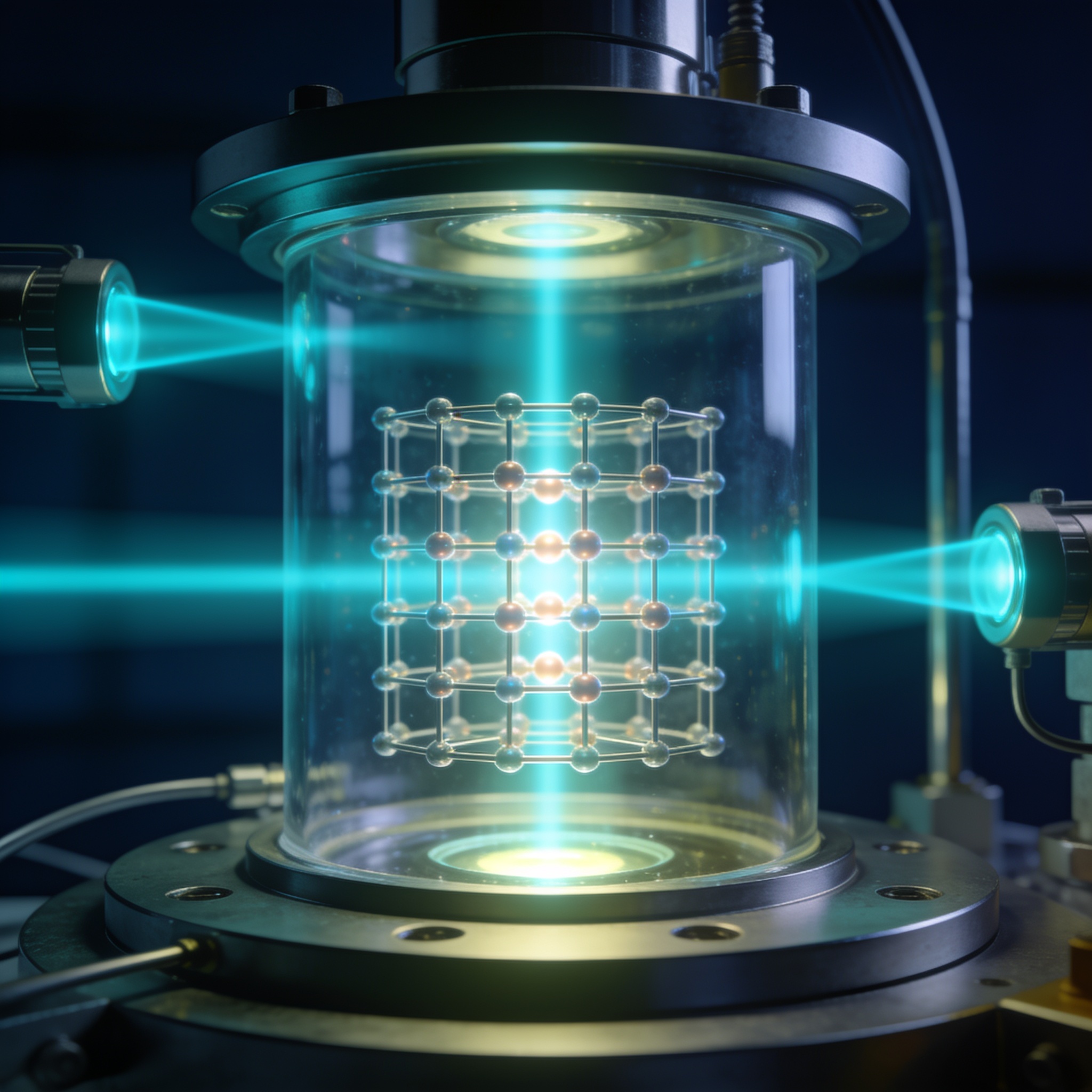
Pasqal builds quantum processors using neutral atoms trapped in optical tweezers—arrays of focused laser beams that hold individual atoms in programmable 2D and 3D geometries. The company's current-generation hardware operates with approximately 100 qubits, with a roadmap targeting 1,000 qubits by 2026-2027. Unlike superconducting qubits that require millikelvin temperatures, neutral-atom systems operate at room temperature in vacuum chambers, potentially reducing infrastructure complexity.
The KACST collaboration will focus on two technical workstreams. First, developing quantum algorithms optimized for Pasqal's analog mode, where the natural Hamiltonian evolution of the atomic array performs computation without gate decomposition. This analog approach is particularly suited to optimization problems and certain quantum simulation tasks. Second, the partners will assess post-quantum cryptography vulnerabilities using Pasqal's processors to benchmark against NIST-standardized PQC algorithms.
Pasqal's qubit connectivity represents a genuine architectural differentiator. In neutral-atom systems, qubits can interact with multiple neighbors simultaneously—not just adjacent qubits as in superconducting architectures. This all-to-all connectivity within interaction ranges enables more efficient compilation of certain quantum circuits. The trade-off: neutral-atom gate fidelities currently trail trapped-ion systems, with two-qubit gate fidelities in the 99.5% range compared to IonQ's reported 99.9%+ on barium qubits as of early 2026.
Winners and Losers
This partnership strengthens Pasqal's position in the Middle East quantum market, where IBM has established a presence through its IBM Quantum Network but where neutral-atom competitors QuEra Computing and Atom Computing have limited institutional relationships. KACST gains a hardware partner with a differentiated architecture, avoiding lock-in with any single quantum modality.
The collaboration poses no immediate competitive threat to superconducting leaders IBM and Google Quantum AI, which maintain substantial qubit-count advantages and more mature error-correction demonstrations. However, it does pressure trapped-ion vendors IonQ and Quantinuum, both of whom compete for government research partnerships globally. IonQ (NYSE: IONQ) has been particularly active in government contracts, including a $54.5 million deal with the U.S. Air Force Research Lab announced in 2025.
For the broader quantum software ecosystem, the deal signals continued demand for hardware-agnostic algorithm development. Companies like Classiq, Q-CTRL, and Horizon Quantum Computing—which build middleware and compilation tools—benefit from any expansion of quantum hardware access points. The PQC angle also creates adjacency opportunities for cybersecurity firms tracking cryptographically relevant quantum threats, including SandboxAQ and QuSecure.
The Bigger Picture
This announcement fits a pattern of Gulf states building quantum capabilities through international partnerships rather than indigenous hardware development. The UAE's Technology Innovation Institute operates a quantum research center in Abu Dhabi. Qatar's Hamad Bin Khalifa University runs a quantum computing program. Saudi Arabia's approach through KACST mirrors these efforts but with a sharper focus on cryptography—a logical priority given the Kingdom's financial services and energy infrastructure sectors.
The PQC angle deserves scrutiny. No quantum computer today can break RSA-2048 or ECC encryption. The cryptographic community's consensus estimate for a cryptographically relevant quantum computer (CRQC) capable of factoring 2048-bit integers remains 10-15 years, requiring roughly 20 million physical qubits with error rates below 10⁻⁴. Pasqal's current 100-qubit systems are approximately five orders of magnitude short of that threshold. The partnership's PQC work is therefore preparatory—benchmarking NIST algorithms against quantum approaches that might emerge, not against existing threats.
Comparable recent deals include QuEra's 2025 partnership with Japan's AIST for neutral-atom quantum computing research and IBM's 2024 agreement with the Spanish government for a quantum computing center in San Sebastián. The Pasqal-KACST deal is smaller in disclosed scope but strategically significant as the first neutral-atom partnership in the Gulf.
The Signal
The signal here is geopolitical market expansion, not technical breakthrough. Pasqal is executing a land-grab strategy in regions where quantum computing infrastructure remains nascent and where government procurement cycles favor long-term research partnerships over immediate commercial deployment. For KACST, the collaboration provides hands-on access to a quantum modality distinct from the superconducting systems available through cloud providers. The PQC framing gives both parties a defensible, nationally strategic narrative. What would validate this partnership as more than a press release: a peer-reviewed demonstration of a quantum algorithm running on Pasqal hardware that provides a demonstrable speedup on a classically relevant problem—even a narrow one—within 24 months.
In short: Pasqal's KACST partnership expands neutral-atom quantum computing into Saudi Arabia's national research infrastructure, prioritizing post-quantum cryptography readiness over near-term commercial applications.
FAQ
What does Pasqal do? Pasqal designs and builds quantum computers using neutral atoms trapped in laser-generated optical lattices. Founded in 2019 as a spinout from the Institut d'Optique in France, the company went public via SPAC merger in 2025 and trades on Nasdaq under ticker PSQL. Its processors operate in both digital (gate-based) and analog modes, with the analog mode enabling direct simulation of quantum many-body physics problems. Pasqal targets enterprise and research customers in energy, finance, and cybersecurity.
How do neutral-atom quantum computers compare to superconducting and trapped-ion systems? Neutral-atom systems offer room-temperature operation and flexible qubit connectivity, advantages over superconducting qubits that require dilution refrigerators at ~15 millikelvin. Compared to trapped-ion systems, neutral atoms typically achieve faster gate speeds (microseconds vs. hundreds of microseconds) but lower individual gate fidelities. Each modality faces distinct scaling challenges: superconducting systems wrestle with wiring complexity, trapped ions with ion chain stability, and neutral atoms with atom loss during computation.
Is quantum computing ready for enterprise use? No. All current quantum processors are noisy intermediate-scale quantum (NISQ) devices incapable of running error-corrected algorithms at commercially relevant scales. Enterprise use cases in 2026 are limited to experimental algorithm development, quantum-inspired classical methods, and workforce training. Production deployment of quantum computing for problems with demonstrated quantum advantage remains at least 5-8 years away, contingent on advances in logical qubit fidelity and count.
What is Pasqal's business model? Pasqal sells quantum computing access through a cloud platform and through on-premises hardware installations for research institutions. The company also generates revenue from algorithm co-development contracts with enterprise customers, particularly in energy grid optimization and materials simulation. The KACST deal appears to follow the co-development model, with Pasqal providing hardware access and research support rather than a full system installation.
What quantum computing milestones matter most in 2026? The critical milestones are logical qubit demonstrations with error rates below the physical qubit threshold (break-even error correction), scalable quantum error correction codes running on 100+ physical qubits, and a clear demonstration of quantum utility—a computation that is infeasible classically but not yet commercially valuable. IBM targets a 200-logical-qubit system by 2029. Google Quantum AI demonstrated below-threshold error correction on a surface code in late 2024. The first vendor to demonstrate 100 logical qubits with error rates below 10⁻⁸ will have a decisive lead.