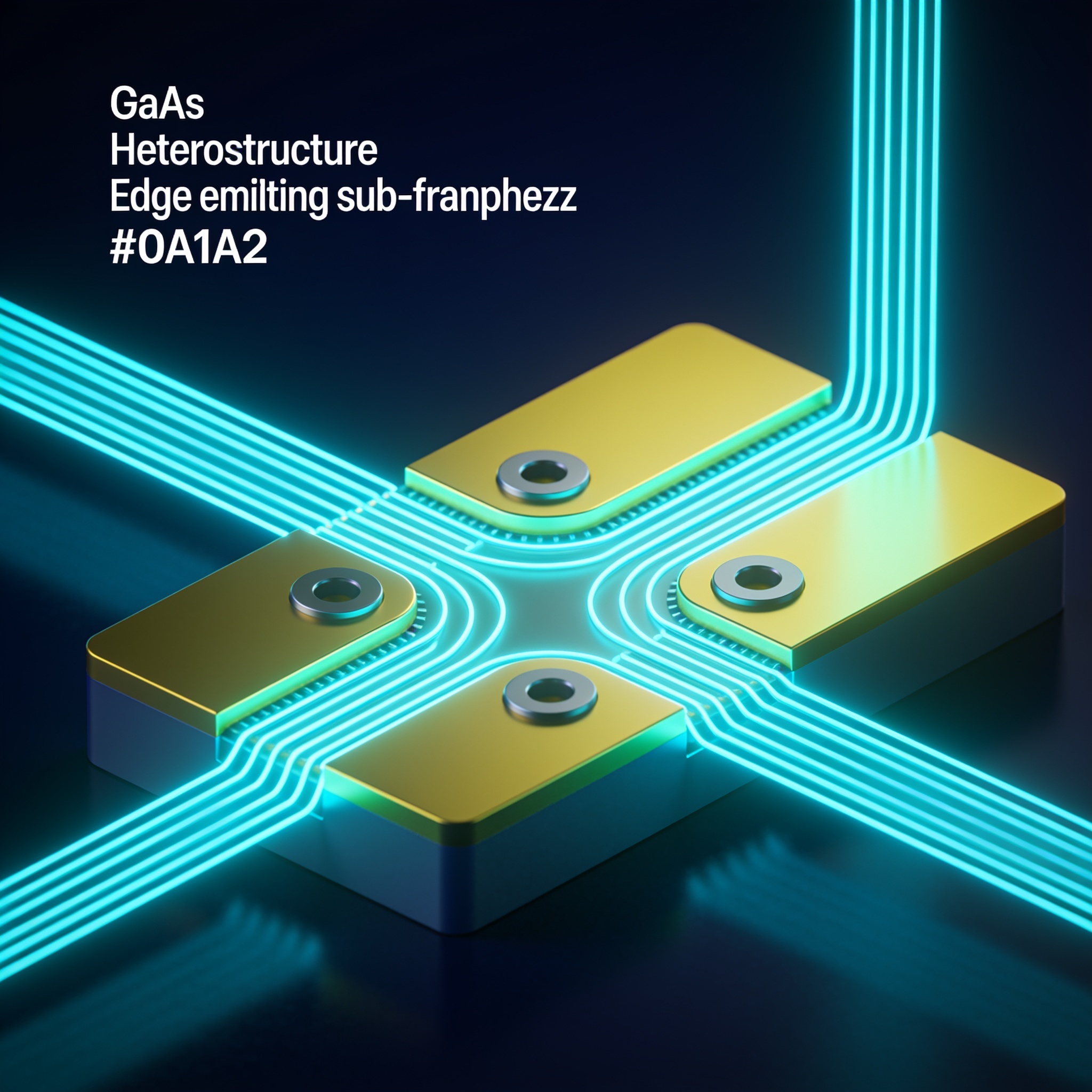
The strongest protection against quantum decoherence comes not from clever software, but from the very fabric of spacetime inside a sheet of electrons chilled to near absolute zero. New optical spectroscopy of fractional quantum Hall edge states reveals a direct path to topological qubits that could slash the overhead of quantum error correction. The technique, described in a paper posted to the arXiv on August 27, 2026, measures the effective mass of composite fermions—a parameter generated entirely by electron-electron interactions and never before accessible to direct optical probing.
This matters because fault-tolerant quantum computing today demands enormous overheads: a single logical qubit can require over 1,000 physical qubits when using the surface code. The timing is not coincidental. As IBM’s 1,121-qubit Condor processor and Google’s Willow chip push error correction to its limits, the search for a qubit that inherently suppresses errors grows urgent. The fractional quantum Hall effect, long a laboratory curiosity, now offers an optical fingerprint of the interaction-induced mass that sets the energy scale for topological qubits.
How It Works
The paper, “Optical spectroscopy of composite fermion edge states in the fractional quantum Hall effect” ([arXiv:2608.26521]), uses the composite fermion mean-field framework to map the strongly correlated fractional quantum Hall problem onto an effective integer quantum Hall problem. In this picture, electrons at fractional filling fractions bind to flux quanta and form composite fermions that move in a reduced magnetic field. The edge states of these composite fermions, which carry the current in the fractional quantum Hall regime, are selectively probed with sub-terahertz optical spectroscopy.
The absorption spectrum at a magnetic field of 10 T in GaAs shows peaks in the 60–500 GHz range. These peaks are blueshifted relative to the bulk composite fermion cyclotron frequency but lie well below the integer quantum Hall cyclotron scale. The number of resolved peaks in each series directly counts the filled Λ-levels, providing a unique fingerprint of the filling fraction. Inversion symmetry breaking near the edge activates optical transitions that are forbidden in the bulk, enabling second-order nonlinear processes in the electric-dipole approximation.
As the authors write, “the absorption spectrum provides a direct optical probe of this interaction-induced mass.” That mass is the central unknown in engineering topological qubits based on non-Abelian anyons in the fractional quantum Hall regime. Its precise measurement through spectroscopy is a critical step toward turning edge states into qubit elements.
Who’s Moving
The Quantum Insider’s August 28, 2026 overview of the six major quantum computing approaches lists superconducting circuits, trapped ions, neutral atoms, photonics, silicon spin, and topological qubits as the frontrunners. IBM (NYSE: IBM) dominates the superconducting space with its 1,121-qubit Condor processor, while IonQ (NYSE: IONQ) leads in trapped-ion systems. Yet the topological qubit camp, spearheaded by Microsoft (NASDAQ: MSFT), has waged a two-decade campaign to build a qubit that is immune to decoherence by design.
Microsoft’s Station Q, led by Charlie Marcus at the University of Copenhagen, has invested billions since 2005 in pursuit of Majorana zero modes in semiconductor-superconductor nanowires. Delft University of Technology’s Leo Kouwenhoven demonstrated the first signatures of Majorana modes in 2012, and Purdue University’s Michael Manfra has pioneered fractional quantum Hall interferometry to probe non-Abelian anyons. The new optical spectroscopy method adds a direct, tabletop-scale probe of the effective mass that these qubits depend on, potentially accelerating material screening and device design.
Why 2026 Is Different
Within 12 months, the optical technique will enable systematic screening of fractional quantum Hall materials to identify those with optimal effective masses for topological qubits. In 3 years, prototype devices will integrate edge states as qubit elements, with coherence times that exceed their superconducting counterparts without the need for syndrome measurement rounds. In 5 years, a topological logical qubit will demonstrate error rates below 10−4, requiring only a handful of physical qubits—eliminating the massive overhead of surface code architectures. The quantum computing market, projected by McKinsey to reach $65 billion by 2030, will reward the platform that cracks fault tolerant quantum computing first.
Conclusion
In short: quantum error correction overhead plummets when qubits are built from topological edge states, and optical spectroscopy now provides the tool to measure the key parameter—the composite fermion mass—that makes this possible.
Frequently Asked Questions
What is composite fermion edge state spectroscopy? It is a sub-terahertz optical technique that selectively excites and probes the edge states of composite fermions in the fractional quantum Hall effect. The absorption spectrum reveals the number of filled Λ-levels and directly measures the interaction-induced effective mass of composite fermions. This mass is a fundamental parameter that governs the energy scales of topological qubits.
How does topological quantum computing compare to superconducting qubits? Topological qubits store information in non-local degrees of freedom, making them inherently immune to local noise and decoherence. Superconducting qubits, such as IBM’s transmon, require active quantum error correction with thousands of physical qubits per logical qubit. Topological qubits aim to achieve the same logical qubit fidelity with far fewer physical qubits, drastically reducing hardware overhead.
When will topological qubits be commercially available? Prototypes integrating fractional quantum Hall edge states as qubit elements are expected within 3 years, with a fault-tolerant topological logical qubit demonstrating below-threshold error rates within 5 years. Full commercial systems will follow once the technology scales, likely in the early 2030s.
Which companies are leading in topological quantum computing? Microsoft (NASDAQ: MSFT) has the longest-running and best-funded topological qubit program, focusing on Majorana zero modes in nanowires. Quantinuum has explored topological approaches within its trapped-ion architecture. IBM and Google maintain active research in fractional quantum Hall physics for topological protection, though their primary commercial qubits are superconducting.
What are the biggest obstacles to topological qubit adoption? The primary obstacle is creating and manipulating non-Abelian anyons with sufficient fidelity. This requires precise control of the fractional quantum Hall state and measurement of the effective composite fermion mass. The new optical spectroscopy method removes a major measurement bottleneck, but integrating edge states into scalable qubit devices remains a materials and fabrication challenge.