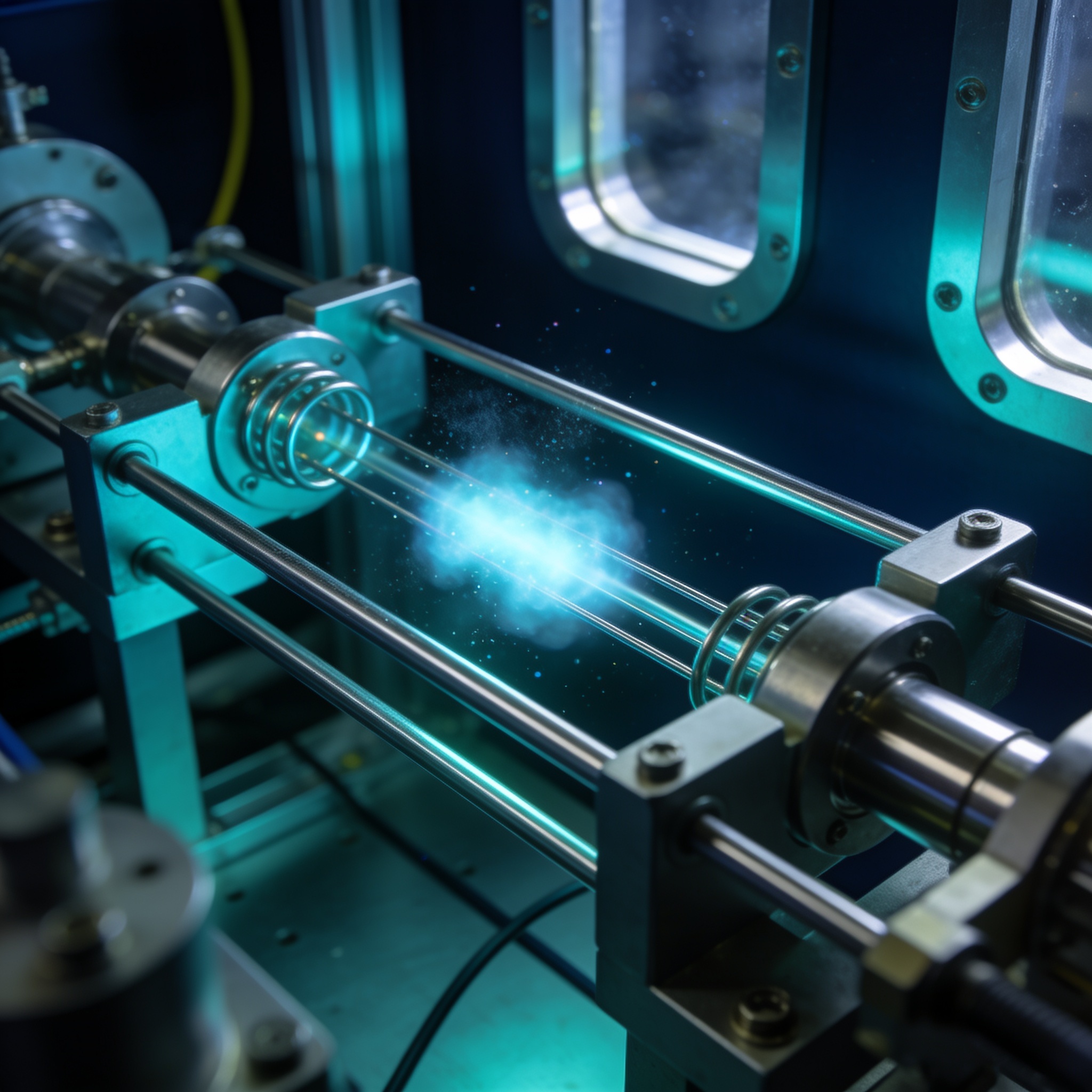
An ion trap that holds non-laser-coolable cesium ions for six hours without measurable decay sounds like a measurement error. It is not. On 24 August 2026, a preprint on arXiv reports a hybrid atom-ion trap that preserves Cs+ ions for six hours. On 25 August 2026, the European High Performance Computing Joint Undertaking opens €119 million in calls for full-stack quantum systems at the 1,000-physical-qubit scale.
The Connection
This matters because stable trapped ions are no longer just a physics demonstration; they are a prerequisite for the syndrome measurement cycles that make fault tolerant quantum computing possible. The timing is not coincidental. Europe’s €119 million call package, published 25 August 2026, funds full-stack systems at the 1,000-physical-qubit scale across three modalities, exactly the scale where the surface code and other Surface Code architectures need qubit fidelity and low decoherence over multi-hour runtimes.
How It Works
The mechanism is resonant charge-exchange cooling. A precisely centered ultracold cloud of cesium atoms sits inside a linear Paul trap. Non-laser-coolable Cs+ ions collide with cold Cs atoms and exchange charge, producing a cold replacement ion without laser cooling. Think of it as a refrigerator that swaps each hot ion for a cold one from the atomic cloud, collision by collision.
The arXiv preprint, posted 24 August 2026 as [arXiv:2608.23768], carries incomplete author metadata; the signal lists no first or last name, so this article does not name an author. The institution is also marked only as “See paper metadata.” What the paper reports is unambiguous.
“Without cold atoms, all ions are lost within 3 minutes.”With the cold atom cloud centered, the ion population remains stable for six hours with no measurable decay.
Six hours matters because quantum error correction is not a single-shot operation. A logical qubit must survive thousands of syndrome measurement rounds. Every round extracts error information from ancillary qubits. If the physical ions escape the trap in three minutes, no code can assemble a logical qubit. Six hours, with no measurable decay, clears that barrier by more than two orders of magnitude, compared to prior hybrid atom-ion systems.
The system exhibits a threshold steady-state number of ions, Ns. Loads above Ns converge downward; loads below Ns do not decay. The dynamics are governed by a competition between ion-ion rf heating and ion-atom collisional cooling. The six-hour hold also constrains three-body recombination to k3 ≪ 1.4 × 10^-25 cm^6 s^-1, a rate low enough to keep Cs2+ formation from destroying the sample.
Who’s Moving
The European High Performance Computing Joint Undertaking (EuroHPC JU) is the public-sector mover. Its six Horizon Europe calls total €119 million, or $139 million USD, and target full-stack systems at the 1,000-physical-qubit scale and hybrid quantum key distribution systems with key rates above 1 Mbps. International Business Machines Corporation (IBM, NYSE: IBM) remains the benchmark with its 1,121-qubit Condor processor. Alphabet Inc. (NASDAQ: GOOGL), through Google Quantum AI, continues to push superconducting qubits and logical qubit demonstrations. Microsoft Corporation (NASDAQ: MSFT) is betting on Topological Qubits. Quantinuum, the trapped-ion specialist, is the commercial player closest to the hybrid atom-ion work because trapped ions already deliver the highest two-qubit gate fidelities.
The EuroHPC JU call package is not a broad research ask. It specifies three full-stack modalities at the 1,000-physical-qubit scale and hybrid quantum key distribution systems with key rates above 1 Mbps. That key rate target puts Europe’s QKD procurement in competition with dedicated photonic platforms. The supply-chain requirements signal that the European Commission wants domestic quantum error correction hardware, not another round of software pilots.
The field’s foundations are person-specific. Peter Shor at MIT established in 1995 that quantum error correction is possible if physical error rates stay below a threshold. David Wineland at NIST won the Nobel Prize for trapped-ion quantum control, the direct ancestor of the linear Paul trap work. John Martinis at the University of California, Santa Barbara led the superconducting qubit transition from laboratory gate fidelities to systems like IBM’s Condor.
Why 2026 Is Different
The 12-month horizon is concrete: EuroHPC’s call package, launched on 25 August 2026, shifts quantum computing procurement from paper architectures to contracted hardware builds. Within three years, the 1,000-physical-qubit systems funded by these calls will test whether qubit fidelity can hold long enough for repeated syndrome measurement. Within five years, the hybrid atom-ion trapping result points to commercial trapped-ion systems that no longer require laser cooling for every ion species, widening the set of usable qubits and molecular ions for error-corrected operations.
No source in these two signals provides a total market size figure. The specific public investment is €119 million from EuroHPC, a down payment on Europe’s quantum autonomy push.
Bottom Line
The hybrid trap result removes a multi-hour stability barrier for non-laser-coolable ions, while Europe’s €119 million call package moves the field from isolated physics experiments to industrial-scale, fault tolerant quantum computing procurement. In short: quantum error correction now has a stable trapped-ion collision refrigerator that holds for six hours, and EuroHPC is paying €119 million to scale it.
FAQ
Q: What is quantum error correction?
A: Quantum error correction is the set of algorithms that encode a single logical qubit across many physical qubits so that errors can be detected by syndrome measurement and corrected without destroying the quantum state. It is the central overhead behind fault tolerant quantum computing. The surface code is the most widely used framework because it works on nearest-neighbor qubit arrays. The goal is to push physical error rates below the threshold where adding more qubits reduces the logical error rate.
Q: How does trapped-ion quantum computing compare to superconducting qubits?
A: Trapped-ion systems have the highest two-qubit gate fidelities and long coherence times, but slower gate speeds. Superconducting qubits, such as IBM’s 1,121-qubit Condor processor, switch faster and integrate with semiconductor fabrication, but suffer more decoherence. The hybrid atom-ion result attacks the trapped-ion weakness by removing the need to laser-cool every ion species. This widens the hardware options for quantum error correction.
Q: When will fault tolerant quantum computing be commercially available?
A: The first commercial fault tolerant logical qubits will appear in the early 2030s, based on the 1,000-physical-qubit systems now being funded in 2026. EuroHPC’s calls launch projects in 2027 and target full-stack systems at that scale. Before 2028, the industry will still be in noisy intermediate-scale mode. By 2031, syndrome measurement and logical qubit operations will be standard in at least three hardware modalities.
Q: Which companies are leading in quantum error correction?
A: IBM (NYSE: IBM) leads in superconducting qubit scale with its 1,121-qubit Condor processor. Alphabet Inc. (NASDAQ: GOOGL) through Google Quantum AI demonstrated logical qubit performance below surface code thresholds in 2024. Microsoft Corporation (NASDAQ: MSFT) is developing topological qubits. Quantinuum leads commercial trapped-ion systems with the highest gate fidelities. EuroHPC is now funding a European supply chain for all three modalities.
Q: What are the biggest obstacles to quantum error correction adoption?
A: Decoherence, qubit fidelity, and syndrome measurement overhead remain the three obstacles. Physical error rates must drop below code thresholds, and the hardware must hold qubits for hours during multi-round correction. The hybrid atom-ion trap reported six-hour stability with no measurable ion decay, addressing the hold-time obstacle directly. The remaining obstacle is integrating that stability into a full-stack system with fast, high-fidelity measurement.