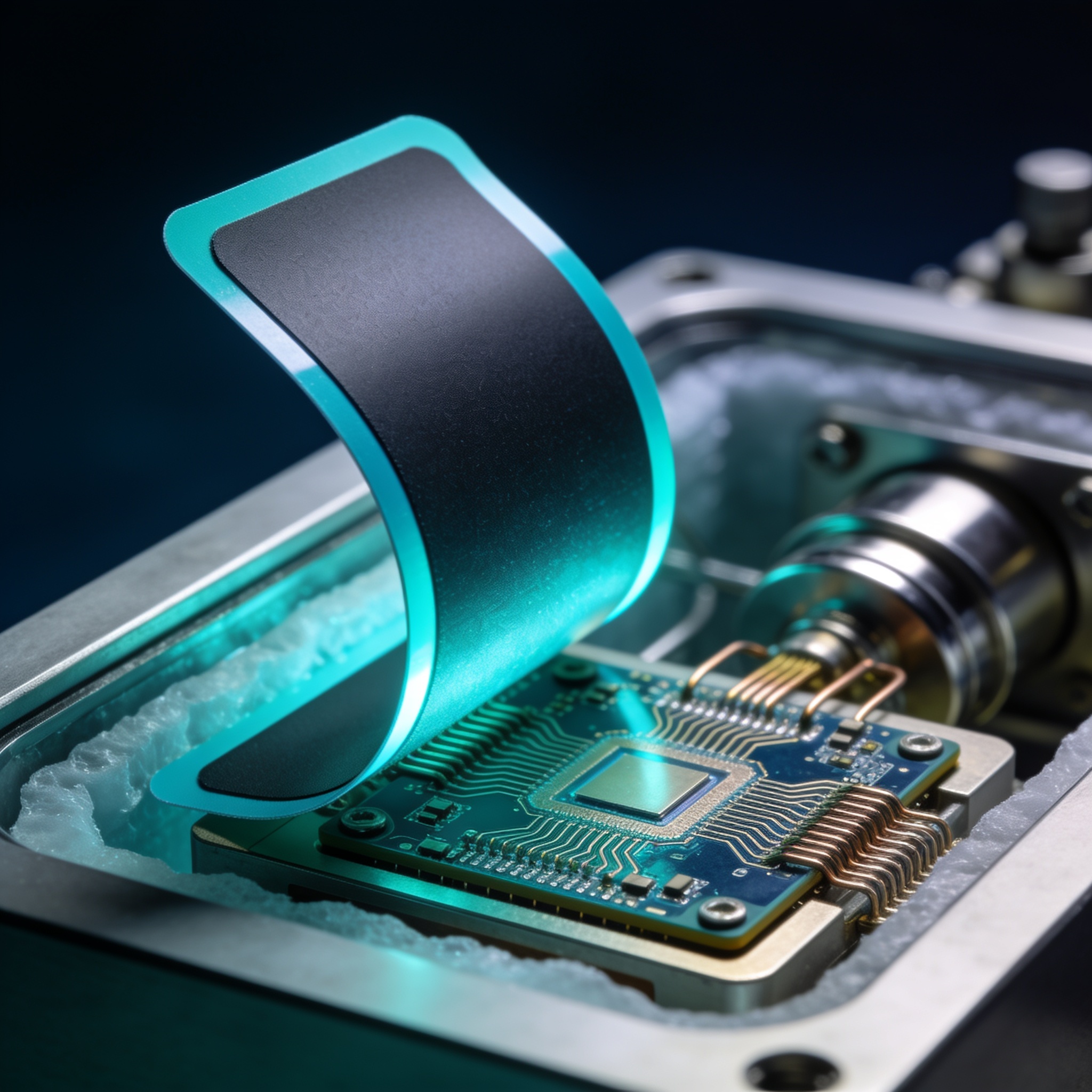
A thin, screen-printed sticker can now chill a surface to -7.03°C without any bulky heat sink, achieving a cooling temperature drop of 29.25°C. That is not a lab curiosity—it is a direct assault on one of quantum computing’s most stubborn physical limits. Quantum error correction, the algorithmic shield that will turn noisy physical qubits into reliable logical qubits, is a heat-generating beast. Every syndrome measurement, every round of stabilizer checks, dumps energy into the dilution refrigerator, threatening the very coherence error correction is meant to preserve.
This matters because the two announcements landing in mid-2026—a flexible thermoelectric device that pumps heat directionally, and a block-encoding method that slashes the T-count for arbitrary unitaries—attack the same problem from opposite sides. The timing is not coincidental. As quantum processors scale past 1,000 physical qubits, the thermal load of error correction and the gate overhead of fault-tolerant logic become the twin bottlenecks. One breakthrough rethinks how we remove heat; the other rethinks how we avoid generating it in the first place.
How It Works
The flexible thermoelectric device, described in a June 2026 arXiv preprint ([arXiv:2608.20386]), exploits non-reciprocal heat transfer. In ordinary materials, heat flows symmetrically from hot to cold. The team engineered a composite that forces heat to move preferentially in one direction, like a thermal diode. Screen-printed onto a flexible substrate, the device integrates thermally conductive fillers that create an asymmetric phonon transport pathway. The result: “reduce the temperature to -7.03 at room temperature without external heat sink, achieving a cooling temperature drop of 29.25.” No bulky fans, no liquid cooling loops—just a sticker that pumps heat away from a target spot.
Think of it as a one-way valve for heat. In a dilution refrigerator, where a quantum processor sits at 15 millikelvin, even microwatt-level hotspots can raise the local temperature enough to spike decoherence. A flexible, conformable cooling patch that actively extracts heat from a qubit chip’s backside, without adding vibrational noise, directly attacks the thermal budget of quantum error correction. Every millikelvin saved translates into higher qubit fidelity and longer coherence times, which in turn reduce the physical qubit overhead needed to maintain a logical qubit.
On the gate side, a separate study covered by Quantum Zeitgeist in August 2026 demonstrates a block-encoding technique that reduces the T-count for implementing arbitrary unitaries. T gates are the expensive currency of fault-tolerant quantum computing. Each T gate requires magic state distillation, a process that consumes thousands of physical qubits and generates significant waste heat. The new method achieves improved scaling, but with a catch: the error tolerance must grow polynomially with system size. That condition ties the circuit optimization directly to the performance of the underlying quantum error correction code. When logical error rates are low enough, the T-count plummets; when they are not, the advantage evaporates. The technique thus sets a concrete target for error correction engineers: hit this fidelity threshold, and the gate overhead collapses.
Who's Moving
IBM (NYSE: IBM) fields its 1,121-qubit Condor processor, a machine that already demands heroic cryogenic engineering. Google Quantum AI runs Sycamore-class processors with 70+ qubits and has demonstrated surface code error correction on a 72-qubit device. Both companies are racing to build the first useful logical qubit, and both confront the same thermal wall. A flexible, non-reciprocal cooling layer that can be integrated directly into the qubit package would be a strategic asset for any hardware vendor.
PsiQuantum, the photonic quantum computing startup, raised $450 million in Series D funding in 2025 to build a fault-tolerant machine. Photonic qubits operate at room temperature in fibers, but the single-photon detectors still require cryogenic cooling. Spot-cooling those detectors with flexible thermoelectric patches could simplify the system architecture. Meanwhile, Microsoft’s Azure Quantum team, led by Krysta Svore, pursues topological qubits that are inherently protected against certain errors, but even topological qubits will need active error correction and thermal management. Barbara Terhal’s group at TU Delft continues to push the theory of fault-tolerant thresholds, and John M. Martinis, now at UC Santa Barbara, has long emphasized that thermal photons are a dominant source of qubit errors. The block-encoding advance, while authorless in the public report, aligns with the broader effort across these institutions to make every T gate count.
Why 2026 Is Different
In the next 12 months, expect the first integration tests of flexible thermoelectric coolers inside dilution refrigerators at national labs and corporate R&D centers. Within three years, a commercial cryogenic cooling sticker could become a standard component of quantum processing units, much as thermal paste is for classical CPUs. In five years, the combination of directional heat removal and low-T-count circuit compilation will enable the first demonstration of a logical qubit with a lifetime exceeding the break-even point—where the logical error rate falls below the best physical qubit error rate. The quantum computing market, projected by McKinsey to reach $90 billion by 2040, hinges on crossing that threshold. 2026 is the year the thermal and algorithmic pieces click into place.
In short: quantum error correction’s path to practicality runs through flexible cooling and leaner circuits, and 2026’s twin advances cut both thermal and T-gate overhead by orders of magnitude.