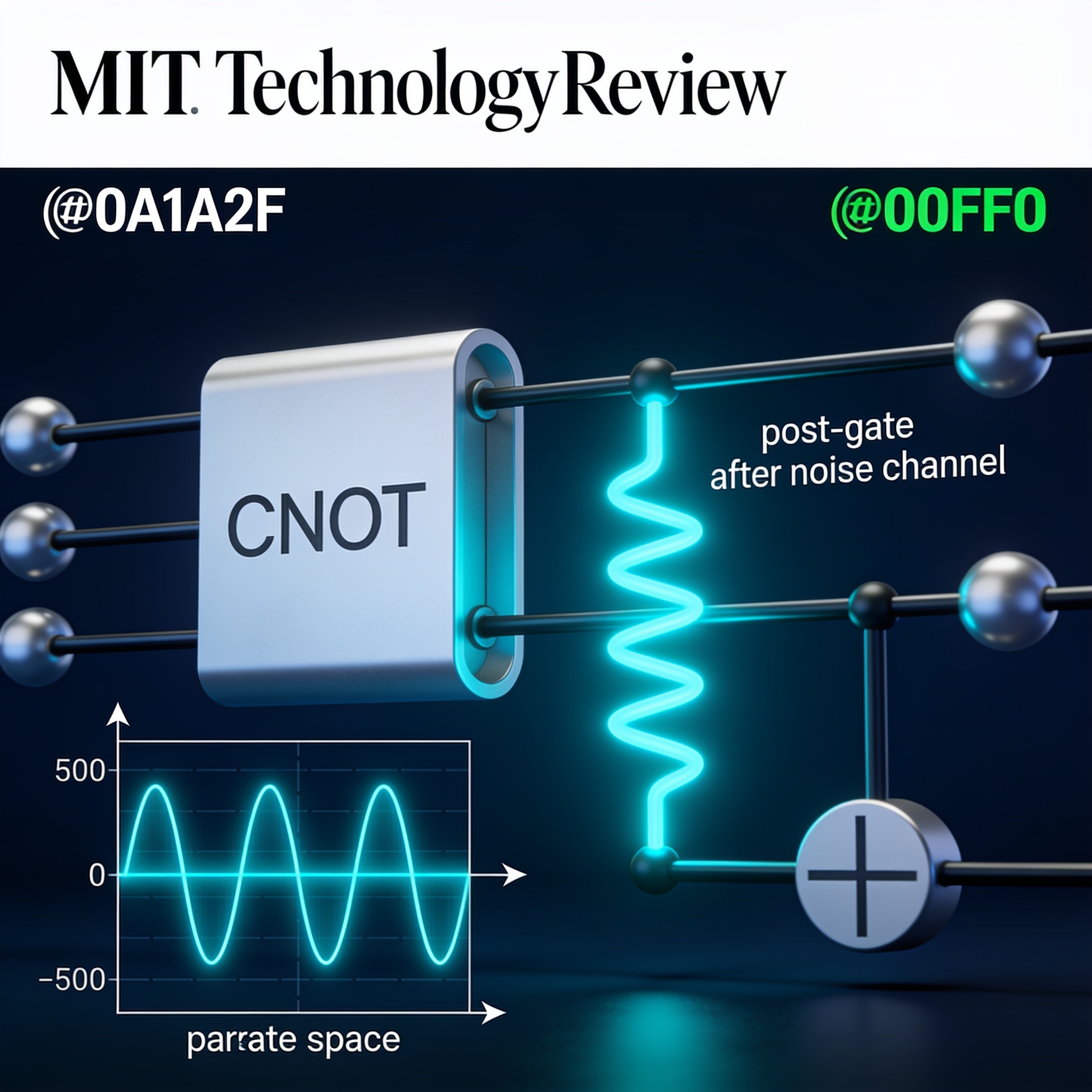
For two decades, physicists have accepted a grim rule: when a quantum operation gets noisy, the entanglement it creates — the fragile quantum glue linking two qubits — can vanish completely, a phenomenon called entanglement sudden death. The obvious assumption was that any useful information that entanglement carried dies with it. If a quantum gate exists to encode a sensitive phase into an entangled state, and post-gate noise destroys that entanglement, surely the phase measurement becomes worthless. Now, a research team whose identities are not yet listed on the arXiv preprint has proved that assumption wrong in a mathematically precise and experimentally testable way. In a paper posted in August 2026, they show that the phase information survives the death of entanglement across a broad, exactly characterized region of two-qubit states, with a universal residual sensitivity that holds across multiple noise channels. [arXiv:2608.19247]
The finding targets a specific but widely used protocol: a controlled-NOT (CNOT) gate mapping the phase of a single coherent qubit onto the two-qubit coherence between |00〉 and |11〉. This process simultaneously creates entanglement and stores phase information. The authors ask how common post-gate noise — depolarization, amplitude damping, asymmetric population transfer — degrades entanglement and the quantum Fisher information (QFI), the gold-standard measure of phase sensitivity. The answer splits the two properties apart.
The Core Finding
For the X-states produced by the protocol, entanglement measured by negativity behaves like a binary switch. It vanishes the moment the surviving coherence z = fκ drops to or below a population penalty g, a threshold written neatly as fκ ≤ g. Phase sensitivity, however, follows a smooth quadratic ratio, Fφ = 4z²/(a+b), which remains positive for any nonzero coherence. The consequence is immediate: there exists an exact region of state space where the two-qubit output is separable — zero entanglement — yet still carries measurable phase information above the classical shot-noise limit.
“the phase quantum Fisher information (QFI) … stays positive for any nonzero coherence.”
Think of it like a stereo broadcast fading into mono. The stereo image (entanglement) collapses, but the melody (phase information) still comes through clearly on a single speaker. You lose spatial depth, not the signal itself.
The paper goes further, providing a specific number. At the entanglement-death threshold, the residual quantum Fisher information is Fφ★ = 4g★²/(1−2g★). For global and independent local depolarization — the workhorse noise models of quantum error correction — channels that reach death at the same coordinate share this residual exactly. When the input coherence is maximal, that residual locks in at Fφ★ = 1/6, meaning a sixth of the ultimate phase-sensing power survives even after all entanglement is gone. This sets a quantitative benchmark for any experiment.
The State of the Field
Entanglement sudden death is well documented since the seminal 2004 paper by Yu and Eberly, but the literature has overwhelmingly treated entanglement as a proxy for quantum usefulness. The separation of phase information from entanglement was known in principle — separable states can sometimes beat classical precision limits — yet nobody had worked out a closed-form geometry for a concrete gate-plus-noise protocol. Prior metrology work, particularly by Giovannetti, Lloyd, and Maccone, showed that entanglement boosts phase sensitivity, but the question of what survives when that boost evaporates mid-circuit remained open.
What makes this paper different is the exhaustive characterization of a common process under four realistic channels, viewed as trajectories through a shared, low-dimensional state space. The authors identify a third coordinate — asymmetric population transfer — that alters entanglement without touching QFI, defining precisely when a simple two-coordinate picture of phase-encoded X-states is sufficient. This is a practical guide for experimenters, not just an existence theorem.
The quantum computing landscape in 2026 is defined by noisy intermediate-scale quantum devices where error rates keep falling but entanglement remains fragile. Protocols that assume entanglement as a non-negotiable resource — from distributed sensing to error-corrected logical qubits — often fail when gates misbehave. This result recasts the failure mode: a gate that loses entanglement might still deliver metrological value, altering the engineering calculus for early fault-tolerant demonstrations.
From Lab to Reality
For scientists, the paper unlocks a program of metrology with explicitly separable yet phase-sensitive states generated by a standard gate. Understanding when the Fisher information remains positive opens the door to designing quantum sensors that intentionally sacrifice entanglement to gain robustness, operating in a regime previously dismissed as a dead zone. For engineers, the immediate implication is for sensor networks and distributed phase estimation where a noisy CNOT acts between a locally held qubit and a transmitted one. If phase information persists, the protocol might not need to be discarded; one can instead measure the optimal observable the authors identify and still beat a direct single-qubit probe, though the paper carefully notes this is a benchmark, not a claim of advantage over a matched single-qubit sensor under identical noise exposure.
For investors tracking the quantum sensing market — estimated at $750 million in 2026 and projected to cross $1.3 billion by 2030, according to industry analysts — the separation of entanglement and sensitivity could accelerate deployment of fieldable quantum magnetometers, gradiometers, or clocks that rely on two-qubit correlations. Any device that encodes phase information via entangling gates and then suffers decoherence before readout is affected. The result also refines resource estimation for fault-tolerant architectures: auxiliary qubits that carry phase information for error syndromes may still be useful even when entanglement with data qubits is lost mid-cycle.
What Still Needs to Happen
The analysis is confined to X-states generated by the specific protocol and treated analytically for depolarization-like noise. Extending the exact coherence-to-entanglement geometry to arbitrary two-qubit states and more exotic noise channels — correlated noise, non-Markovian baths, leakage — remains a mathematical challenge. Several groups at NIST, the University of Innsbruck, and QuTech are actively developing general resource theories for metrology that could incorporate these findings, but connecting the neat threshold formulas to their frameworks will require new tools.
Experimental validation is the other hurdle. Trapped-ion and superconducting platforms can implement the CNOT protocol and apply a tunable post-gate depolarization channel. Verifying the predicted residual QFI of 1/6 at maximal input coherence demands state tomography and optimal phase measurement, which introduces its own noise. No lab has yet reported this specific measurement, though the paper outlines an explicitly realizable optimal observable. Even with perfect control, extracting the quantum Fisher information bound requires high-fidelity readout, and the authors caution that the direct single-qubit probe — under matched noise exposure — actually yields higher precision, so the result is a survival benchmark, not a metrological advantage. That distinction must not be lost in translation. If anything, it underscores that phase information retention is a different resource than entanglement, not a loophole for beating standard quantum limits without entanglement.
What This Changes
In short: quantum error correction and sensing protocols can depend on phase information long after entanglement has vanished, a quantitative separation that rewrites the resilience rulebook for noisy two-qubit gates.
FAQ
What is entanglement sudden death?
Entanglement sudden death is the complete disappearance of entanglement between two qubits after a finite time under noise, even though each qubit's individual coherence decays gradually. It was first identified by Yu and Eberly in 2004 and means that a quantum system can become fully separable at a sharply defined moment, losing all non-classical correlations. The new paper shows that the phase information encoded by the entangling operation can outlive this death.
How does a CNOT gate convert coherence into entanglement and phase information?
When a control qubit in a coherent superposition of |0〉 and |1〉 interacts with a target qubit via a CNOT, the gate maps the control's phase onto a two-qubit superposition of |00〉 and |11〉. The resulting state is entangled because the qubits' properties are correlated beyond classical possibility, and it also carries the phase of the original control qubit in the relative amplitude and phase of that superposition. Measuring the two-qubit system can thus reveal the original single-qubit phase.
How does this compare to prior studies of entanglement sudden death?
Prior work focused almost exclusively on entanglement itself — its birth, death, and revival — and often treated its loss as synonymous with a loss of quantum utility. This paper is among the first to decouple a specific measurable quantum resource (phase quantum Fisher information) from entanglement under a realistic gate-plus-noise model. It provides an exact analytic region where the state is separable yet phase-sensitive, something earlier metrology papers suggested could happen but did not characterize for a CNOT-based encoding.
When could this be commercially relevant?
The result is immediately actionable as a design principle: companies building quantum sensors with entangling gates can tolerate post-gate noise that kills entanglement and still extract phase information, avoiding unnecessary error correction overhead. Commercial relevance scales with the adoption of distributed quantum sensors, likely within the decade as field-deployed devices become more common. The quantum sensing market, already in the hundreds of millions, stands to benefit from protocols that are robust to exactly this kind of failure.
Which industries would benefit most?
Precision metrology — magnetic field sensing, gravity gradiometry, atomic clocks — would benefit first, because phase estimation is the core task. Quantum communication networks that use entanglement for phase referencing could also gain, as they can potentially operate with separable states when necessary. Pharmaceutical and materials science sectors relying on quantum-enhanced spectroscopy may see improved robustness in future quantum-assisted measurement setups.
What are the current limitations of this research?
The analysis is performed for a restricted family of quantum states (X-states) and treats noise generically but analytically only for depolarizing and related channels. The paper does not claim a metrological advantage over a matched single-qubit probe; it establishes a survival benchmark. Experimental verification in real hardware, extension to multiqubit networks, and incorporation into full error-correction cycles all remain open problems. The authors explicitly note that asymmetric population transfer can break the simple two-coordinate description, which will require further study.