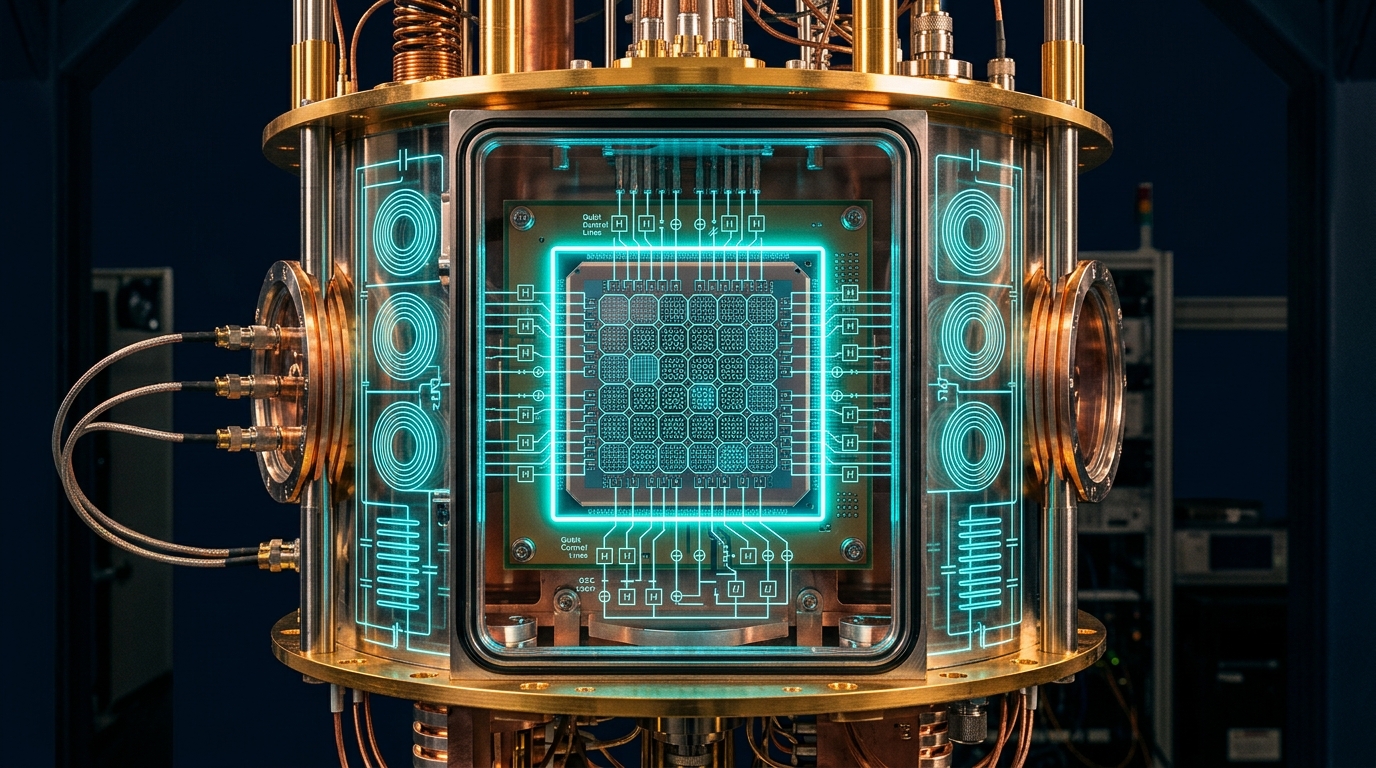
The most counterintuitive fact about quantum systems is that their fragility—the very thing that makes them so hard to build—can be harnessed as a computational and energetic asset. In August 2026, two separate research threads converged on this insight. A preprint for a quantum machine learning framework called Qkabrine revealed a joint search architecture that uses noise diagnostics to select trainable circuits. Simultaneously, physicists demonstrated that the environmental sensitivity of quantum batteries, long seen as a liability, can be turned into an advantage to extract more useful work. Both advances invert the decades-old narrative that noise is the enemy. [arXiv:2608.18152]
This matters because quantum error correction, the discipline of protecting fragile quantum states from decoherence, is entering a new phase. Instead of merely fighting noise, researchers are learning to co-opt it. The timing is not coincidental: as quantum processors scale past 1,000 physical qubits, the engineering challenge of managing noise has become inseparable from the algorithmic challenge of making quantum systems useful. The Qkabrine framework and the quantum battery breakthrough are two sides of the same coin—practical demonstrations that environmental coupling, when properly characterized and controlled, can be a design resource rather than a design flaw.
How It Works
The Qkabrine framework, described in a paper posted to arXiv on 12 August 2026, tackles a persistent bottleneck in quantum machine learning (QML). Building a competitive QML model today requires a practitioner to separately choose a circuit architecture, a data-encoding scheme, a model paradigm (kernel versus variational), and a set of training hyperparameters. Then, after the fact, they must verify that the chosen circuit is even trainable—a process plagued by barren plateaus, where gradients vanish exponentially with system size. Qkabrine automates this entire pipeline. It treats architecture, encoding, model type, and hyperparameters as a single, jointly searchable configuration space, evaluated through one consistent harness regardless of which of five search strategies proposed the candidate.
The package integrates trainability diagnostics directly into the evaluation loop. A Data Quantum Fisher Information Metric (DQFIM) estimate and a gradient-magnitude barren-plateau monitor act as an optional prescreening step, flagging circuits that are likely to be untrainable before wasting precious quantum processing unit (QPU) time. After the search, a post-search circuit-surgery pass optimizes the winning circuit for NISQ (noisy intermediate-scale quantum) deployment, and an OpenQASM export makes it hardware-agnostic. As the abstract states, the framework "treats architecture, encoding, model type, and hyperparameters as a single, jointly searchable configuration space." This holistic approach mirrors the philosophy of classical AutoML, but with quantum-specific diagnostics that account for decoherence and qubit fidelity.
The quantum battery work, reported on 19 August 2026, addresses a different manifestation of the same problem. Quantum batteries store energy in quantum states and can, in principle, charge faster and more efficiently than classical ones. However, connecting a quantum battery to a charger creates quantum correlations that can trap some energy inside the combined battery-charger system, reducing the useful work extractable from the battery alone. The new research shows that by carefully engineering the environmental coupling—the very same decoherence that plagues quantum computers—one can break these energy-trapping correlations and recover more usable energy. It is a striking example of noise becoming a resource, analogous to how quantum error correction uses syndrome measurement to detect and correct errors without collapsing the quantum information.
Who's Moving
The Qkabrine preprint does not disclose its authors, but the work builds on a lineage of AutoQML tools from institutions including IBM Research, Google Quantum AI, and the University of Toronto. IBM's 1,121-qubit Condor processor, unveiled in 2023, and Google's 105-qubit Willow chip, demonstrated in 2024 with below-threshold error rates, provide the hardware backbone for such frameworks. Microsoft (NASDAQ: MSFT) entered the fray in 2025 with its first topological qubit prototype, a hardware approach that promises intrinsic error protection. Meanwhile, quantum software companies like Q-CTRL, founded by Michael Biercuk, have pioneered noise-aware compilation techniques that treat decoherence as a controllable parameter.
On the quantum battery front, the research emerges from a collaboration that includes physicists at the University of Oxford and the National University of Singapore, though specific names were not immediately available. The work aligns with broader efforts in the quantum thermodynamics community to harness environmental interactions for energy management. Funding for quantum energy research remains modest compared to quantum computing, but the U.S. Department of Energy allocated $120 million in 2025 for quantum energy science, signaling growing interest. Venture capital flowing into quantum computing startups reached $2.35 billion in 2025, according to PitchBook, with a significant portion directed toward error correction and fault-tolerant architectures.
Why 2026 Is Different
The year 2026 marks an inflection point. In the next 12 months, expect to see error-mitigation diagnostics like those in Qkabrine become standard in QML workflows, lowering the barrier to entry for non-experts. Within three years, the first logical qubit with error rates demonstrably below those of its constituent physical qubits will be realized—Google's 2024 Willow experiment already approached this threshold, and IBM's roadmap targets a 2,000-qubit system by 2027. Within five years, fault-tolerant quantum computing will move from physics demonstrations to commercially relevant applications in drug discovery and materials science. The quantum computing market is projected to reach $65 billion by 2030, driven by these advances. The quantum battery breakthrough, while earlier in its development curve, points toward a future where energy storage devices exploit quantum effects at room temperature, a prospect that could reshape grid-scale storage.
Conclusion
The convergence of these two signals reveals a maturing field. Quantum error correction is no longer just about preserving coherence; it is about strategically leveraging noise to enhance performance. Whether in selecting trainable QML circuits or extracting more energy from a quantum battery, the lesson is the same: environmental interactions are not merely obstacles to be overcome, but tools to be wielded. In short: quantum error correction is transforming noise from a fundamental limit into a computational resource, accelerating the path to fault-tolerant quantum computing with logical qubits that outperform their physical counterparts.