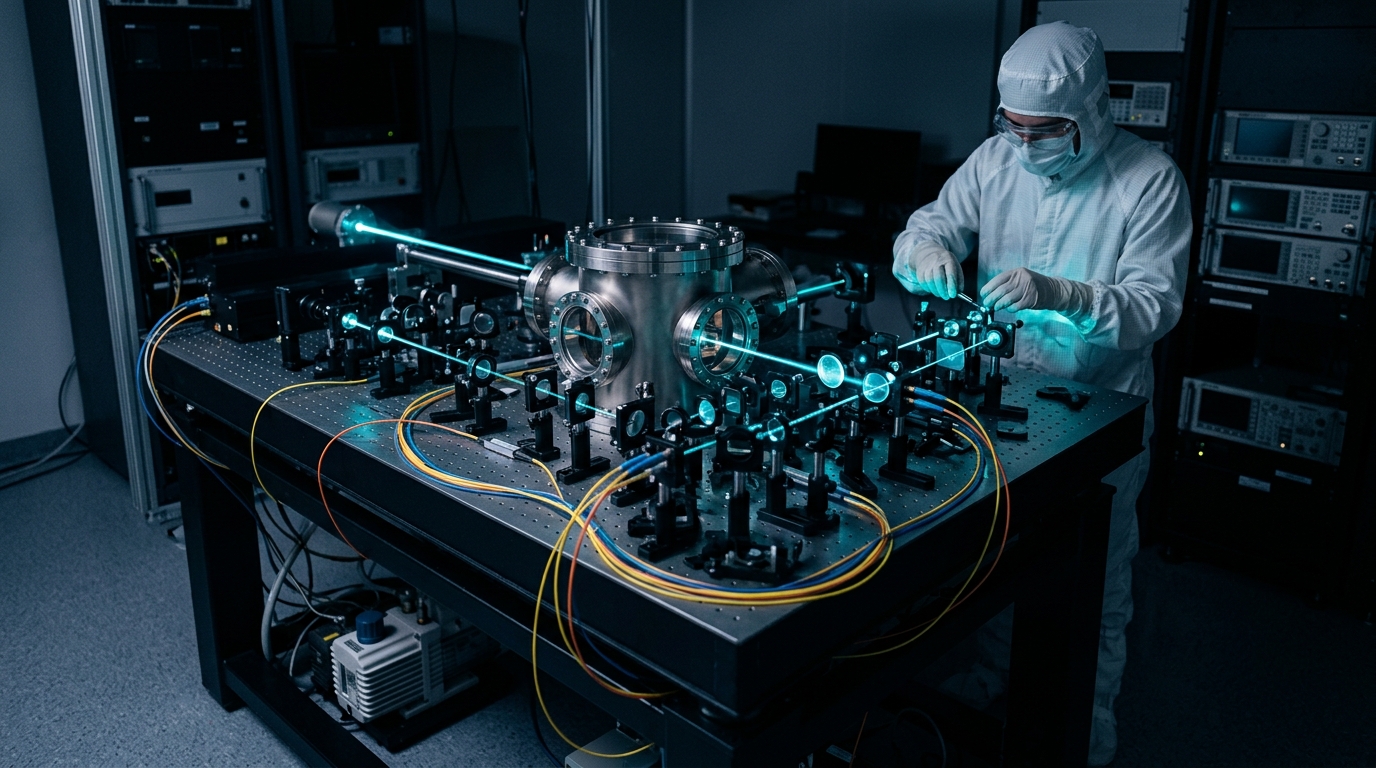
Quantinuum will receive $1.5 million in Local Economic Development Act (LEDA) grants from the State of New Mexico and the City of Albuquerque to expand its research and development center in Albuquerque, the company confirmed on August 19, 2026. The incentive package — $750,000 from the state and $750,000 from the city — is a small public contribution toward the trapped-ion quantum computing developer's physical footprint, not an equity funding round. Quantinuum said it would use the funds to add lab space and support hiring at its existing Albuquerque facility, which already collaborates with Sandia National Laboratories and the Air Force Research Laboratory. No valuation, revenue milestones, or technology roadmap updates accompanied the announcement.
What They're Actually Building
Quantinuum manufactures trapped-ion quantum computers based on ytterbium ions shuttled around a "quantum charge-coupled device" (QCCD) architecture. Its current-generation System Model H1 and H2 processors have demonstrated two-qubit gate fidelities above 99.8% and high-fidelity mid-circuit measurement. In 2025, the company said it used the 32-qubit H2 device to generate 48 logical qubits — a key step toward fault-tolerant operation. The public roadmap calls for a 100-logical-qubit error-corrected machine by 2027 and a million physical qubits by the early 2030s.
Compared to superconducting-qubit rivals, Quantinuum's trapped-ion approach offers naturally long coherence times (seconds) and all-to-all connectivity, but scaling the number of qubits requires complex laser and vacuum systems. IonQ, also a pure-play trapped-ion firm, has publicly reported 36 algorithmic qubits (AQ) on its Forte system and targets 64 AQ by late 2026. IBM's superconducting Heron processor reached 1,121 qubits in 2025, while Google's Willow chip demonstrated below-threshold error correction with 105 physical qubits. In the trapped-ion niche, Quantinuum and IonQ are the clear leaders, with Austria's AQT trailing in qubit counts.
Winners and Losers
The $1.5 million incentive package does not shift the competitive landscape. Quantinuum is a well-capitalized company with access to Honeywell's balance sheet and a network of investors including JPMorgan Chase and Amgen. The Albuquerque expansion, however, deepens the company's ties to the New Mexico quantum ecosystem, which includes Sandia's trapped-ion research and Air Force quantum networking programs. That proximity could accelerate recruitment of specialized engineers and physicists — a constant bottleneck in quantum hardware.
IonQ, headquartered in College Park, Maryland, with a manufacturing facility in Bothell, Washington, remains the most direct competitor. IonQ has also expanded via public incentives, including a $2.5 million Maryland grant in 2024. Neither company's geographic moves meaningfully change technical differentiation, which still hinges on qubit quality, gate speeds, and error correction progress. For the superconducting-qubit camp (IBM, Google, Rigetti), trapped-ion facilities in Albuquerque pose no new threat; the technology battles are fought in fidelities and scale, not in local zoning.
The Bigger Picture
State and local economic development authorities are increasingly targeting quantum computing firms for relocation and expansion deals, mirroring earlier trends in semiconductor fabs and biotech. New Mexico's LEDA program has a history of incentivizing advanced manufacturing and R&D, and the Quantinuum grant follows a $5 million LEDA package for a photonics startup in 2025. Nationally, the CHIPS and Science Act of 2022 and updates have funneled billions into quantum R&D, but direct facility grants remain relatively small. Comparable moves: IonQ’s 2024 $2.5 million Maryland incentive for its headquarters expansion, and PsiQuantum’s $250 million package from Illinois in 2025 for a photonic quantum computing facility (a much larger bet).
For Quantinuum, the New Mexico deal signals a multi-hub strategy. The company’s primary R&D and manufacturing remains in Broomfield, Colorado, with a UK-based software division from the Cambridge Quantum merger. Albuquerque adds a satellite R&D center, not a new headquarters. From an investment standpoint, the size of the incentive — barely enough to outfit a single lab — suggests the expansion is organic scaling rather than a strategic pivot.
The Signal
The signal here is that Quantinuum is methodically adding physical capacity to support a growing headcount and sustain its roadmap, but the $1.5 million public incentive is far from a technical catalyst. No new qubit record, error correction demonstration, or enterprise customer win was attached to the announcement. In a sector where a single dilution refrigerator can cost over $500,000, and a complete trapped-ion system many millions, LEDA funds are a rounding error. The real test remains: can Quantinuum hit 100 logical qubits with demonstrable error correction by its self-imposed 2027 deadline? That milestone — not a real-estate expansion — will determine whether the company can deliver on its valuation and challenge superconducting approaches in the long run.