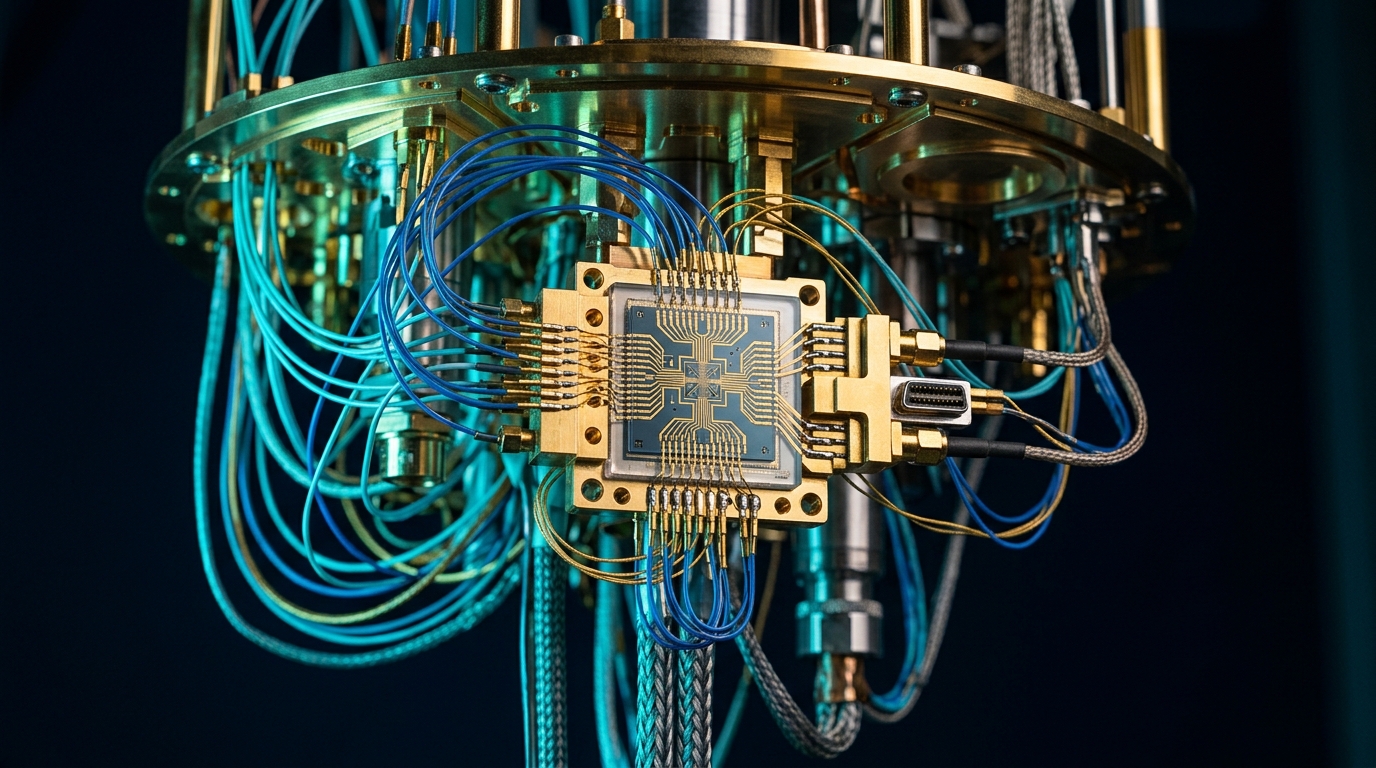
Alice & Bob, the Paris-based quantum computing startup, has joined QuBriC, a €4.6 million Horizon Europe doctoral network dedicated entirely to quantum error correction. The program, announced August 13, 2026, will train 15 doctoral researchers across 16 universities and seven quantum companies, bridging classical coding theory with quantum information science.
The network represents Europe's first coordinated doctoral training effort focused exclusively on quantum error correction — the single hardest problem standing between today's noisy quantum processors and fault-tolerant quantum computers capable of running commercially useful algorithms.
What They're Actually Building
Alice & Bob specializes in cat qubits — superconducting qubits that encode quantum information in superpositions of coherent states of a microwave resonator. The architecture is designed to suppress bit-flip errors exponentially while leaving phase-flip errors to be handled by a separate error correction layer. This bias toward a single error type dramatically reduces the overhead required for full quantum error correction.
The company's roadmap targets 100 logical qubits by 2030, with a gate error rate below 10⁻⁶. By comparison, IBM's 2026 Heron processor operates at roughly 10⁻³ two-qubit gate error rates on 156 physical qubits, while Google's Willow chip demonstrated below-threshold error rates on 105 physical qubits in late 2024. Alice & Bob's approach theoretically requires 10x fewer physical qubits per logical qubit than surface-code architectures used by IBM and Google, though the company has not yet publicly demonstrated a logical qubit with a lifetime exceeding its constituent physical qubits — the threshold test for any error correction scheme.
The QuBriC network gives Alice & Bob access to academic expertise in classical error correction codes, including low-density parity-check (LDPC) codes and turbo codes, which the quantum industry is increasingly adapting for quantum error correction. The doctoral researchers will work on code design, decoder implementation, and hardware-software co-design across the full stack.
Winners and Losers
The immediate beneficiary is the European quantum workforce pipeline. Quantum error correction expertise is scarce globally, and the 15 researchers trained through QuBriC will enter a market where fault-tolerant quantum computing companies compete aggressively for talent. Alice & Bob gains early access to this talent pool and academic partnerships without bearing the full cost of doctoral training.
Companies pursuing surface-code architectures — IBM, Google Quantum AI, and Rigetti — face no direct competitive threat from this announcement. Their error correction strategies are well-funded and backed by internal research teams orders of magnitude larger than QuBriC's doctoral cohort. However, if cat-qubit architectures demonstrate a logical qubit with break-even fidelity in the next 18 months, the reduced overhead argument becomes materially threatening to surface-code roadmaps that require millions of physical qubits for commercially relevant logical qubit counts.
Quantum cloud providers — AWS Braket, Microsoft Azure Quantum, and IBM Quantum — benefit regardless of which architecture wins. More error-corrected qubits mean more cloud-accessible quantum compute, expanding their addressable market. The quantum software ecosystem, particularly error mitigation middleware companies like Q-CTRL and Riverlane, sees increased demand as error correction moves from theory to engineering practice.
The Bigger Picture
This announcement lands in a 2026 quantum computing landscape defined by a widening gap between public roadmaps and private skepticism. IBM targets 100,000 qubits by 2033. Google aims for a fault-tolerant quantum computer by 2029. PsiQuantum is building a dedicated facility in Australia for a photon-based million-qubit system. Yet no company has demonstrated a logical qubit that outperforms its physical constituents for a commercially meaningful duration.
The €4.6 million QuBriC investment is modest by quantum funding standards — compare to the €1 billion EU Quantum Flagship launched in 2018, or the $1.2 billion US National Quantum Initiative reauthorized in 2024. But the network's narrow focus on error correction reflects a maturing understanding that incremental qubit count increases without commensurate error correction advances produce diminishing returns. The US CHIPS and Science Act allocated $500 million for quantum R&D in 2025, with error correction identified as a priority area.
Comparable workforce development efforts include the UK's £45 million Quantum Skills Taskforce (2025) and IBM's Quantum Network, which partners with over 200 universities globally. QuBriC's distinguishing feature is its exclusive focus on error correction rather than general quantum information science.
The Signal
The signal here is that quantum error correction has transitioned from a theoretical discipline to an engineering bottleneck requiring dedicated workforce development. Alice & Bob's participation is strategically rational — cat qubits require novel error correction codes distinct from the surface codes that dominate the field, and the company needs code designers who understand both classical information theory and superconducting qubit physics. But this is a talent pipeline announcement, not a technical milestone. The metric that matters — a logical qubit with lifetime exceeding its best physical qubit — remains undemonstrated by Alice & Bob as of August 2026. Until that threshold is crossed, cat qubits remain a promising architecture with a theoretical advantage, not a proven one.
In short: Alice & Bob joins a €4.6 million quantum error correction doctoral network, strengthening Europe's talent pipeline for fault-tolerant quantum computing while the company's cat-qubit architecture awaits its first break-even logical qubit demonstration.
FAQ
What does Alice & Bob do? Alice & Bob is a Paris-based quantum computing startup founded in 2020 that builds superconducting cat qubits — qubits designed to be inherently resistant to bit-flip errors by encoding information in superpositions of coherent microwave states. The company has raised over €30 million from investors including Elaia Partners, Bpifrance, and Breega. Its technical approach aims to reduce the physical qubit overhead required for fault-tolerant quantum computing by a factor of 10 compared to conventional superconducting qubit architectures.
How do cat qubits compare to IBM's transmon qubits? Cat qubits and transmon qubits are both superconducting circuits, but they encode quantum information differently. Transmons encode information in the energy states of a nonlinear oscillator and suffer from both bit-flip and phase-flip errors at roughly comparable rates, requiring isotropic error correction like the surface code. Cat qubits encode information in superpositions of coherent states, creating an exponential suppression of bit-flip errors at the cost of linear phase-flip error rates. This bias allows simpler error correction codes requiring fewer physical qubits per logical qubit. The tradeoff is that cat qubits are more complex to fabricate and control, and no team has yet demonstrated a logical cat qubit with break-even fidelity.
Is quantum computing ready for enterprise use? No. As of August 2026, no quantum computer has demonstrated a computational advantage on a commercially relevant problem. Current systems operate in the noisy intermediate-scale quantum (NISQ) regime, with physical qubit counts in the hundreds and two-qubit gate error rates around 10⁻³. Enterprise use cases remain experimental, limited to algorithm co-development partnerships between quantum hardware providers and Fortune 500 companies exploring potential future applications in optimization, materials simulation, and cryptography. Production deployment of quantum computing for business-critical workloads requires fault-tolerant systems with thousands of logical qubits, which most roadmaps place in the 2030s.
What is Alice & Bob's business model? Alice & Bob plans to offer cloud-accessible quantum computing via a platform-as-a-service model, similar to IBM Quantum and AWS Braket. The company has not announced pricing or general availability as of mid-2026. In the near term, revenue likely comes from research partnerships and government grants, including Horizon Europe funding through programs like QuBriC. The long-term commercial thesis depends on cat qubits achieving fault tolerance with significantly lower overhead than competitors, enabling earlier commercial viability at lower cost per logical qubit-hour.
What quantum computing milestones matter most in 2026? The three milestones that matter in 2026 are: (1) a logical qubit with lifetime exceeding its best constituent physical qubit — the break-even threshold for quantum error correction, not yet publicly demonstrated by any team; (2) a quantum algorithm running on error-corrected qubits that produces a result unattainable by classical methods on a problem with commercial relevance, not just a contrived benchmark; and (3) a clear, independently validated roadmap from a major vendor showing the scaling path from current systems to 1,000 logical qubits. Workforce development announcements like QuBriC are infrastructure signals — necessary but not sufficient for progress.