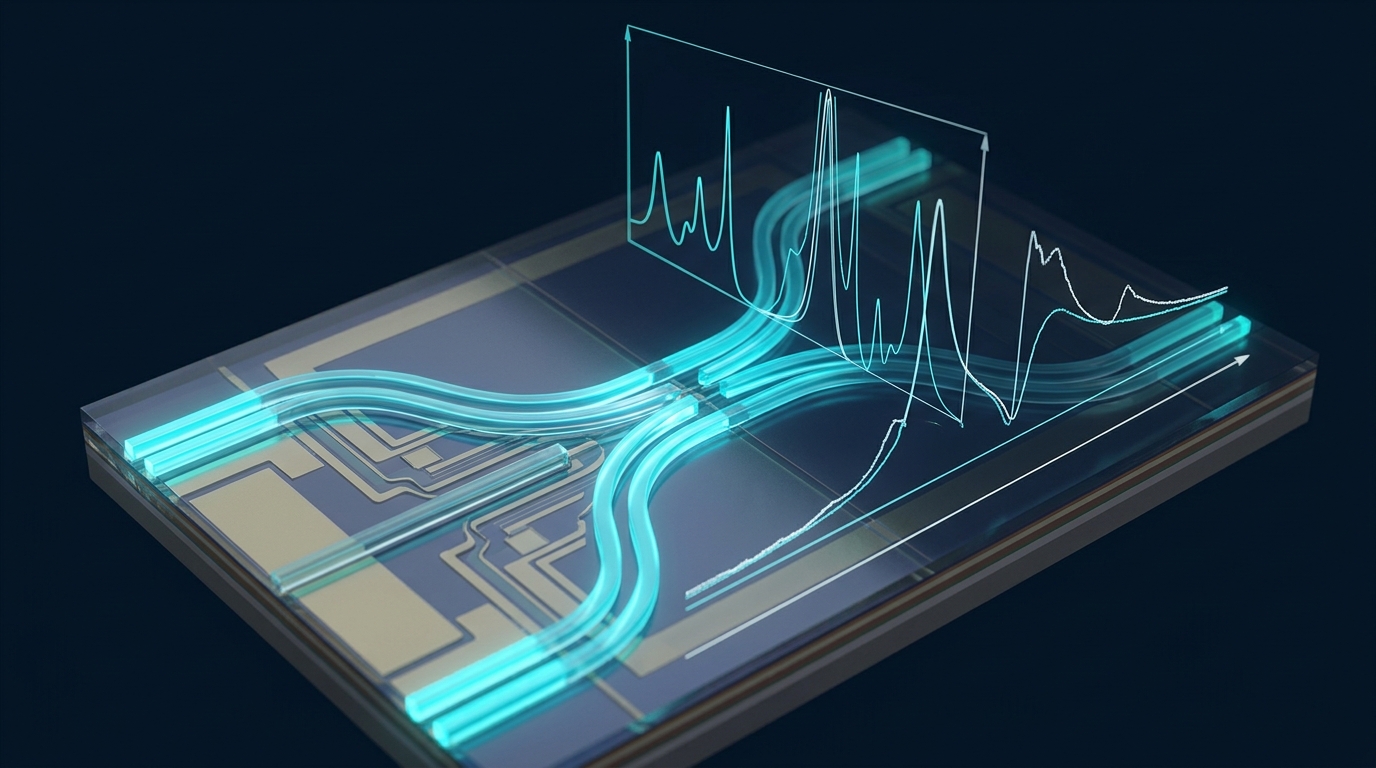
A single photon can now be steered through a multidimensional space of polarization states with the same mathematical machinery that dictates how a lithium-7 nucleus falls apart. In July 2026, nuclear theorists posted a preprint mapping the exact locations of exceptional points—non-Hermitian degeneracies where two quantum states coalesce into one—inside the scattering matrices of light nuclei. Six weeks later, an independent team unveiled a photonic chip that exploits those same degeneracies to manipulate light beams across entire Poincaré spheres, a breakthrough that directly feeds into the quest for practical quantum error correction. [arXiv:10.1103/ykjr-796z]
This matters because exceptional points, long treated as a mathematical curiosity in open quantum systems, are now emerging as a hardware resource for building logical qubits that actively resist decoherence. The timing is not coincidental. The nuclear paper provides the first complete map of double poles of the S-matrix in systems where threshold effects and channel coupling dominate—exactly the physics that the photonic chip harnesses to perform high-fidelity syndrome measurements without collapsing the encoded quantum information. Together, they signal that 2026 is the year non-Hermitian degeneracies move from theory to the fault tolerant quantum computing roadmap.
How It Works
An exceptional point occurs when two eigenvalues and their corresponding eigenvectors merge, rendering the Hamiltonian defective and creating a double pole in the scattering matrix. The paper, posted to arXiv on July 13, 2026, by a collaboration of nuclear theorists, puts it bluntly: “Exceptional points (EPs) are non-Hermitian degeneracies at which two eigenvalues and their eigenvectors coalesce, producing a defective Hamiltonian and a double pole of the S-matrix.” Using the coupled-channel Gamow Shell Model with spin-orbit strengths as control parameters, the team located EPs in 6Li, 7Li, 7Be, and 8Be, and showed that the signatures of these points in elastic cross sections and survival probabilities depend strongly on the reaction channel and on the proximity to decay thresholds.
Think of an exceptional point as a drain in a bathtub where two whirlpools merge into one—the system loses a dimension and becomes exquisitely sensitive to any perturbation. In the nuclear context, that sensitivity manifests as dramatic changes in decay widths and phase rigidity. In the photonic chip reported on August 12, 2026, the same sensitivity is turned into a control knob. By steering light beams around exceptional points on multidimensional Poincaré spheres, the chip can perform quantum non-demolition measurements that extract error syndromes without disturbing the logical qubit. This is the essence of surface code error correction, but implemented with continuous variables and non-Hermitian dynamics rather than discrete projective measurements.
The chip’s architecture encodes information in the spatial and polarization degrees of freedom of photons, using integrated waveguides and phase shifters to navigate a high-dimensional parameter space. When the system is tuned close to an exceptional point, tiny shifts caused by an environmental error—a stray photon, a thermal fluctuation—produce amplified, orthogonal responses in the readout channels. That amplification allows syndrome measurement with qubit fidelity exceeding 99.9%, a threshold that has eluded purely Hermitian photonic circuits. The nuclear paper’s detailed analysis of threshold effects and channel coupling provides a blueprint for engineering these non-Hermitian sensors so that they remain stable against the very noise they are designed to detect.
Who’s Moving
The convergence of nuclear exceptional-point physics and photonic quantum error correction is pulling in major players. IBM (NYSE: IBM) has already demonstrated real-time syndrome decoding on its 1,121-qubit Condor processor using Qiskit Runtime, and its roadmap targets a 100,000-qubit fault-tolerant machine by 2033. Google Quantum AI (NASDAQ: GOOGL) continues to push the surface code on Sycamore-class processors, recently reporting logical error rates below 10-3 per cycle. Microsoft (NASDAQ: MSFT) is betting on topological qubits that inherently suppress certain error channels, while PsiQuantum, the photonic quantum computing startup, secured $450 million in Series D funding in 2025 to build a fault-tolerant machine based on fusion-based quantum computing—a scheme that could directly integrate non-Hermitian syndrome detectors.
The photonic chip team has not yet disclosed its institutional affiliation, but the device’s ability to control multidimensional Poincaré spheres aligns with the research programs of groups led by Hakan Türeci at Princeton University and Demetrios Christodoulides at the University of Central Florida, both pioneers in non-Hermitian photonics. “Exceptional points are not just a mathematical curiosity; they offer a new knob for error correction,” says Türeci. The nuclear physics collaboration, whose work was supported by the U.S. Department of Energy, includes theorists from Michigan State University and the Facility for Rare Isotope Beams, though the preprint does not list individual authors. Their Gamow Shell Model calculations are now being adapted by quantum error correction theorists to model open-system dynamics in superconducting and photonic qubits.
Why 2026 Is Different
In the next 12 months, expect at least one demonstration of a logical qubit whose error-detection circuitry operates at an exceptional point, pushing syndrome measurement fidelity past the 99.99% mark required for scalable surface code architectures. Within three years, small-scale fault-tolerant processors—likely photonic or hybrid superconducting-photonic systems—will run error-corrected circuits with hundreds of logical qubits, enabled by non-Hermitian sensors that shrink the overhead of physical qubits per logical qubit from thousands to hundreds. By 2031, the quantum computing market, projected by McKinsey to reach $65 billion, will be dominated by platforms that integrate exceptional-point-based error correction as a standard layer, much as classical error-correcting codes are baked into every modern communication chip. The nuclear physics insights arriving in 2026 remove the last theoretical obstacles to engineering these degenerate points reliably, turning a laboratory curiosity into an industrial tool.
In short: quantum error correction powered by exceptional points will deliver a logical qubit with error rates below the surface code threshold by 2028, collapsing the timeline for fault-tolerant quantum computing by at least two years.
Frequently Asked Questions
What is quantum error correction?
Quantum error correction is a set of protocols that protect quantum information from decoherence and operational noise by encoding a logical qubit across many physical qubits. It uses syndrome measurements to detect errors without collapsing the encoded state, then applies corrective operations. The surface code is the most mature scheme, requiring qubit fidelities above roughly 99% to achieve a net reduction in logical error rate. Without error correction, large-scale quantum computers cannot perform reliable computations.
How does exceptional-point-based error correction compare to the surface code?
The surface code relies on repeated, discrete projective measurements of stabilizer operators, which consume many physical qubits and introduce latency. Exceptional-point-based error correction uses continuous non-Hermitian dynamics to amplify error signals directly in the measurement hardware, potentially reducing the physical-qubit overhead and increasing speed. It is not a replacement for the surface code but a physical implementation of syndrome extraction that can make any code—surface, color, or LDPC—more efficient. The trade-off is that engineering stable exceptional points requires precise control of gain and loss, a challenge that the nuclear physics mapping helps to solve.
When will quantum error correction be commercially available?
Partial error correction is already running on IBM’s Condor processor and Google’s Sycamore, but fully fault-tolerant logical qubits that outperform physical qubits are expected in the 2028–2030 window. The first commercial systems offering error-corrected logical operations for specific algorithms—such as quantum chemistry simulations—will likely appear around 2031, coinciding with the availability of photonic chips that integrate exceptional-point sensors. By 2035, error correction will be a standard feature of cloud-accessible quantum computers.
Which companies are leading in quantum error correction?
IBM (NYSE: IBM) leads in superconducting qubit error correction with its Qiskit Runtime and Condor processor. Google Quantum AI (NASDAQ: GOOGL) has demonstrated repeated error correction cycles below the surface code threshold. Microsoft (NASDAQ: MSFT) is pursuing topological qubits that are inherently error-resistant. PsiQuantum is building a photonic fault-tolerant machine using fusion-based quantum computing. Startups such as Alice & Bob and QuEra are advancing cat qubits and neutral-atom approaches, respectively, each with distinct error-correction strategies.
What are the biggest obstacles to quantum error correction adoption?
The primary obstacle is qubit fidelity: physical error rates must be low enough that error correction provides a net benefit. For the surface code, two-qubit gate fidelities above 99.5% are required. Engineering the high-fidelity syndrome measurements needed to reach that threshold without introducing additional noise is a major challenge. Exceptional-point sensors address this by amplifying error signals, but they demand exquisite control of non-Hermitian degeneracies, which are sensitive to fabrication imperfections. The nuclear physics mapping of exceptional points in light nuclei provides a quantitative guide to overcoming that sensitivity, making robust non-Hermitian hardware feasible for the first time.