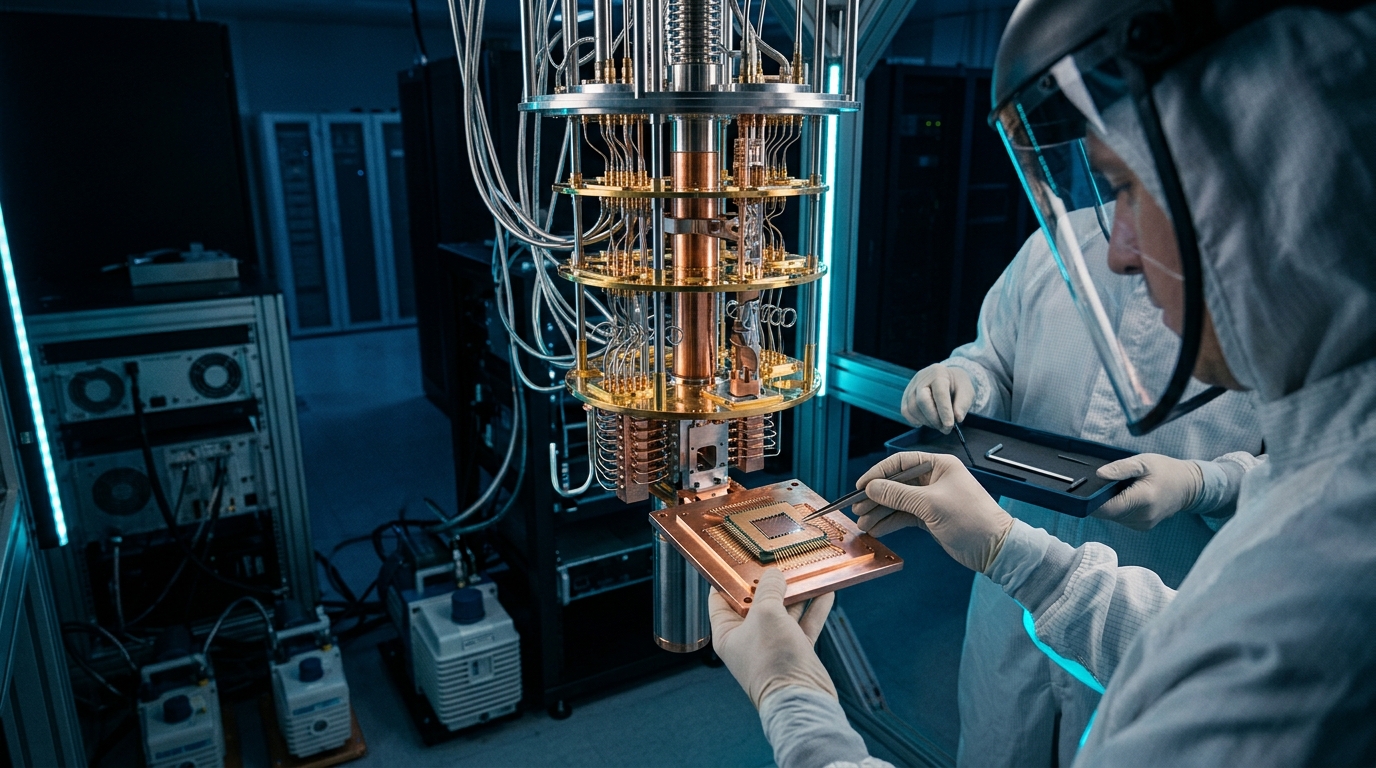
Yonsei University will upgrade its on-premises IBM Quantum System One to the 120-qubit Nighthawk quantum processing unit (QPU) in November 2026, replacing the current 127-qubit Eagle processor. The installation, at the Songdo Campus in Incheon, South Korea, makes Yonsei the second facility worldwide—after IBM's own internal deployment—to receive the next-generation superconducting chip. No financial terms were disclosed.
The move signals that IBM's Nighthawk processor has matured beyond internal testing and is now ready for customer sites. Yonsei, an early member of the IBM Quantum Network, has hosted a System One since 2023. The hardware refresh is an operational upgrade, not a new system purchase, and reflects the beginning of a hardware upgrade cycle for on-premises quantum computers.
What They're Actually Building
Nighthawk is a 120-qubit superconducting transmon processor fabricated by IBM. While the qubit count is slightly lower than Eagle's 127, the architecture prioritizes gate fidelity and coherence times over raw qubit number. IBM has not publicly released full specifications, but based on the company's roadmap trajectory, Nighthawk likely achieves two-qubit gate fidelities above 99.9%—a threshold that enables deeper circuits and more reliable error mitigation. Eagle processors typically operated at around 99% two-qubit gate fidelity.
The chip uses fixed-frequency transmons with tunable couplers, a design IBM has refined since the 133-qubit Heron processor announced in 2024. Nighthawk appears to be a further iteration of that architecture, optimized for on-premises deployment with improved stability and reduced crosstalk. IBM's long-term target remains 100,000 qubits by 2033, but the near-term roadmap emphasizes quality: Nighthawk is expected to deliver quantum volume in the hundreds, a metric that balances qubit count, connectivity, and error rates.
By comparison, Google's 105-qubit Willow processor (2024) demonstrated two-qubit gate fidelities of 99.9% and a milestone in quantum error correction below the surface code threshold. IonQ's Forte Enterprise, a trapped-ion system, offers 36 algorithmic qubits with all-to-all connectivity and gate fidelities exceeding 99.9%. Quantinuum's H2 system, also trapped-ion, reaches 56 qubits with similar fidelity. Nighthawk's 120 qubits with high fidelity would place it competitively among superconducting systems, though its nearest-neighbor connectivity remains a limitation compared to ion-trap architectures.
Winners and Losers
IBM is the primary beneficiary. Deploying Nighthawk at a customer site validates the processor's reliability and strengthens IBM's on-premises quantum business, which competes with its own cloud access model but locks in institutional customers with dedicated hardware. Yonsei gains early access to higher-fidelity hardware for research in quantum algorithms, materials science, and optimization.
Google faces pressure to match on-premises deployments. While Google offers quantum computing via Google Cloud, it has not announced on-premises installations of its processors. IonQ and Quantinuum, which already sell on-premises systems, now see IBM accelerating in a segment they have cultivated. IonQ's Forte Enterprise and Quantinuum's H-Series are direct competitors; IBM's move could intensify pricing and performance comparisons.
Quantum software and middleware providers—especially those in the Qiskit ecosystem—benefit from a larger installed base of capable hardware. Cloud quantum platforms like AWS Braket and Microsoft Azure Quantum may see reduced demand if more organizations opt for on-premises IBM systems, though they still aggregate access to multiple backends.
For investors, IBM's quantum business remains embedded within the company's broader portfolio, but this deployment demonstrates a recurring revenue stream from hardware maintenance and upgrades. The competitive moat for superconducting qubits depends on whether IBM can sustain a fidelity roadmap that keeps pace with trapped-ion and neutral-atom alternatives.
The Bigger Picture
In August 2026, quantum computing remains in the noisy intermediate-scale quantum (NISQ) era, with error correction demonstrations just beginning to emerge. IBM's own 2026 error mitigation techniques, paired with Nighthawk's improved fidelities, aim to extract useful results before full fault tolerance. The Yonsei upgrade aligns with South Korea's national quantum strategy, which has committed over $2 billion to quantum research and infrastructure through 2030.
Comparable deployments include the 2025 IBM System One at Cleveland Clinic, focused on healthcare research, and IonQ's 2024 sale of an on-premises Forte system to the European Quantum Computing Center in Germany. The Yonsei upgrade is notable as one of the first hardware refreshes in the industry, mirroring the upgrade cycles of classical high-performance computing clusters. It suggests that quantum computers are becoming operational assets with planned generational improvements, not one-off experimental installations.
The Signal
This is a genuine step forward, not a PR exercise. The signal here is that IBM has enough confidence in Nighthawk's stability and performance to ship it to a paying customer site, where it must operate with minimal vendor intervention. The true test will be the published benchmarks from Yonsei's system after installation—specifically, two-qubit gate fidelities, coherence times, and quantum volume. If Nighthawk delivers 99.9% fidelity at scale, it will mark a shift in the industry's focus from qubit count to circuit quality, a necessary condition for practical quantum advantage.
What this reveals is that the quantum hardware market is entering a phase of iterative improvement and customer-driven upgrade cycles, much like the early days of classical supercomputing. The companies that can deliver reliable, high-fidelity systems on-premises will capture institutional budgets that previously went to cloud access.
In short: IBM's Nighthawk QPU upgrade at Yonsei University delivers 120 qubits with improved gate fidelities, prioritizing circuit quality over raw qubit count and signaling the start of on-premises quantum hardware refresh cycles.