Shanghai-based photonic quantum computing company TuringQ has entered the IPO tutoring period with sponsor Guotai Haitong Securities, formally launching a process that could make it China’s first publicly traded pure-play quantum computing firm. The move, disclosed on August 7, 2026, follows a funding run that saw the company raise nearly 1 billion yuan ($137 million) in 2026 and reach a post-money valuation above 7 billion yuan (roughly $960 million) after its Series C round.
TuringQ’s decision to engage a tutoring broker — a mandatory pre-listing step in China’s A-share market that typically lasts three to six months — signals serious intent to list on the Shanghai STAR Market or ChiNext board. While the total size of the proposed offering hasn’t been disclosed, the filing sets up a direct race with other Chinese quantum hardware makers, especially Hefei-based Origin Quantum, which has also telegraphed IPO ambitions.
What They’re Actually Building
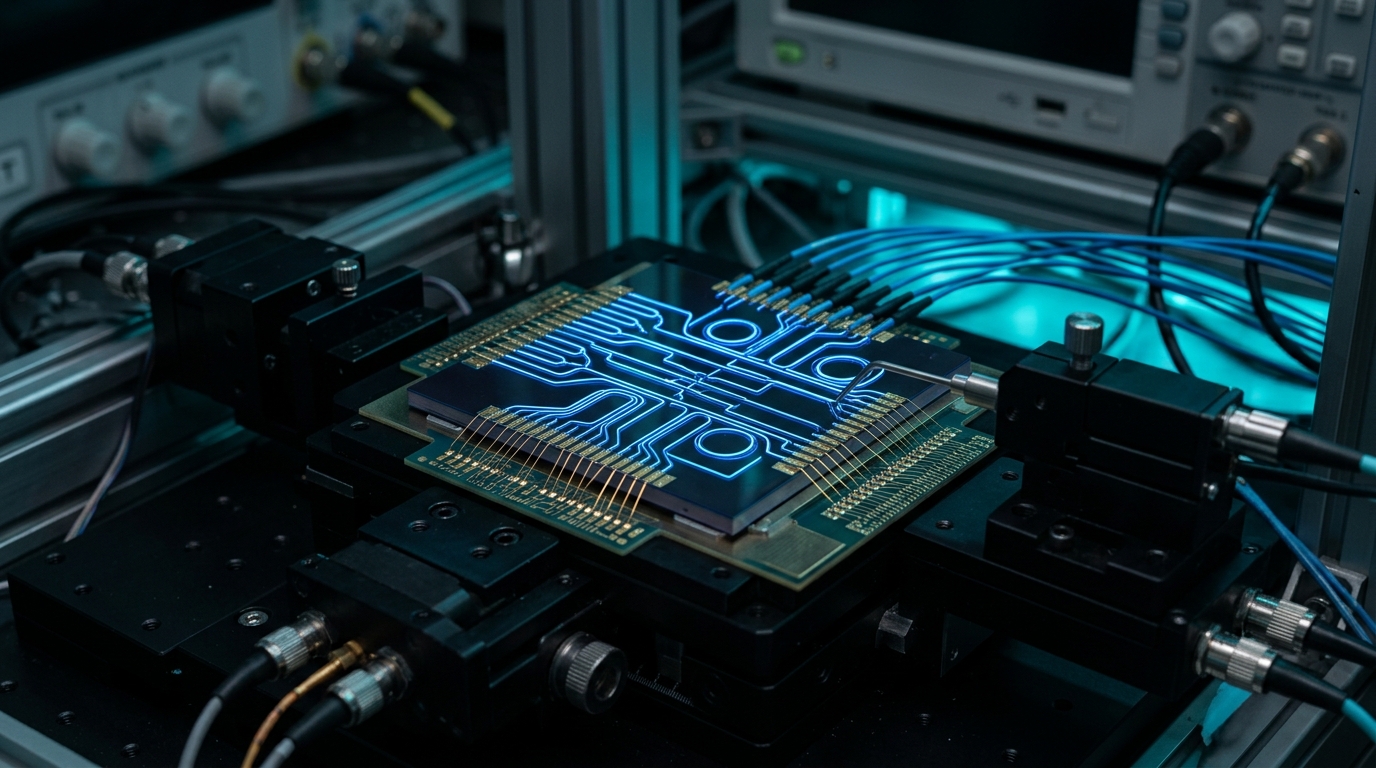
TuringQ designs and builds photonic quantum computers based on lithium niobate on insulator (LNOI) photonic integrated circuits. The company has established a pilot line for LNOI photonic chips and unveiled a second-generation (“Gen2”) quantum computing system. Photonic qubits are encoded in squeezed states of light, which operate at room temperature and can, in principle, be fabricated using semiconductor-compatible processes on wafers.
Unlike superconducting or trapped-ion architectures, photonic quantum computing does not require millikelvin cryogenics or ultra-high vacuum. Instead, the challenge lies in generating large numbers of indistinguishable single photons and performing high-fidelity entanglement operations without loss. TuringQ’s Gen2 system likely increases integration density — possibly reaching hundreds of optical modes — but the company has not publicly reported qubit count, gate fidelities, or error-correction benchmarks. The LNOI platform offers strong electro-optic coefficients, enabling fast modulation and potential for large-scale integration, a path also being pursued by global rival PsiQuantum with its fusion-based approach on silicon photonics.
For context, Canada’s Xanadu demonstrated 216 squeezed-light modes in its Borealis boson sampling machine in 2022, and PsiQuantum has partnered with GlobalFoundries to build a million-physical-qubit fault-tolerant system by the late 2020s. TuringQ’s progress remains opaque, but the existence of a Gen2 prototype and a dedicated foundry-like pilot line suggests they are moving beyond lab-scale demonstrations.
Winners and Losers
The most immediate competitor threatened by TuringQ’s IPO timetable is Origin Quantum, a Hefei-based superconducting quantum computing startup that raised around 1 billion yuan in 2024 and has been China’s highest-profile quantum computing company to date. Origin’s Wukong chip has 72 superconducting qubits, and it has signed cloud-access deals with state-owned enterprises. However, if TuringQ lists first, it could capture the first-mover advantage in Chinese quantum stocks and relegate Origin to a follower position in the public-market narrative.
Globally, the top photonic quantum computing firms remain private. PsiQuantum last raised $450 million in 2024 at a $3.15 billion valuation, while Xanadu collected $100 million in 2022. Neither has signaled near-term IPO plans. A successful Chinese listing of a photonic quantum company could put pressure on these private rivals to accelerate their own public-market timelines or risk being valued at a discount to a listed peer. In adjacent markets, the move could benefit LNOI wafer suppliers and optical component makers in China, while cloud-quantum providers like Alibaba Cloud might see TuringQ as a potential hardware partner to rival Azure Quantum’s photonic integration with PsiQuantum.
The Bigger Picture
TuringQ’s IPO tutoring lands in a 2026 landscape where quantum computing stocks trade on promise rather than revenue. IonQ (NYSE: IONQ) held a market cap of about $6 billion as of mid-2026 despite delivering a few tens of millions in annual sales. Rigetti Computing (NASDAQ: RGTI) has seen its valuation contract significantly since its 2022 SPAC merger. No Chinese quantum computing company has yet tested the domestic market, though the STAR Market has hosted other deep-tech firms with limited profitability.
China’s 14th Five-Year Plan designates quantum computing as a strategic frontier, and both the central government and municipal authorities in Shanghai and Hefei have poured money into quantum infrastructure. An IPO would offer state-backed funds an exit path while recycling capital into the sector. It would also serve Beijing’s goal of building a domestic quantum supply chain that reduces reliance on US-made specialty components, such as cryogenic systems and certain photonic chips.
Comparable deals calibrate the market: German quantum computing startup IQM raised €128 million in 2025, and French firm Pasqal closed a €100 million Series B in 2024. TuringQ’s ¥1 billion Series C matches these hauls, but its valuation of nearly $1 billion is rich for a company with probably no meaningful commercial revenue. If the IPO prices at or above that valuation, it will signal that Chinese investors are willing to price quantum risk on a par with or above Western private-market valuations.
The Signal
This is a concrete regulatory step, not a press release. IPO tutoring in China involves months of due diligence by the sponsor, financial re-audits, and compliance checks. That TuringQ has entered this phase suggests its financials and corporate governance meet the standards of a Chinese public listing, even if its technology remains pre-revenue. The signal here is that China’s capital-market regulators are open to listing a quantum computing company as part of a broader push to fund strategic technology. Still, the absence of disclosed technical metrics — error rates, logical qubit roadmaps, even a qubit count — means investors will be betting on photonic quantum’s promise rather than proof of utility. A successful IPO would validate the fundraising model for hardware-first quantum startups, but the real test will come when one of these companies must demonstrate commercial quantum advantage with real-world applications.
In short: TuringQ’s IPO tutoring, backed by a 7-billion-yuan valuation and a 1-billion-yuan 2026 raise, makes it the first photonic quantum computing firm to file for a public listing, intensifying China’s race to put a quantum pure-play on the boards.
What remains to be seen is whether the public market will reward a quantum company that has yet to reveal the qubit counts or error-correction milestones that define the long road to fault tolerance. The next six months will reveal whether Chinese retail and institutional investors buy into the photonic quantum story at a valuation approaching a billion dollars.