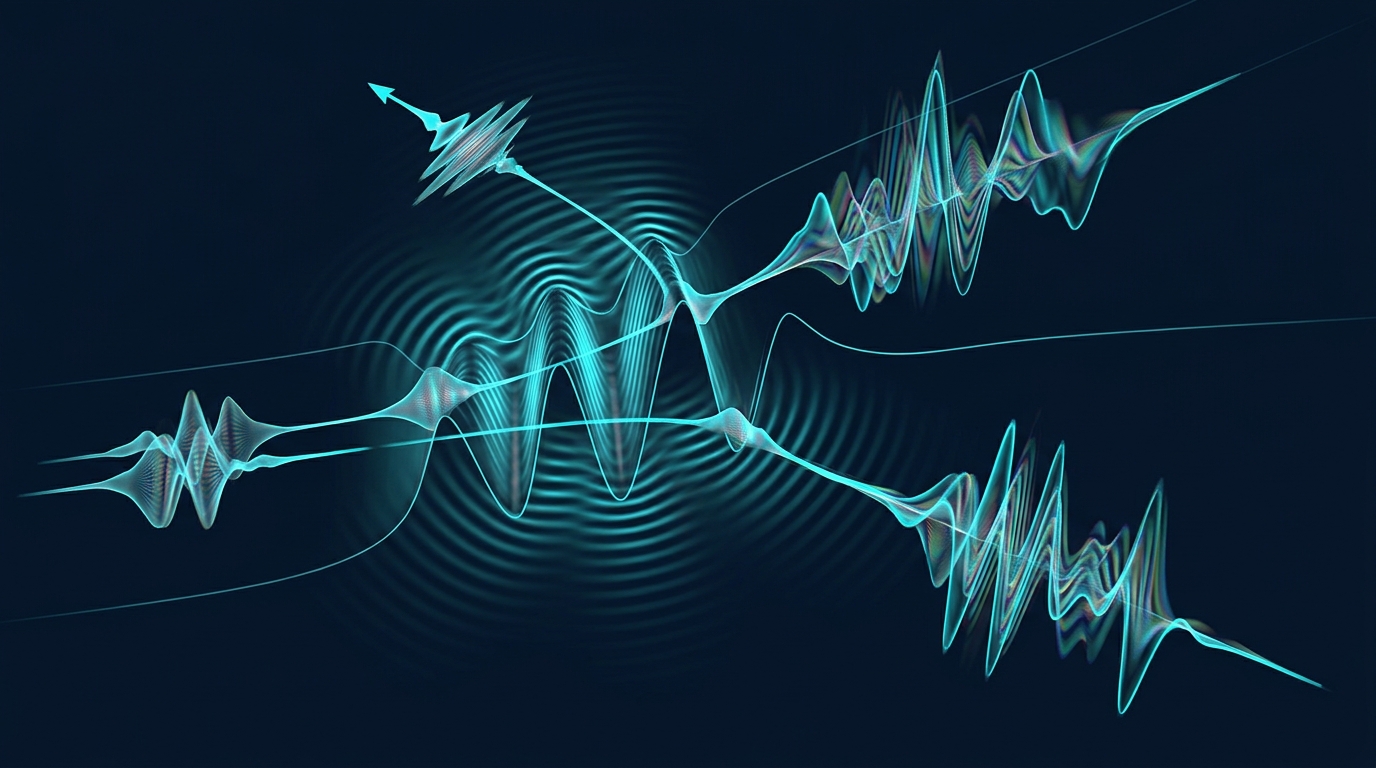
Two electrons, repelling each other, tunnel through a laser-built barrier together. Their paths split sideways in opposite directions, a quantum duo moving as one. This is the collective tunnel effect, demonstrated for the first time in neutral xenon and negative bromine ions and reported on August 4, 2026, on arXiv. The observation is not just an atomic physics curiosity. It is a direct window into the kind of correlated quantum behavior that quantum error correction codes must tame.
Why This Matters Now
On the same day, a separate breakthrough in imaging molecular orbitals in three dimensions appeared, opening a path to record femtosecond videos of electron motion. The timing is not coincidental. Together, these advances arm quantum computing engineers with both a warning and a tool: a new failure mode to model, and a camera that can in principle capture it. The collective tunneling paper, titled "Collective tunnel ionization in atomic systems" ([arXiv:2608.03998]), reveals that under strong low-frequency laser fields, two electrons can escape an atom via a joint sub-barrier trajectory. Their momentum distributions show distinct shoulders lateral to the polarization direction—a smoking gun for collective dynamics. "Collective tunneling in the presence of the electron-electron repulsion comprises the joint sub-barrier motion of the two electrons along quantum trajectories transversely shifted in opposite directions," the authors write. This correlated motion directly challenges a foundational assumption in quantum error correction: that errors on individual qubits are independent.
How It Works
Standard nonsequential double ionization already tells us that electrons do not always ionize one by one. But collective tunneling is a more subtle beast. Here, both electrons move under the barrier at the same time, their paths shaped by mutual Coulomb repulsion. The semi-classical method used by the team—backed by numerical solutions of the time-dependent Schrödinger equation—maps out quantum trajectories where the electrons are shifted transversely in opposite directions. Think of two dancers spinning away from each other while still forced to exit through the same narrow door. The result is a momentum correlation that leaves a measurable imprint: shoulders in the lateral distribution.
The imaging technique described in the second signal uses ultrafast laser pulses to reconstruct electron probability clouds in 3D, effectively giving scientists a stroboscopic movie of molecular orbitals. When paired with circularly polarized pulses—exactly the kind the collective tunneling paper proposes for experimental verification—this setup can freeze the correlated escape act. A logical qubit, the fundamental unit of a fault-tolerant machine, relies on detecting and correcting errors without disturbing the encoded information. If errors come in pairs, as collective tunneling suggests they can in nature, then a surface code that assumes independent errors loses its edge. The new data forces a rethink of error models.
Who's Moving
IBM (NYSE: IBM) has been scaling its fault tolerant quantum computing program around the 1,121-qubit Condor processor and the 156-qubit Heron chip, which emphasize heavy hexagonal surface code implementations. Jay Gambetta, IBM Quantum Vice President, has repeatedly stressed the need for realistic noise models. Google Quantum AI, led by Hartmut Neven, demonstrated the first below-threshold error correction on its Sycamore processor and is now working on a 1,000-logical qubit machine. Both teams rely on the assumption that errors from decoherence are largely uncorrelated in space and time. The collective tunneling finding—if confirmed in solid-state environments—undermines that assumption.
PsiQuantum, the startup pursuing photonic quantum computing, closed a $450 million Series D in 2025 and is building a 1-million-qubit system that leans on fusion-based error correction. Meanwhile, Quantinuum (private) has demonstrated real-time error detection on its 56-qubit H2 processor using a color code variant. The broader industry, from IonQ (NYSE: IONQ) to Alice & Bob, must now assess whether collective tunneling analogs appear as multi-qubit correlated bit-flips or phase errors in trapped ions, superconductors, or Topological Qubits. The imaging front is equally crowded: attosecond science groups led by Ferenc Krausz at the Max Planck Institute of Quantum Optics and Anne L'Huillier at Lund University have been capturing electron dynamics in atoms and molecules. Their tools are now primed to test the collective tunneling prediction directly.
Why 2026 Is Different
Twelve months from now, the first independent verification of the collective channel in circularly polarized fields will either confirm it in other atomic species or constrain its parameters. Within three years, cryogenic syndrome measurement circuits in superconducting qubits will be probed for correlated error signatures that mirror the lateral momentum shoulders seen in xenon. By 2031, the updated noise models flowing from this work will be baked into the firmware of error-correcting chips. The quantum computing market, projected to reach $80 billion by 2035 according to McKinsey, will pivot on whether qubit fidelity can be maintained in the face of surprises like collective tunneling. The imaging pipeline—3D molecular orbitals captured at femtosecond resolution—will become a standard debugging tool for error correction code designers.
The observation of collective tunneling forces a rewrite of the independent-error playbook that has governed quantum error correction for two decades.
Conclusion
In short: quantum error correction must now accommodate collective tunneling dynamics, as the first direct evidence of paired electron sub-barrier motion reshapes noise models for fault-tolerant machines.