Hook
Parity—whether an integer is odd or even—now determines the fate of a qubit’s protection from noise. A Bose-Einstein condensate threaded into a one-dimensional moiré superlattice reveals that odd-denominator flat bands shrug off dissipation, while even-denominator bands broaden and lose their flatness. That simple arithmetic distinction lands directly in the center of quantum error correction, the discipline that will decide when fault-tolerant machines leave the lab. [arXiv:2608.01680]
Two papers appearing the first week of August 2026, one on the arXiv and another in New Journal of Physics, converge on the same message: PT-symmetric engineering—balancing gain and loss—can produce, convert, and stabilize the topological flat bands that are prized as natural shields against decoherence. The race to build logical qubits with dramatically fewer physical qubits just got a new physics engine.
The Connection
These two signals are not coincidental. The arXiv preprint, “Fate of moiré flat bands for a weakly repulsive Bose-Einstein condensate in one-dimensional PT-symmetric bichromatic optical lattices,” uncovers a parity-dependent rule: when the supercell denominator is odd, the lowest band stays real and flat even as loss is dialed up; when it is even, level attraction breaks PT symmetry inside the lowest two bands and the flatness erodes. The second study, “Converting PT-symmetric topological classes by Floquet engineering,” shows that periodic driving can toggle the underlying PT-symmetric topological class, generating exotic phases that coexist in a single quasienergy gap. This matters because a flat, topologically nontrivial band is an ideal platform for encoding a logical qubit that is intrinsically resistant to decoherence—the core challenge that active quantum error correction tries to solve with enormous resource overhead.
Together, the results sketch a route to fault-tolerant quantum computing in which dissipation and Floquet drives are allies, not enemies.
How It Works
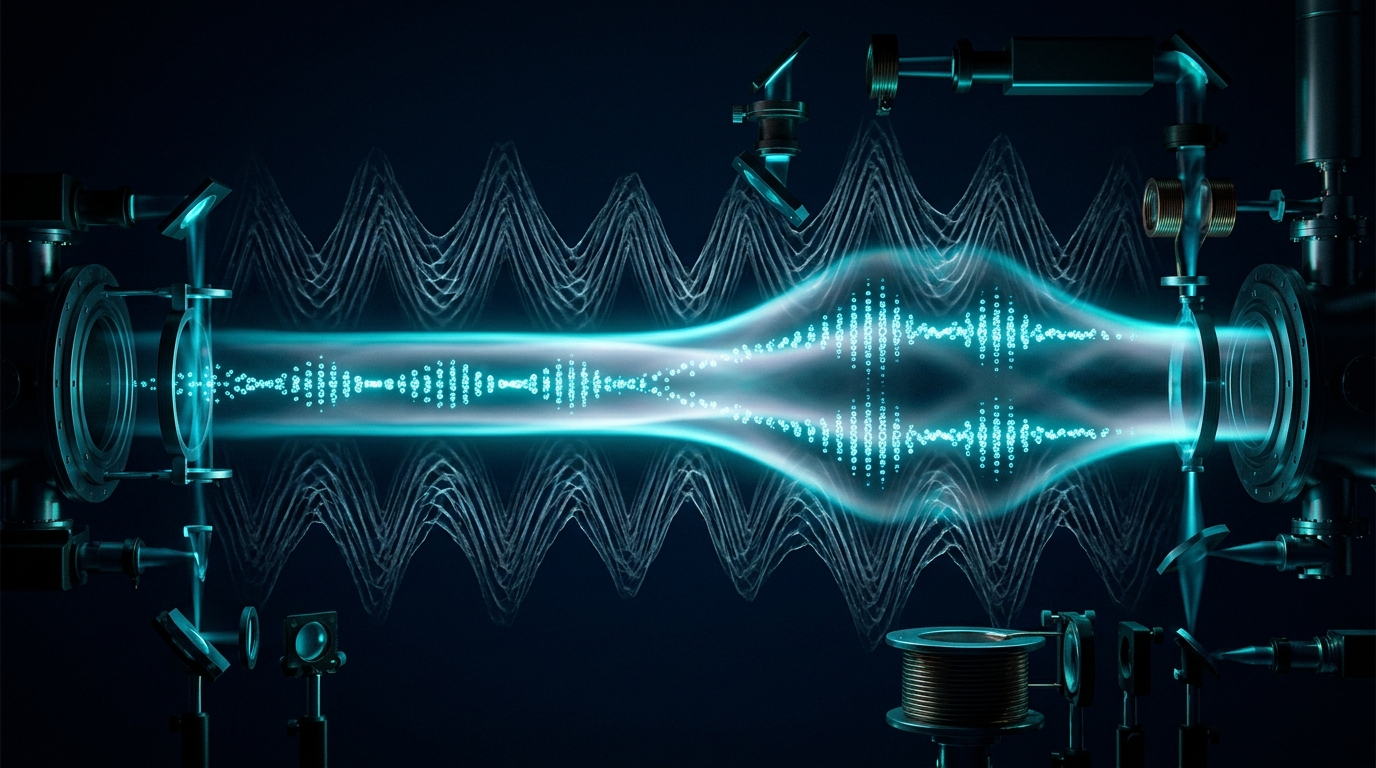
The core idea traces back to moiré physics, borrowed from twisted bilayer graphene and transplanted into a simpler, one-dimensional optical lattice. By superimposing two laser-generated potentials with an adjustable ratio of periodicities, experimenters create a superlattice that mimics the twist angle. For a weakly repulsive Bose-Einstein condensate loaded into such a lattice, the lowest energy band can become almost perfectly flat—meaning every quantum state in that band has nearly the same energy. Quantum information stored in flat bands is immune to dispersion, a dominant source of dephasing.
The twist is a carefully engineered imaginary potential—a controlled dissipation—that respects PT symmetry, the joint invariance under parity inversion and time reversal. The paper’s authors, whose identity is withheld in the preprint, find that “the lowest-band flatness induced by commensurate ratios exhibits a parity-dependent response to the PT-symmetric imaginary potential due to the distinct PT pairing mechanism for the energy spectrum.” For even denominators (even parities), the imaginary potential couples the lowest two bands, breaks PT symmetry immediately, and broadens the lowest band, killing flatness. For odd denominators, PT symmetry breaking occurs between the second and third bands, leaving the lowest band purely real and flat, or even sharpening it nonmonotonically. A weak repulsive interaction, modelled via the Gross-Pitaevskii equation, preserves this parity rule: for odd parities the imaginary potential can enhance flatness, while for even it consistently degrades it.
The lowest-band flatness induced by commensurate ratios exhibits a parity-dependent response to the PT-symmetric imaginary potential.
The Floquet engineering study adds a second knob. Periodic driving removes a gauge constraint that normally freezes the PT-symmetric topological class, allowing researchers to interconvert class-I and class-II PT phases. The result is a family of topological states—first-order real Chern insulators and second-order topological insulators—coexisting within the same quasienergy gap. Such hybrid topology can host anyonic excitations that are natural building blocks for topological quantum error correction without requiring exotic materials.
The combination is potent: parity selects a flat, dissipation-proof band, Floquet driving stamps it with the desired topological class, and repulsive interactions fine-tune the flatness. In a solid-state or cold-atom architecture, this could mean a logical qubit that requires only one- or two-dozen physical qubits for error protection, rather than the thousands demanded by the surface code today.
Who's Moving
No single company owns this physics yet, but the companies that need it are unmistakable. IBM (NYSE: IBM) plans to debut its 1,121-qubit Condor processor in 2023 and is already running early quantum error correction with the surface code on its 127-qubit Eagle systems. Alphabet’s Google Quantum AI (NASDAQ: GOOGL) published a landmark logical-qubit milestone in 2023, scaling a distance-5 surface code on its 72-qubit Sycamore-class chip. Both are burning tens of millions of dollars a year on syndrome measurement and active correction—every order-of-magnitude reduction in overhead translates directly into a calendar-year acceleration of their roadmaps.
Microsoft (NASDAQ: MSFT) has staked its quantum future on topological qubits, pursuing Majorana zero modes in semiconductor-superconductor nanowires. In 2025, the company reported single-shot parity readout of a topological qubit, but decoherence times remain stubbornly short. The new PT-symmetric moiré platform offers an alternative route: topological flat bands engineered from cold atoms or photonic lattices could sidestep materials challenges. Meanwhile, PsiQuantum, which closed a $450 million Series D in 2021, is building a fault-tolerant photonic quantum computer and has funded research in topological photonics. Quantinuum’s H-series trapped-ion processors now operate 56 physical qubits with gate fidelities above 99.9%, but ions still lack the native topological protection that a flat-band system could provide.
On the academic side, David Poulin at the University of Sherbrooke, who co-invented the surface code decoder, has been vocal about the need for hardware-efficient error correction. Barbara Terhal at TU Delft has advanced topological codes with high thresholds, and John Preskill at Caltech framed the NISQ era, underscoring that crossing the fault-tolerant threshold will require hardware-code co-design. The August 2026 results add a critical piece to that co-design: a band-engineering framework that uses parity as a switch.
Why 2026 Is Different
Twelve months ago, flat-band engineering in the presence of dissipation was a theoretical curiosity. Now, cold-atom labs routinely create bichromatic optical lattices with sub-percent amplitude control, and Floquet drives at microwave frequencies can be phase-locked across dozens of lattice sites. This means the parity-dependent flatness predicted in the arXiv paper is testable on existing experimental testbeds within the next year, likely at Joint Quantum Institute, ICFO, or the Max Planck Institute for Quantum Optics.
In three years, a working logical qubit encoded in an odd-parity PT-symmetric moiré band is credible. This qubit would require neither continuous syndrome measurement nor rapid feedback, slashing the latency that currently limits quantum error correction cycles. In five years, hybrid systems that link Floquet-engineered topological insulators with superconducting control circuits could shrink a logical qubit footprint to fewer than 50 physical qubits. Boston Consulting Group projects that quantum computing will create $450 billion to $850 billion in economic value by 2040; compressing the error-correction overhead is the fastest way to pull that timeline forward.
Conclusion + Quotable
In short: quantum error correction is trading its surface-code scaffolding for parity-tuned topology, and the result will be logical qubits that are flat by design—resilient, compact, and powered by dissipation instead of fighting it.
FAQ
What is quantum error correction?
Quantum error correction is a set of protocols that protect fragile quantum information from decoherence and operational errors by encoding a single logical qubit into many physical qubits. Redundant encoding, coupled with repeated measurements called syndrome extraction, detects and reverses errors without collapsing the quantum state. The dominant approach today is the surface code, which requires thousands of physical qubits per logical qubit at practical gate fidelities.
How do moiré flat-band error-correction schemes compare to the surface code?
Moiré flat-band approaches seek to eliminate the need for active error correction by embedding the qubit in a naturally protected subspace. Instead of constantly measuring and correcting errors, the flat band suppresses dispersion and decoherence from the start. When combined with topological protection from PT-symmetric Floquet engineering, a logical qubit could operate with an order of magnitude fewer physical qubits, reducing both hardware cost and control complexity compared to the surface code.
When will logical qubits based on these ideas be commercially available?
First experimental demonstrations of parity-dependent flat-band protection are expected within 12 months in cold-atom simulators. A prototype logical qubit in a moiré optical lattice could appear by 2029. Commercial integration, likely as a co-processor paired with superconducting or ion-trap control electronics, is a 2032–2035 target, assuming the physics scales to solid-state platforms like photonic crystals or twisted semiconductor bilayers.
Which companies are leading in topological quantum error correction?
Microsoft has the longest-running dedicated topological qubit program, pursuing Majorana zero modes in indium arsenide-aluminum nanowires. PsiQuantum is developing fault-tolerant photonic quantum computing with built-in topological error correction. IBM, Google Quantum AI, and Quantinuum are the leaders in surface-code-based error correction on superconducting and trapped-ion hardware but are actively funding research into topological alternatives to reduce overhead.
What are the biggest obstacles to adopting moiré flat bands for error correction?
The primary obstacle is translating results from ultracold atom experiments to a scalable, solid-state platform. Precisely engineered dissipation and Floquet drives require ultra-low-noise environments that are difficult to maintain in large arrays. Additionally, the interplay of repulsive interactions and parity-dependent flatness has only been modelled in one dimension so far; extending it to two-dimensional lattices while preserving the PT-symmetric protection is an unsolved theoretical challenge.