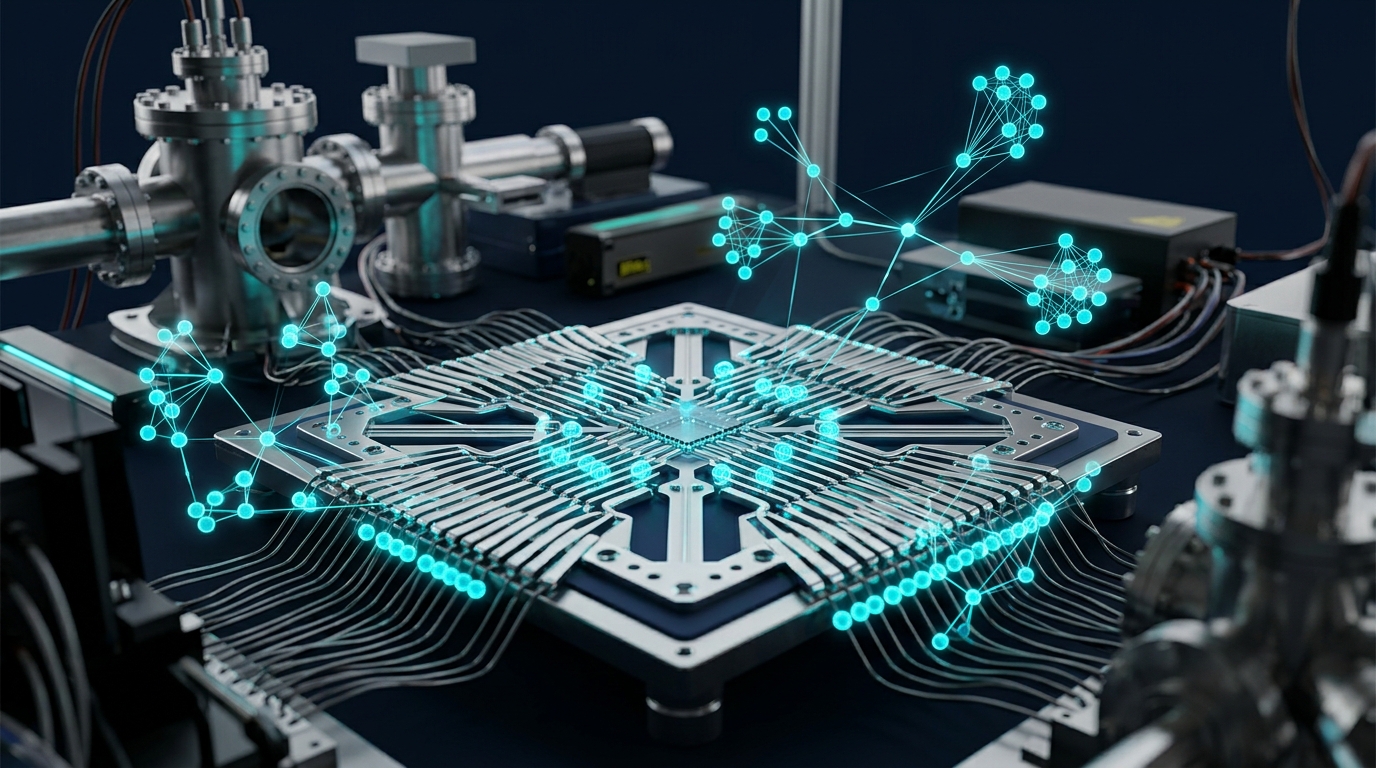
On August 2, 2026, The Qubit Report disclosed a white paper—published in July 2026 by SoftBank Corp. and Quantinuum—that identifies telecommunications fraud detection, specifically International Revenue Share Fraud (IRSF), as a potentially nearer-term commercial opportunity for quantum topological data analysis (TDA) than the chemistry simulations that have dominated quantum computing investment. Experiments using the BUPT fraud dataset showed that adding quantum-computed features—normalized Laplacian moments—to a graph neural network improved macro recall and F1 scores, according to the paper, which maps the hybrid workflow against successive Quantinuum system generations.
What They’re Actually Building
Quantinuum’s trapped-ion quantum computers, including the H-Series, achieve two-qubit gate fidelities above 99.8% and have demonstrated logical qubits with error rates as low as 3×10⁻⁴—below the threshold for fault-tolerant operation. The company’s public roadmap targets Helios, a system with 128 logical qubits, by 2028. For this fraud detection use case, the joint paper proposes a hybrid quantum-classical workflow: a quantum processor estimates spectral moments of the normalized graph Laplacian of a call-detail-record (CDR) network, producing feature vectors that augment a classical graph neural network (GNN). The method is not “quantum advantage” in the strict computational speedup sense; rather, it adds geometrically-rich features that are classically hard to compute for large graphs, improving classification performance on the BUPT dataset. IBM’s Heron processor (133 physical qubits) and IonQ’s Forte (35 algorithmic qubits) offer alternative architectures, but neither has published a similar TDA-fraud integration milestone with a major carrier.
Winners and Losers
Quantinuum gains a tangible use-case narrative with a Tier‑1 telecom partner, moving beyond pharma-focused quantum chemistry. SoftBank, which operates millions of mobile lines, could reduce IRSF losses—an estimated $38 billion industry-wide annually, per the Communications Fraud Control Association—if the hybrid method proves scalable. IonQ and IBM, both pursuing enterprise quantum solutions, now face pressure to demonstrate comparable vertical-specific applications. Startups in quantum graph analytics, such as Classiq or Qedma, could see increased demand for algorithm compilation or error mitigation. The cloud quantum providers AWS Braket and Azure Quantum benefit, as the workflow assumes a hybrid HPC–AI–quantum stack they already offer. Classical fraud detection vendors like SAS and FICO are not disrupted today; the quantum approach remains experimental.
The Bigger Picture
In 2026, the quantum industry is shifting from proof-of-concept to the search for early commercial traction. Governments continue funding: the U.S. CHIPS and Science Act allocated $2.5 billion for quantum R&D through 2028, and the EU Quantum Flagship’s second phase runs at €1 billion. The SoftBank-Quantinuum paper aligns with a broader trend—after years of chemistry focus, financial services and telecommunications are emerging as nearer-term adopters. Last year, IBM partnered with HSBC on quantum machine learning for credit scoring, while IonQ worked with Volkswagen on battery chemistry. Fraud detection on call graphs is a logical extension: the data is already graph-structured, and the financial incentive is immediate. The use of the BUPT public dataset adds reproducibility and helps calibrate expectations.
The Signal
This white paper is a credible, if incremental, step. It does not claim practical revenue impact or quantum speedup; it demonstrates that quantum‑computed topological features can improve a classifier on a known dataset. The signal is that telecom operators are actively scoping quantum applications in the analytics layer, not just in network optimization. The real test will be running the hybrid workflow on a logical‑qubit system with real-time CDR streams and showing a measurable reduction in fraud losses. Until then, Quantinuum’s partnership with SoftBank provides a well‑defined use case to anchor its early‑logic‑qubit era, but it does not upend the competitive order.