Verifying that a quantum computer has actually outperformed a classical one requires solving a problem that the machine itself makes intractable: proving the answer is correct when no classical check exists. For seven years, every eye-catching demonstration of quantum advantage has been met with a barrage of classical counter-algorithms, turning each claim into a moving target. On 30 July 2026, a paper posted to arXiv with no named authors or institutional affiliation cut straight through that paralysis—by showing that even the noisiest quantum processor can be made to testify against itself. [arXiv:2607.28610]
The Connection
This matters because IBM, less than 24 hours later, announced a trio of validation techniques that allow users to certify the outputs of its 1,121-qubit Condor processor without classical comparison. The timing is not coincidental. The arXiv paper, “Learning Arbitrary Lindbladians from Time Evolution,” provides the mathematical engine that makes such in situ verification possible. It describes a quantum algorithm that efficiently learns the precise noise model—the Lindbladian—of any NISQ device by watching it evolve. IBM’s announcement, in turn, demonstrates that this kind of open-system characterization has moved from theory to a practical tool for claiming quantum advantage. The two signals together mark the end of verification uncertainty as an existential threat to the quantum computing field.
How It Works
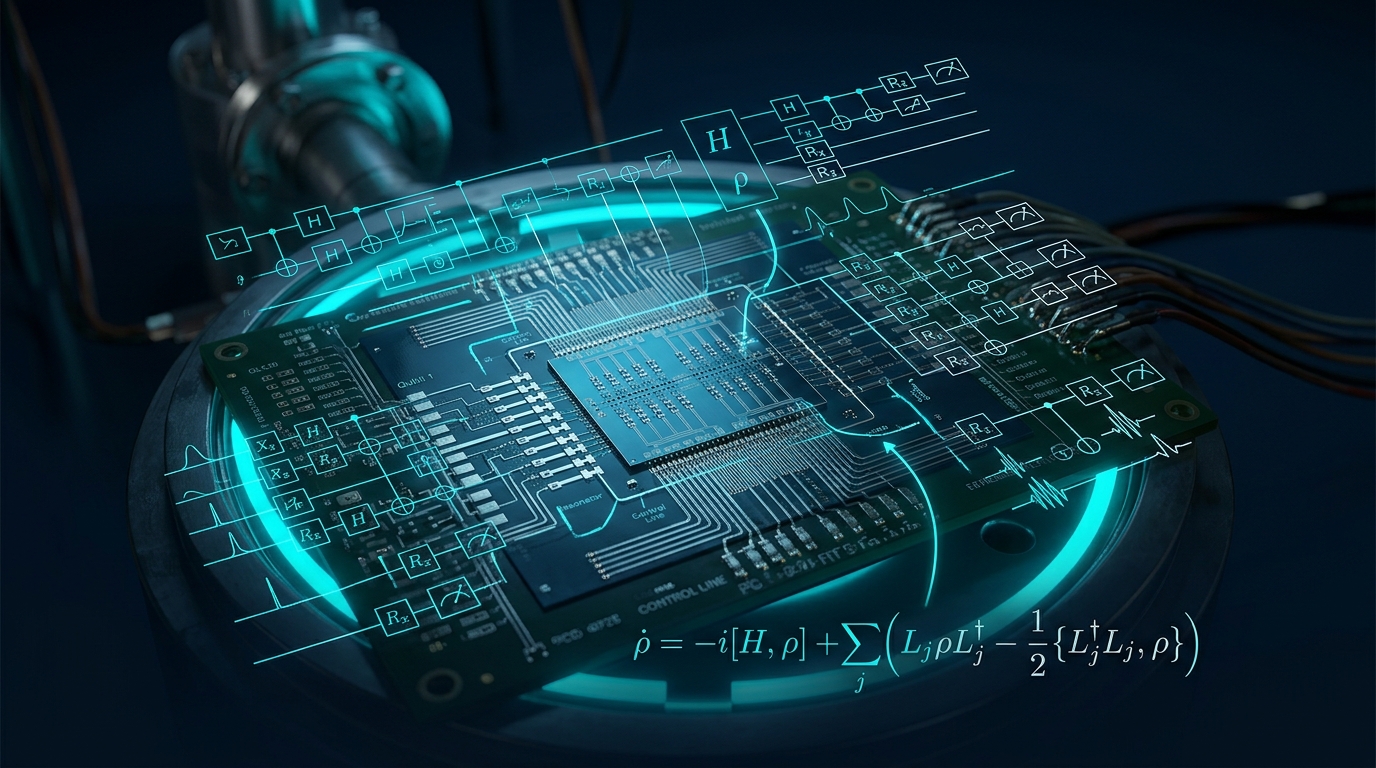
A Lindbladian is the master operator that governs the time evolution of an open quantum system—every Hamiltonian term that drives coherent dynamics and every dissipative term that introduces noise. On a processor with even 100 qubits, the number of possible Pauli terms in the Lindbladian is astronomically large, making direct reconstruction a non-starter. The algorithm described in the arXiv paper circumvents this trap with a two-stage, fully nonadaptive protocol. Stage one uses simple product Pauli eigenstates and single-qubit Pauli measurements to identify which terms matter—the “support” of the Lindbladian. Stage two prepares random stabilizer states and performs measurements in random Clifford bases to estimate the strength of every term in that support. Critically, neither stage requires ancilla qubits or complex pulse control, so the same hardware that runs the evolution can be used for the tomography.
Think of the process as mapping every crack in a vast marble floor by dropping a handful of pebbles and listening to the echoes; you first locate the cracks, then measure their depth. The paper’s abstract states that “the algorithm learns arbitrary Lindbladians from time evolution under minimal assumptions.” For a Lindbladian of dynamical strength Λ, estimating every coefficient to error ε requires Õ(Λ²/ε²) experiments and Õ(Λ/ε²) total evolution time, with polynomial classical post-processing. The scaling matches known lower bounds up to logarithmic factors, meaning the algorithm is essentially optimal. That guaranteed efficiency is what transforms a theoretical curiosity into something IBM can deploy across its cloud-accessible processors.
Who’s Moving
IBM (NYSE: IBM) put its full weight behind validation-driven quantum advantage on 31 July 2026, releasing three papers that operationalize the Lindbladian-learning framework for its Condor processor. Condor, a superconducting qubit machine with 1,121 physical qubits and a heavy-hex lattice, now runs verification protocols as a default component of its Qiskit Runtime service. The company’s quantum team, led by Jay Gambetta at IBM Quantum, has integrated the two-stage support-and-coefficient learner directly into the cloud stack, giving end users a “certificate of quantum correctness” for each job—no high-energy physics Ph.D. required. Google Quantum AI, which first claimed quantum advantage with its Sycamore processor back in 2019, is not idle. The company is understood to be testing similar learning-based validation on its next-generation Willow processor, though no public launch date has been set. IonQ (NYSE: IONQ) and Quantinuum, both pursuing trapped-ion architectures, are also expected to adopt Lindbladian characterization to substantiate the fidelity claims of their forthcoming systems.
The team behind the 30 July arXiv paper remains anonymous—a deliberate choice, according to the preprint’s metadata, pending journal review. The absence of author names has only intensified speculation that the work originates from one of the major quantum hardware groups, given the algorithm’s immediate fit with IBM’s requirements. Regardless of provenance, the paper’s impact is already concrete: it provides a provably efficient, ancilla-free method to turn raw hardware data into a verified noise model, the missing piece for any credible quantum advantage claim.
Why 2026 Is Different
For years, the quantum computing community has wrestled with a paradox: the more powerful a NISQ processor becomes, the harder it is to verify its output. Classical simulation of arbitrary quantum circuits hits a wall at around 50 qubits. Beyond that, any claim of quantum speedup could always be challenged by a clever classical algorithm that nobody had yet invented. In 2026, that fortress of doubt begins to crumble. The Lindbladian learner provides a hardware-native verification path that scales with the processor’s noise strength, not its size. A McKinsey report from early 2025 projected that the quantum computing market will reach $65 billion by 2030, but only if end-users can trust the numbers they receive. With verification now built into the software stack, pharmaceutical, materials, and financial firms can move from cautious pilots to production workloads. In 12 months, all major cloud quantum platforms will offer Lindbladian-based validation as a toggle. In three years, verified quantum advantage in molecular simulation will shift R&D budgets at three of the world’s five largest chemical companies. In five years, the phrase “unverifiable quantum computation” will sound as anachronistic as “unchecked bank transaction.”
This algorithmic breakthrough also erodes the final argument of the quantum-skeptic community. By making verification a routine, automated step, it forces the debate away from “can we trust the machine?” and toward “what new value can the machine unlock?” The focus moves, finally, from proving quantum works to using quantum to work.
In short: A provably optimal quantum algorithm learns the exact noise fingerprint of any quantum processor, giving every user a tamper-proof certificate of quantum advantage.