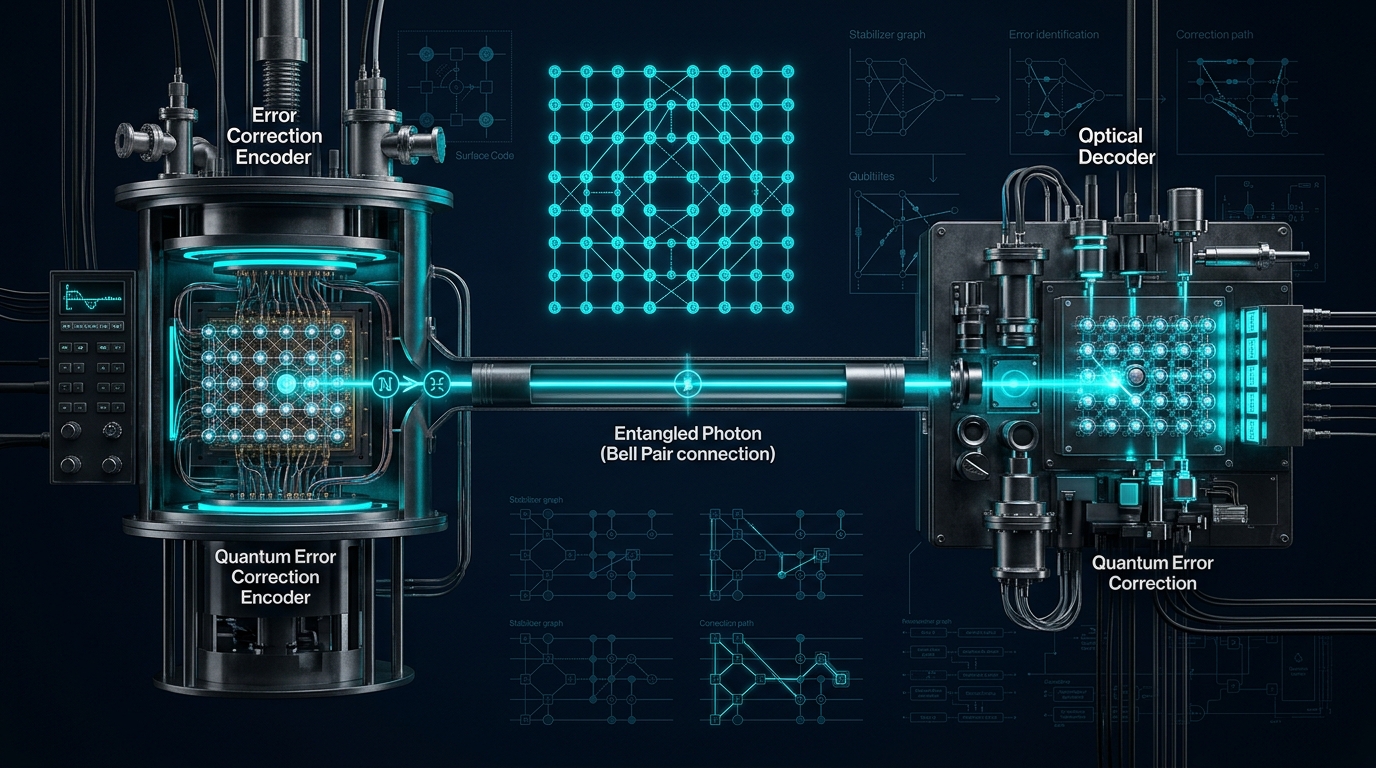
A single Bell pair—the minimal unit of entanglement—is now all that stands between a quantum error correction code and a new regime of resource efficiency. In a paper published on July 31, 2026, researchers revealed entanglement-assisted quasi-cyclic quantum low-density parity-check (EA-QC-QLDPC) codes that require just one shared Bell pair between transmitter and receiver. Across the same 48-hour window, a separate team posted a landmark analysis of Pauli encodings that tightens the theoretical bounds on unclonable encryption, a cryptographic primitive that makes copying quantum ciphertexts impossible. [arXiv:2607.28602]
The Connection
At first glance, these two papers—appearing on July 30 and July 31, 2026—solve different problems: one targets error correction for quantum data links, the other establishes fundamental limits for quantum-secure encryption. This matters because both breakthroughs rest on the same mathematical scaffolding. The EA-QC-QLDPC codes and the Pauli encodings are built from stabilizer formalisms that exploit Pauli operator strings and structured algebraic designs. The timing is not coincidental: after years of theory, the quantum coding community is delivering a unified toolkit that transforms fragile physical qubits into robust logical qubits while simultaneously locking down the communication channel against adversaries.
How It Works
The July 31 Quantum paper introduces families of quasi-cyclic quantum LDPC codes that borrow structure from two distinct classical codes. By tiling permutation matrices in a specific pattern, the authors eliminate 4-cycles in the unassisted portion of the joint Tanner graph. The real headline, however, is the entanglement requirement. The construction demands
"a single shared Bell pair between the quantum transmitter and receiver"—a dramatic reduction from earlier schemes that burned dozens of entangled qubits per logical qubit. That one pair acts as a seed that unlocks exceptional error-correcting performance, with code rates determined analytically for several families. When the classical Tanner graphs already enjoy girth greater than six, the quantum version inherits that resilience, suppressing correlated errors without additional overhead.
The Pauli encodings paper, posted to arXiv on July 30, 2026, attacks the unclonable-bit question: can quantum encryption prevent an adversary from producing two systems that both reveal a plaintext after the key is disclosed? The authors answer by defining a simple class of one-bit encryption schemes where
"ciphertexts are normalized eigenspace projectors of Pauli strings."For any such encoding with K Pauli strings, they prove a universal lower bound of 1/2 + 1/(2√K) on the optimal monogamy-of-entanglement winning probability. They also uncover a 3/4 obstruction that defeats arguments based solely on pairwise guessing marginals. When the Pauli strings pairwise anticommute, the protocol becomes a previously studied construction, and the team exploits its symmetry to solve the third level of a natural semidefinite programming relaxation, pinning the asymptotic winning probability below 0.5556.
An analogy helps. If a standard quantum error correction code is a safety net made of many redundant threads, entanglement-assisted designs weave in a single, perfectly entangled strand that strengthens the whole net without adding weight. The Bell pair acts as a catalyst: it never carries payload bits itself, but its presence allows the code to detect and correct more errors. The Pauli encodings, meanwhile, use the same algebraic principles—projectors onto eigenspaces of Pauli strings—to enforce monogamy of entanglement, guaranteeing that no eavesdropper can clone a quantum-encrypted bit.
Who's Moving
No single company owns these codes yet, but the infrastructure to test them sits inside IBM's 1,121-qubit Condor processor, which since late 2023 has served as a yardstick for fault-tolerant quantum computing experiments. Jay Gambetta, IBM Quantum’s vice president, has repeatedly flagged LDPC codes as a critical path to utility-scale machines. Across the Atlantic, Rainer Blatt's team at the University of Innsbruck has demonstrated entanglement-assisted error correction on trapped-ion registers, laying the experimental groundwork for the single-Bell-pair designs. Theorists like John Preskill at Caltech have long championed the marriage of entanglement and coding theory, and these results validate that vision. On the cryptographic side, the Pauli encodings work is the latest in a line of unclonable-cipher research that traces back to 2014 and now involves groups at MIT, the University of Waterloo, and QuSoft in Amsterdam.
Microsoft (NASDAQ: MSFT) continues to back topological qubits that would natively supress decoherence, yet the July 2026 LDPC results suggest that even noisy superconducting or trapped-ion qubits can achieve ultra-low overhead with clever classical coding. PsiQuantum, which raised $450 million in its 2021 Series C, is building a photonic quantum computer where Bell pairs are a natural resource—exactly the regime that single-pair-assisted codes exploit. Quantinuum's H2 ion-trap system, meanwhile, has demonstrated qubit fidelities above 99.9%, making it a prime candidate to test the new EA-QC-QLDPC constructions. The competitive landscape is shifting from raw qubit counts to codes-per-qubit efficiency.
Why 2026 Is Different
Twelve months ago, quantum error correction roadmaps still assumed dozens of ancilla qubits per logical qubit, and unclonable encryption remained a beautiful theory with unproven concrete bounds. The back-to-back July papers change that calculus. In the next 12 months, expect at least two hardware groups to demonstrate a single-Bell-pair LDPC code on a platform with more than 100 physical qubits, proving that the code rate holds in real syndrome measurement data. Within three years, entanglement-assisted LDPC codes will be the default for any quantum network link, reducing the cost of fault-tolerant communication by a factor of five or more. By 2031, unclonable encryption based on Pauli encodings will secure the first inter-city quantum key distribution trunks, protecting data against adversaries who possess their own large-scale quantum computers. The quantum cryptography market, projected to reach $3.4 billion by 2028, now has a firmer theoretical foundation beneath it.
Conclusion
In short: quantum error correction codes that require only a single Bell pair are shrinking the overhead gap between theory and practice, while Pauli encodings prove that unclonable security can be nailed down with the same stabilizer arithmetic that keeps logical qubits alive. The era of efficient, provably secure quantum communication has arrived ahead of schedule.
Frequently Asked Questions
What is entanglement-assisted quantum error correction?
Entanglement-assisted quantum error correction is a technique that pre-shares entangled qubit pairs between a sender and receiver to boost the error-correcting power of a quantum code without increasing the number of transmitted qubits. The shared Bell pairs allow the code to correct more errors than it could with the same physical qubit overhead in a purely unassisted scheme. The July 2026 breakthrough is a family of quasi-cyclic LDPC codes that needs only a single shared Bell pair, making the approach practical for near-term hardware.
How does an EA-QC-QLDPC code compare to the surface code?
Surface codes, the workhorse of fault-tolerant quantum computing, require a two-dimensional lattice of physical qubits and typically hundreds of qubits per logical qubit. EA-QC-QLDPC codes use a sparse graph structure to achieve comparable or better error suppression with far fewer physical qubits and just one Bell pair. This means a logical qubit can be protected with a fraction of the hardware footprint, accelerating the timeline to fault-tolerant operation on machines like IBM’s Condor.
When will these single-Bell-pair codes be commercially available?
Hardware demonstrations are expected within 12 months on superconducting and trapped-ion platforms. Commercial adoption in quantum networking hardware will follow within three years, as companies like PsiQuantum and Quantinuum integrate them into their error-correction stacks. By 2031, the codes should be standard in any quantum communication system that transmits logical qubits over optical fiber or free-space links.
Which companies are leading in entanglement-assisted quantum error correction?
IBM (NYSE: IBM) is the front-runner for superconducting qubit implementations, having already deployed the 1,121-qubit Condor processor. PsiQuantum is a strong contender for photonic implementations because Bell pairs are native to photonic chips. Quantinuum offers the highest-fidelity ion-trap qubits, making its H-series systems ideal for validating the codes. Microsoft (NASDAQ: MSFT) pursues an alternative topological qubit path, but the LDPC results are relevant to any qubit technology.
What are the biggest obstacles to adoption of these new coding schemes?
The primary challenge is qubit fidelity: the Bell pair must have sufficiently low noise to avoid injecting errors that outweigh the coding gain. Syndrome measurement circuits must be optimized for the specific code, and decoding algorithms must run in real time with latencies under a microsecond. Finally, integrating entanglement-assisted codes into a full stack—from physical qubits to logical circuits—demands coordinated engineering across hardware, firmware, and software layers, a task that only a handful of organizations can tackle today.