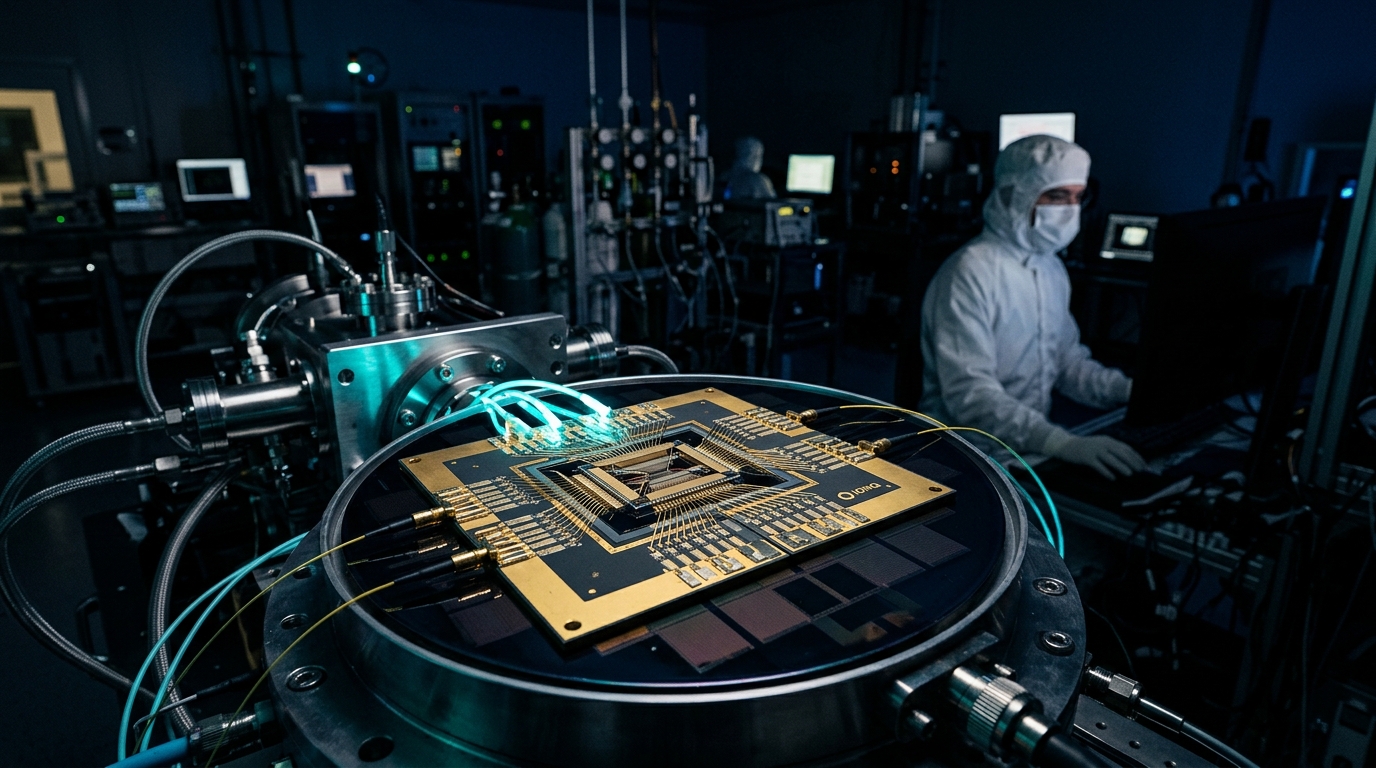
IonQ (NYSE: IONQ) closed its acquisition of SkyWater Technology (formerly NASDAQ: SKYT) on July 31, 2026, following final regulatory approvals. The deal, first announced in May 2026, merges a leading trapped-ion quantum computing developer with the largest exclusively U.S.-based semiconductor foundry. Financial terms were not disclosed, but the transaction creates a vertically integrated quantum platform company that now controls design, wafer fabrication, advanced packaging, and system-level deployment.
What They're Actually Building
IonQ builds quantum computers using trapped ytterbium ions as qubits, manipulated by lasers in ultra-high vacuum chambers. Individual ions are confined in microfabricated surface traps, and quantum gates are performed by addressing ions with precisely tuned laser pulses. The company's current flagship system, IonQ Forte, operates 36 algorithmic qubits with a reported two-qubit gate fidelity above 99.9%. IonQ's roadmap targets scaling to hundreds of qubits via photonic interconnects between multiple trap modules, a technique known as modular quantum computing. These interconnects require photonic integrated circuits and precise fiber alignment—areas where SkyWater's silicon photonics capabilities are directly applicable.
SkyWater Technology operates a 200mm semiconductor fab in Bloomington, Minnesota, specializing in custom MEMS, photonics, and rad-hard processes. It is a trusted foundry for the U.S. Department of Defense and has received over $170 million in CHIPS Act funding to expand its domestic manufacturing capacity. The acquisition gives IonQ in-house capability to fabricate ion traps, photonic interconnects, and custom control ASICs—components that previously relied on external suppliers such as Sandia National Laboratories and commercial MEMS foundries. However, trapped-ion qubits do not require the advanced lithography nodes used for superconducting qubits; the traps themselves are typically fabricated with micron-scale features, well within SkyWater's mature process capabilities. The real value lies in co-designing the trap, photonics, and electronics on a single platform to reduce signal loss and improve system reliability.
The technical rationale is supply chain control and potential cost reduction, not access to bleeding-edge nodes. IonQ CEO Peter Chapman stated in a press release that the acquisition "accelerates our ability to deliver fault-tolerant quantum computers by integrating the full hardware stack." The company has not yet disclosed specific improvements in qubit count or error rates attributable to the vertical integration. Industry observers note that while in-house fabrication can shorten iteration cycles, the fundamental scaling challenges for trapped ions—such as ion shuttling speed and laser crosstalk—remain independent of who manufactures the trap chip.
Winners and Losers
IonQ gains a strategic asset that could differentiate it from other trapped-ion competitors. Quantinuum, the other major trapped-ion player, already benefits from deep integration with Honeywell's microfabrication and control systems expertise; its H2 system has demonstrated 32 qubits with two-qubit gate fidelities of 99.8%. By bringing fabrication in-house, IonQ reduces its dependency on third-party foundries and may lower the cost per qubit over time. The move also positions IonQ to bid more aggressively for classified U.S. government contracts that require trusted domestic supply chains—a market SkyWater already serves. Smaller trapped-ion startups like Alpine Quantum Technologies and Universal Quantum, which lack such vertical integration, may face increased pressure on cost and supply assurance.
SkyWater's existing commercial and defense customers face uncertainty. A quantum computing startup now owns a critical node in the U.S. semiconductor ecosystem. While IonQ has stated it will honor existing contracts, any shift in foundry priorities could disrupt supply for rad-hard chips, MEMS sensors, and other specialty components. Competitors like IBM and Google, which fabricate their own superconducting qubits in-house, are unaffected directly, but the acquisition underscores a broader industry trend toward vertical integration in quantum hardware. IBM's in-house transmon fabrication has long been a competitive advantage, and IonQ is now mirroring that approach for trapped ions.
For investors, the deal is a double-edged sword. IonQ absorbs SkyWater's capital-intensive fab operations and its workforce, adding fixed costs at a time when quantum revenue remains negligible—IonQ reported just $22 million in revenue for 2025. The acquisition could pressure IonQ's cash reserves and distract management from the core challenge of improving qubit fidelity and scaling to logical qubits. On the other hand, if IonQ can leverage the foundry to produce ancillary revenue from non-quantum customers, it might create a financial buffer that pure-play quantum companies lack. The market will closely watch IonQ's next earnings report for guidance on fab operating costs and integration expenses.
The Bigger Picture
In 2026, the quantum computing industry is still in the NISQ (noisy intermediate-scale quantum) era, with no company having demonstrated a clear path to fault-tolerant machines at scale. Government investments, including the U.S. CHIPS and Science Act, have poured billions into domestic semiconductor manufacturing, and quantum computing is a stated priority. IonQ's acquisition of a U.S.-based foundry aligns with the geopolitical push to secure critical technology supply chains, but it also raises questions about whether a quantum startup should own a general-purpose fab. The EU's Quantum Flagship and similar programs in Asia are also driving sovereign quantum capabilities, making vertical integration a potential differentiator for companies seeking government contracts.
Comparable moves are rare. In 2024, Quantinuum integrated Honeywell's trapped-ion fabrication line, but that was an internal transfer within the same corporate group. IBM has long manufactured its own transmon qubits at its Yorktown Heights facility. No other pure-play quantum company has acquired a merchant foundry. The deal may signal that IonQ sees hardware differentiation—not just software or cloud access—as the key to long-term competitive advantage. It also reflects a maturation of the quantum industry, where control over the physical layer is becoming as important as algorithmic breakthroughs.
The Signal
The signal here is that IonQ is betting heavily on vertical integration as a moat, but the acquisition's technical payoff is unproven. Owning a foundry does not directly solve the fundamental challenges of trapped-ion quantum computing: improving gate fidelity, reducing crosstalk, and scaling to thousands of logical qubits with error correction. The real test will be whether IonQ can demonstrate a quantum processor fabricated entirely in-house that achieves two-qubit gate fidelities above 99.99% and supports error correction codes with a logical error rate below the surface code threshold. Until that milestone is reached, the SkyWater deal remains a bold corporate maneuver with uncertain quantum dividends. What this reveals is a company willing to make unconventional bets to control its destiny, even if the immediate quantum payoff is years away.
In short: IonQ's SkyWater acquisition creates the first vertically integrated trapped-ion quantum platform, but the quantum advantage still hinges on error correction, not fab ownership.