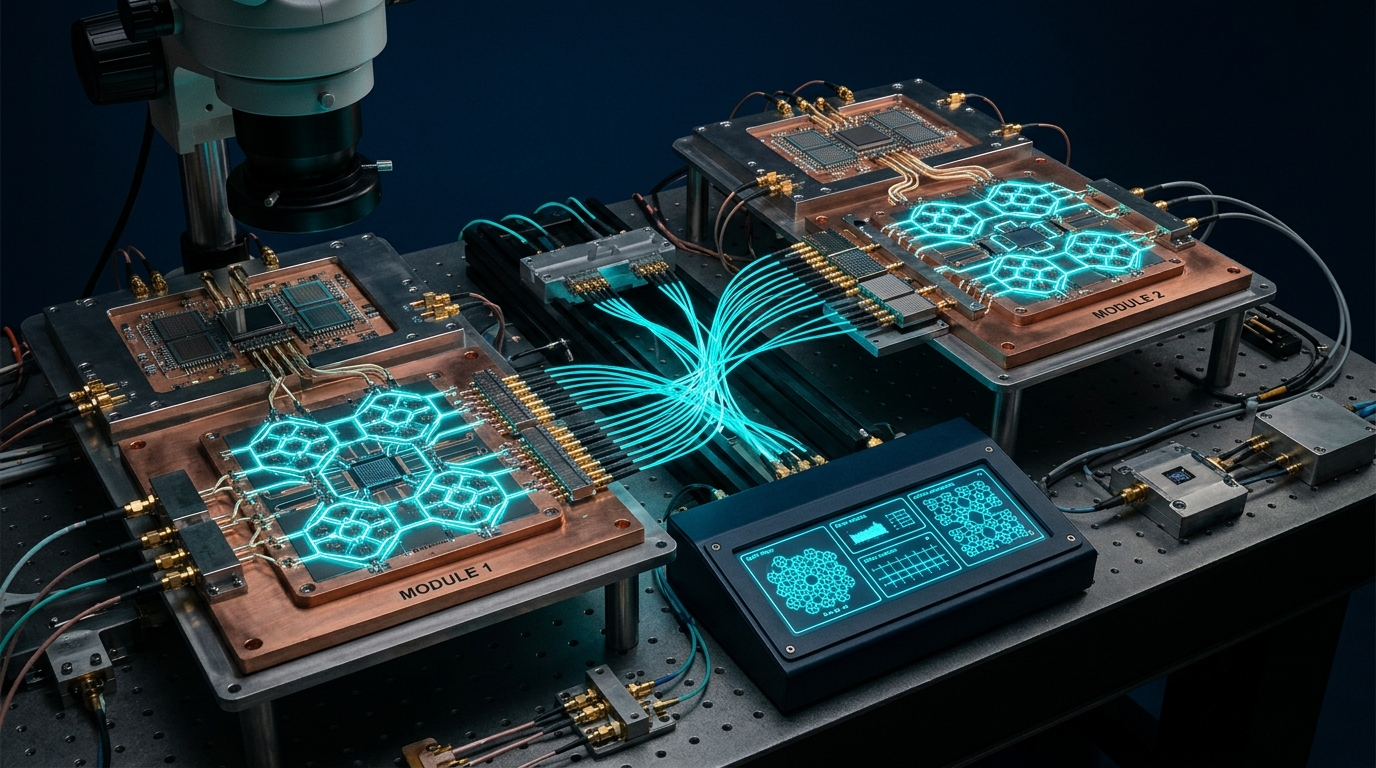
Building a quantum computer large enough to solve practical problems means connecting many smaller processors, much like data centers link servers. But the connections between quantum modules are inherently noisy, and until now, no one knew whether fault-tolerant quantum error correction could survive those noisy links. A team of quantum researchers (institution details unavailable) has now answered that question with precise circuit-level simulations, establishing the first quantitative noise budget for modular interconnects. [arXiv:2607.27204]
The Core Finding
The team modeled the rotated surface code, a leading error correction scheme, and performed fault-tolerant nonlocal CNOT gates using lattice surgery between quantum processing units (QPUs) connected by noisy Bell pairs. They found that the interfaces can tolerate noise up to an order of magnitude higher than the local gate errors within each QPU, with only a minor reduction in the overall fault-tolerance threshold. Think of it like a digital communication channel: the error-correcting code can fix a messy signal as long as the noise is below a certain level, and the modular link is remarkably forgiving compared to the delicate qubits inside each chip.
“interfaces can tolerate noise up to an order of magnitude higher than intra-QPU noise, with only a minor reduction in the fault-tolerance threshold.”The researchers also developed an efficient protocol for preparing distributed fault-tolerant logical GHZ states, reducing ancilla overhead, time, and nonlocal Bell-pair consumption. They showed that ancilla minimization in this setting is equivalent to a vertex-cover problem on an associated graph, and introduced a polynomial-time heuristic algorithm for finding low-overhead solutions.
The State of the Field
Prior studies on modular quantum computing largely focused on logical-memory benchmarks—how long a logical qubit can store information without gates. Seminal work by Bravyi and Kitaev (1998) established surface code thresholds for memory, but extending to full circuit-level operations across modules with noisy interconnects remained unexplored. Meanwhile, companies like IBM (2023) and Google have announced modular roadmaps, and researchers have demonstrated small-scale networked processors. The new paper moves beyond memory benchmarks by simulating lattice-surgery-based nonlocal CNOT gates, providing the first quantitative evidence that distributed quantum error correction can sustain practical noise levels. The discovery that interface noise can be ten times higher than intra-QPU noise without breaking fault tolerance reshapes the design trade-offs for modular quantum systems.
From Lab to Reality
For scientists, the work sets a concrete benchmark for interface noise and introduces a polynomial-time heuristic for GHZ state preparation that can be applied to future distributed architectures. For engineers, it means that optical or microwave interconnects between modules can be designed with relaxed noise requirements, reducing cost and complexity. For investors, the fault-tolerant quantum computing market, which some analysts project could exceed $2 billion by 2030, gains a clearer path to scalable hardware. The vertex-cover formulation of ancilla minimization also provides a new optimization tool that can be built into quantum compilers as modular systems mature.
What Still Needs to Happen
The simulations assume idealized noise models; real-world interconnects suffer from correlated errors, loss, and limited Bell-pair generation rates. Achieving high-fidelity entanglement links at scale remains a major challenge, and groups at AWS Center for Quantum Computing, IBM, and academic labs are working on transmon and trapped-ion modular systems. The polynomial-time heuristic for vertex cover may need to be extended to handle dynamic network topologies and realistic latency constraints. Moreover, the paper does not address the additional overhead of distributing logical qubits across many modules, which could degrade the threshold if not carefully managed. These obstacles suggest that a fully fault-tolerant modular quantum computer is still roughly a decade away, but the new noise budget provides a crucial engineering target.
Conclusion
In short: quantum error correction can tolerate noisy inter-module links up to an order of magnitude higher than local gate errors, paving the way for scalable fault-tolerant modular quantum computers.