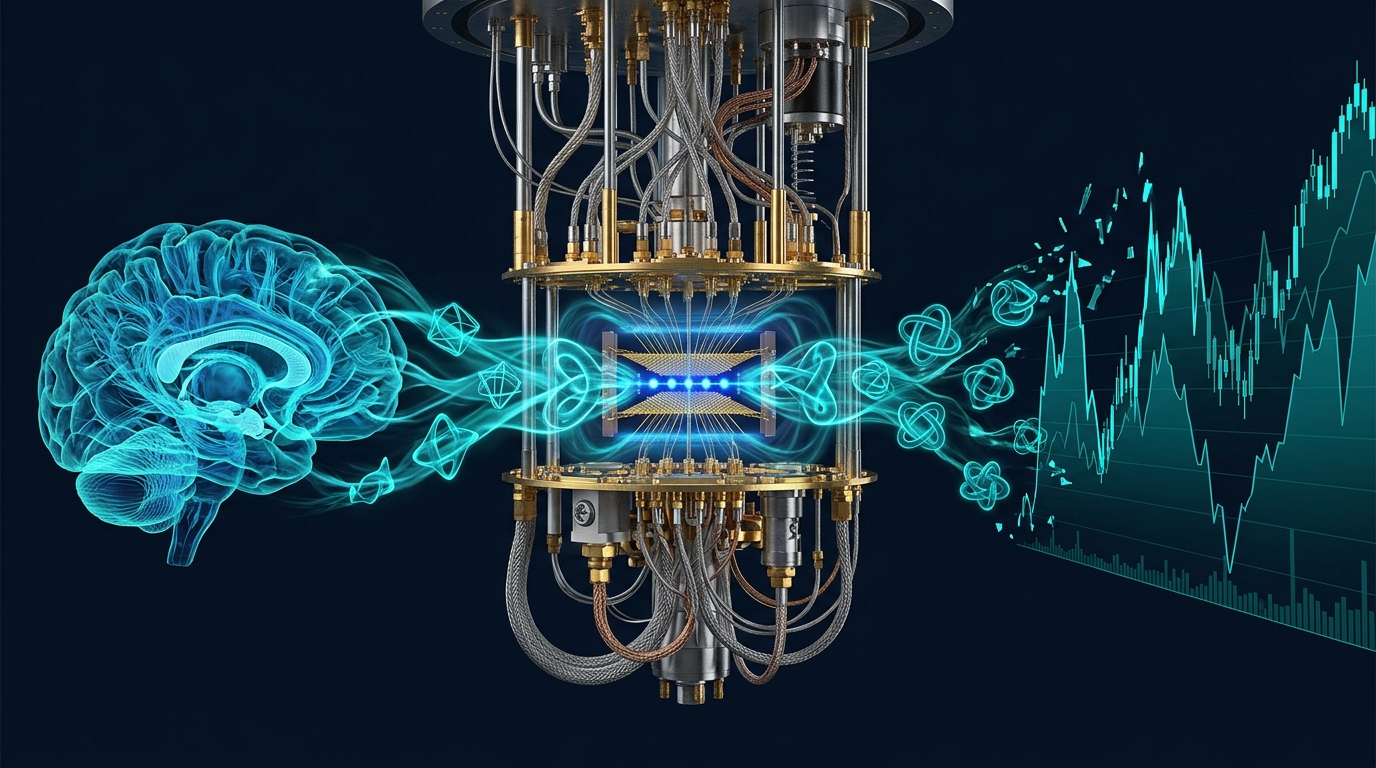
The same mathematical structures that separate quantum from classical computing—magic states—are now being used to extract hidden shapes from brain scans and financial data. On July 29, 2026, two papers landed on the arXiv and in the journal Quantum that, together, close a critical gap in the race for practical quantum advantage. One presents a quantum algorithm for topological data analysis (TDA) that uses low-order moments of the combinatorial Laplacian to classify fMRI scans and detect market instability. The other establishes the first quantitative lower bound on stabilizer fidelity as a function of stabilizer rank, pinning down exactly how many magic states a quantum circuit needs to outperform classical computers. [arXiv:2607.27206]
The timing is not coincidental: the TDA algorithm’s real-world viability hinges on consuming precisely the kind of non-Clifford resources that the second paper quantifies. This matters because, until now, quantum TDA proposals focused on exact Betti number estimation, making the regime for practical quantum advantage appear narrow. By reframing TDA as a feature-extraction method that relies on low-order spectral moments, and by simultaneously bounding the magic-state cost of any circuit that could deliver a quantum speedup, the two works define a concrete path from NISQ hardware to industrially relevant data analysis.
How It Works
Classical topological data analysis computes Betti numbers—counts of holes and voids in data—to reveal its shape. But for high-dimensional features, the classical cost explodes. The quantum algorithm sidesteps this bottleneck by estimating low-order spectral moments of the combinatorial Laplacian, a matrix that encodes the connectivity of a simplicial complex built from the data. The paper’s central finding: “low-order moments, including the relative trace, are strongly correlated with high-dimensional Betti information, even when the relative Betti number is small.” In other words, you don’t need to compute the full Betti numbers; a few moments carry enough topological signal for classification tasks.
The algorithm uses a moment-based quantum circuit that can run on near-term devices. It prepares a mixed state whose expectation values yield the desired moments, then feeds those moments into a classical machine-learning pipeline. The experimental demonstration on a Barium development system—similar to the forthcoming IonQ Tempo line—extracted Laplacian-derived observables from graph instances and quantitatively compared them with exact Betti information, confirming the strong correlation.
But achieving a quantum speedup requires non-Clifford gates, specifically T gates that inject magic states. This is where the stabilizer rank paper becomes essential. In 2024, Kliuchnikov and Schönnenbeck showed a connection between Barnes Wall lattices, stabilizer states, and Clifford operations. The new work extends that link to prove a lower bound: the approximate stabilizer rank of |H⟩⊗n scales as Ω(n log n), even when the fidelity between the approximation and the target state is exponentially small. That means any quantum circuit aiming to outperform classical simulation must consume a number of magic states that grows at least linearly with the number of qubits. For the TDA algorithm, this translates into a concrete resource requirement: the circuit depth and magic-state distillation overhead are now bounded from below, giving hardware designers a clear target.
Who’s Moving
IonQ (NYSE: IONQ) is the primary hardware player. The TDA experiments ran on a Barium development system, a trapped-ion architecture that uses barium qubits for long coherence times and all-to-all connectivity. IonQ’s forthcoming Tempo line, expected in 2026, will offer 64 algorithmic qubits with high fidelity—enough to run the moment-based algorithm on real-world datasets. Chris Monroe, co-founder and chief scientist at IonQ, has long championed trapped ions as the platform for early quantum advantage in machine learning.
IBM (NYSE: IBM) provides the superconducting contrast. Its 1,121-qubit Condor processor, unveiled in 2023, emphasizes qubit count over gate fidelity, but the TDA algorithm’s reliance on magic states favors platforms with lower error rates per T gate. Seth Lloyd of MIT pioneered the original quantum algorithms for Betti number estimation, and Robert Raussendorf of the University of British Columbia developed the magic-state injection model that underpins the stabilizer rank bounds. The quantum computing sector attracted $2.1 billion in venture funding in 2025, according to market analysts, fueling the hardware and software ecosystem that makes these algorithms testable today.
Why 2026 Is Different
In 2026, IonQ Tempo will make the moment-based quantum TDA algorithm executable on real hardware for the first time, with circuit depths that fall within the bounds set by the stabilizer rank lower bounds. Within 12 months, pharmaceutical companies and hedge funds will pilot quantum TDA for biomarker discovery in neurodegenerative disease and for volatility prediction in financial time series. In 3 years, hybrid quantum-classical pipelines that combine moment extraction with classical machine learning will become standard for high-dimensional feature extraction. In 5 years, quantum TDA will be a routine tool in data science, with the market for quantum computing in healthcare and finance reaching $8.6 billion by 2030, according to McKinsey.
In short: The quantum algorithm for topological data analysis extracts high-dimensional features from noisy data using moments that are provably hard to simulate classically, with magic-state resource bounds now quantified by stabilizer rank lower bounds.