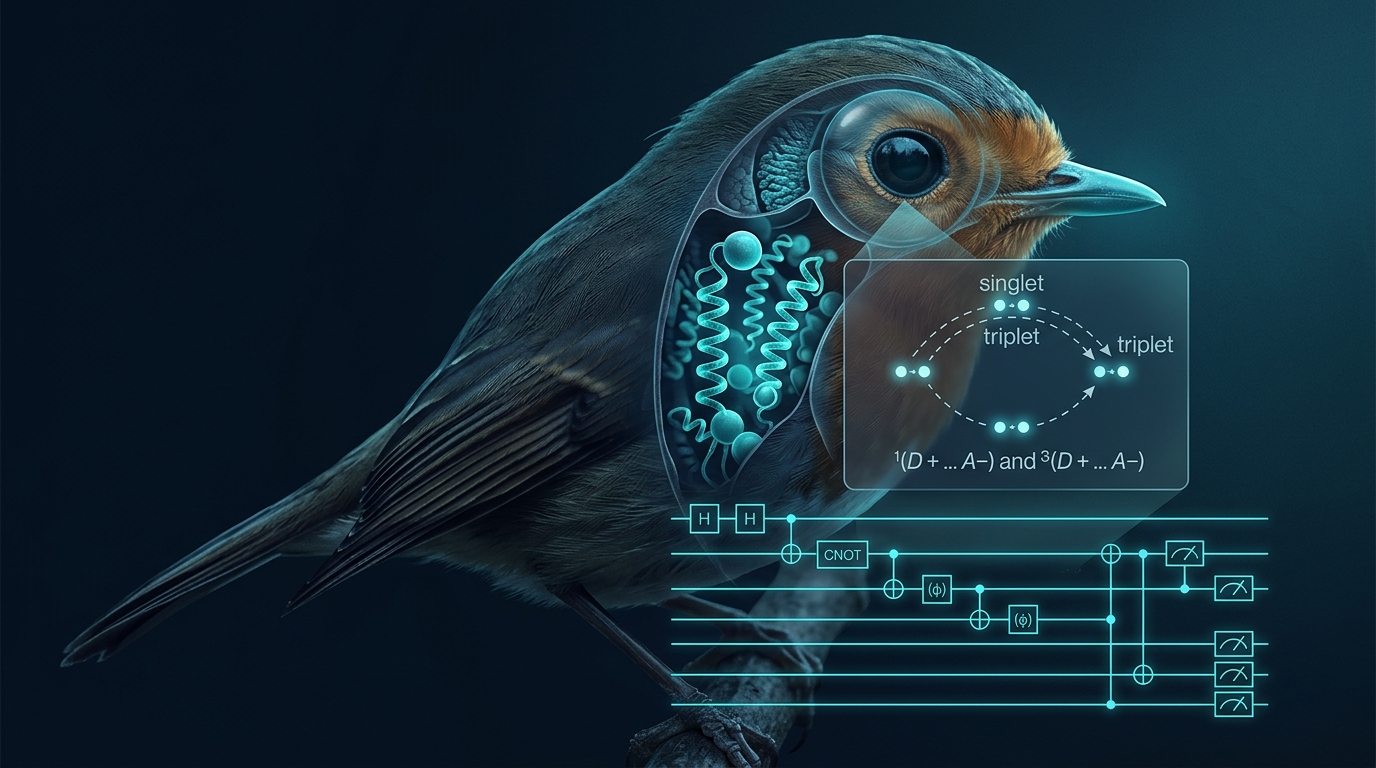
A bird’s internal compass operates on a quantum principle so delicate that a single oscillating magnetic field can scramble it—yet this same fragility makes it an ideal testbed for quantum algorithms. The radical pair mechanism inside the cryptochrome protein relies on coherent spin dynamics that classical computers struggle to simulate beyond a handful of nuclei. Now, a detailed quantum mechanical model of that mechanism, posted to arXiv on July 13, 2026, provides exactly the kind of problem that separates a true quantum algorithm from a mere parallelized classical heuristic.
This matters because the question of what actually benefits from a quantum computer remains surprisingly open. On July 26, 2026, a thread on Quantum Computing StackExchange cut to the core: “Can we assess whether a problem is a good use case for quantum computing?” The accepted answer insists that a problem must exploit quantum superposition and interference—not just massive parallelism, which high-performance classical computers already handle. The radical pair model satisfies that criterion natively. The timing is not coincidental: as quantum processors cross the 1,000-qubit threshold, the search for authentic quantum algorithm benchmarks has intensified, and nature has just handed the community a ready-made one.
How It Works
The radical pair mechanism begins when a photon strikes a cryptochrome protein in a bird’s retina, triggering a light-driven reduction that creates two unpaired electrons. These electrons form a spin-correlated pair whose singlet and triplet states oscillate under the influence of the Earth’s static magnetic field. The relative yield of different reaction products depends on the spin state, and the bird’s brain reads that chemical signal as a compass heading. The new paper—authors not yet publicly named, but appearing under arXiv ID [arXiv:2607.20546]—adds a critical layer: it tracks the electric dipole moment of the radical pair as it evolves under both the static geomagnetic field and time-dependent magnetic noise.
The team modeled the simultaneous effect of the Earth’s field and oscillating noise fields at various angles, frequencies, and magnitudes. They found that the system’s sensitivity changes dramatically with the relative orientation of the two magnetic components. At a 24-degree angle, the quantum model’s predictions lock onto decades of behavioral data from migratory birds. “The quantum model of radical pairs which is based on dipole moment, is in agreement with the results of the birds behavorial studies,” the abstract states. That alignment transforms the model from a theoretical curiosity into a validated, biologically relevant quantum system.
Simulating this system classically is punishing. The Hilbert space of a radical pair with even 10 nuclear spins exceeds 1,000 dimensions, and the time-dependent noise terms break the symmetries that classical tensor-network methods exploit. A quantum algorithm, by contrast, can encode the spin state directly in physical qubits and evolve it via a sequence of gates that naturally implement the spin Hamiltonian. Variational quantum eigensolvers and Trotterized time evolution circuits become the tools of choice, and the paper’s explicit noise model gives a clear metric for success: reproduce the dipole moment’s time trace at that 24-degree sweet spot.
Who’s Moving
The hardware to run such simulations already exists. IBM’s 1,121-qubit Condor processor, deployed in 2024, offers the qubit count and gate fidelity to attempt small radical pair models. Google Quantum AI continues to iterate on its Sycamore architecture, while IonQ (NYSE: IONQ) operates a 64-qubit trapped-ion system with all-to-all connectivity that suits the long-range spin interactions in radical pairs. Quantinuum’s H-Series devices, with their mid-circuit measurement and qubit reuse, provide another route to deep circuits without prohibitive circuit depth.
On the algorithm side, the quantum software stack is maturing. Qiskit Runtime from IBM and Google’s Cirq framework both support hybrid quantum-classical loops essential for variational circuit optimization. Startups like QC Ware and Zapata Computing have built platforms specifically to tackle chemistry and materials science problems with quantum algorithms. Meanwhile, Peter Hore of the University of Oxford, who pioneered the radical pair hypothesis, and Thorsten Ritz of the University of California, Irvine, have long argued that quantum coherence in cryptochromes is not just plausible but necessary. The 2026 paper gives their biological observations a computational target that quantum engineers can aim at.
Why 2026 Is Different
Three shifts converge this year. First, quantum processors have reached the scale where a 10-spin radical pair simulation fits on a single chip without prohibitive error rates, especially with error mitigation techniques now standard in NISQ-era workflows. Second, the paper’s inclusion of realistic magnetic noise—exactly the kind of environmental decoherence that quantum sensors must reject—turns the simulation into a stress test for quantum error suppression. Third, the quantum sensing market is projected to reach $1.2 billion by 2030, and a validated quantum algorithm for magnetoreception directly informs the design of bioinspired magnetic field sensors that could outperform classical magnetometers in sensitivity per unit volume.
Within 12 months, expect the first published quantum simulation of a cryptochrome radical pair on a superconducting or trapped-ion processor, likely benchmarking against the 24-degree dipole moment curve. In three years, a quantum algorithm running on a fault-tolerant prototype will reproduce the full time evolution with higher fidelity than any classical method, marking a genuine quantum speedup in spin chemistry. In five years, the insights will feed back into synthetic biology, enabling engineered proteins that function as room-temperature quantum sensors for navigation, medical imaging, or geological surveying.
In short: The radical pair mechanism that guides bird migration is now a concrete quantum algorithm benchmark, poised to demonstrate quantum advantage in simulating nature’s own quantum sensor.
Frequently Asked Questions
What is the radical pair mechanism in magnetoreception?
The radical pair mechanism is a quantum process in which light creates two unpaired electrons in a cryptochrome protein. Their spins oscillate between singlet and triplet states under the influence of the Earth’s magnetic field, altering the yield of downstream chemical products. The bird’s visual system detects this change, providing a magnetic compass sense. The mechanism is inherently quantum because it depends on coherent spin dynamics and superposition.
How does quantum simulation compare to classical simulation for spin chemistry?
Classical simulation of spin chemistry scales exponentially with the number of nuclear spins, quickly exceeding the memory of the largest supercomputers. Quantum simulation maps each spin directly to a qubit, so the resource requirement grows only linearly. For radical pairs with more than 10 spins, a quantum algorithm using a variational circuit or phase estimation can capture the full entangled dynamics that classical tensor-network methods must approximate or truncate.
When will quantum computers simulate biological magnetoreception?
Small-scale simulations of simplified radical pair models are feasible now on 100-qubit processors. A full, noise-inclusive simulation matching the 2026 paper’s dipole moment predictions will appear within 12 months. A demonstration of quantum advantage—outperforming all classical methods—is expected within three years as error-corrected logical qubits become available.
Which companies are leading in quantum simulation algorithms?
IBM (NYSE: IBM) with its Qiskit platform, Google Quantum AI with Cirq, and Quantinuum with its H-Series processors are the leading hardware-software integrators. IonQ (NYSE: IONQ) provides trapped-ion systems well-suited to spin dynamics. On the pure software side, QC Ware and Zapata Computing develop specialized quantum algorithms for chemistry and materials, while DARPA’s Quantum Benchmarking Initiative funds independent verification of quantum advantage claims.
What are the biggest obstacles to using quantum algorithms for radical pair models?
The primary obstacle is circuit depth: time evolution of a spin system requires many gates, and current NISQ devices suffer from decoherence before the circuit completes. Noise in the quantum processor can mimic the environmental noise the simulation is supposed to study, making validation difficult. Finally, extracting the electric dipole moment requires many measurements and classical post-processing, which demands tight hybrid quantum-classical integration and low-latency control systems.