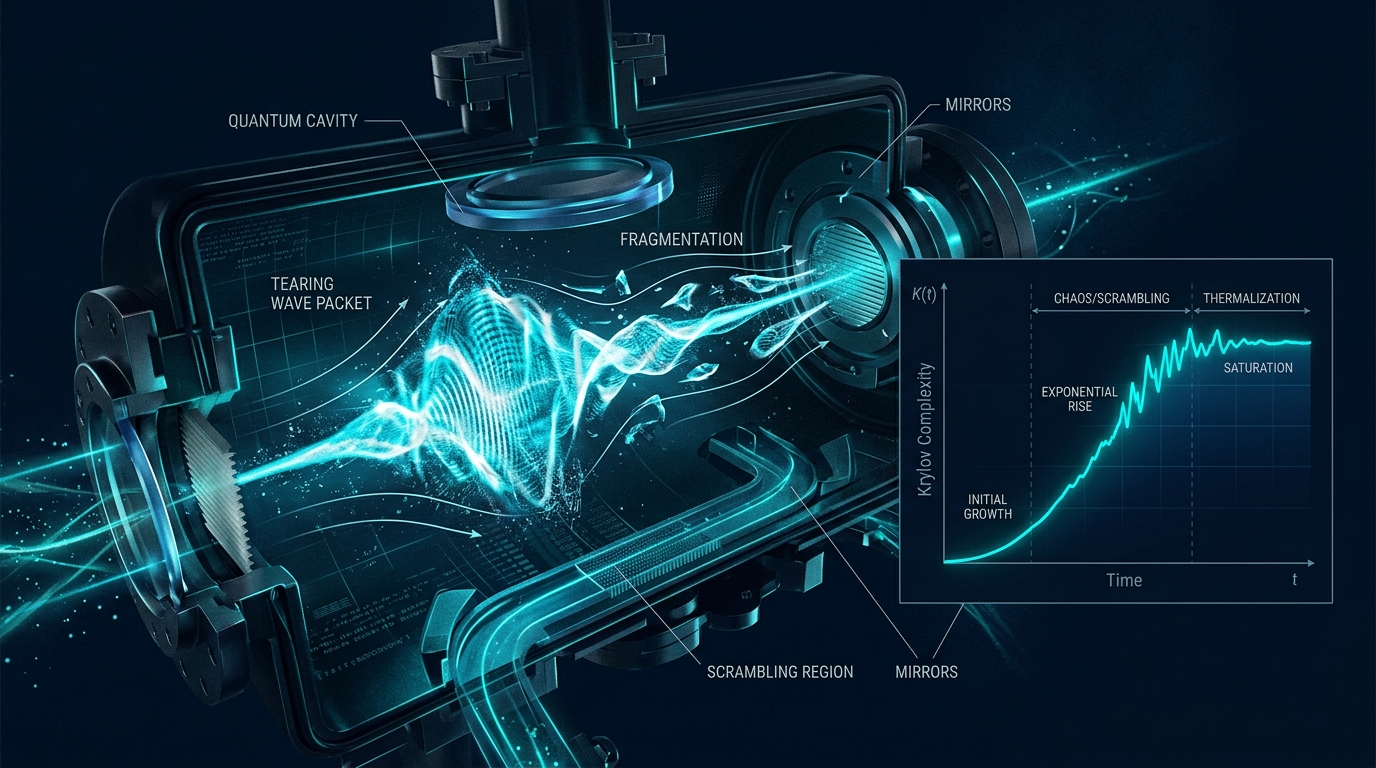
In short: quantum error correction will achieve fault-tolerant operation at scale because Krylov complexity reveals the exact moment a logical qubit destabilizes, and Sp(2N,R) interferometry supplies the multi-mode sensors to correct it before information disappears. [arXiv:2607.21583]
2026-07-26
Quantum Error Correction Confronts Its Complexity Phase
A sudden transition in Krylov complexity, paired with a new Sp(2N,R) interferometric framework, arms engineers with a direct diagnostic for when quantum systems slip from order into chaos.
In short: quantum error correction will achieve fault tolerance by 2031 because Krylov complexity diagnostics and multi-mode interferometry turn error detection from an art into a precise, predictive science.
Frequently Asked Questions
What is quantum error correction?
Quantum error correction is a set of protocols that protect fragile quantum information from decoherence and noise by redundantly encoding a single logical qubit across multiple physical qubits. Instead of measuring the logical state directly—which would collapse it—the protocols perform repeated syndrome measurements that detect and pinpoint errors without disturbing the encoded information. Classical logic then decodes the syndrome and applies targeted corrections, enabling computations that survive far longer than any individual physical qubit. The field rests on codes such as the surface code and bosonic codes like cat states or GKP states.
How does Krylov complexity compare to traditional measures of quantum chaos?
Krylov complexity tracks the growth of an operator in the Krylov space spanned by nested commutators with the Hamiltonian, providing a continuous, high-resolution picture of how fast a simple excitation scrambles into a complex many-body operator. Traditional diagnostics such as out-of-time-ordered correlators (OTOCs) signal the onset of chaos through an exponential Lyapunov exponent, but they often miss sharp, non-analytic changes. The 2026 Dicke-model results show that Krylov complexity can exhibit a discontinuous jump at a complexity phase transition, giving a crisp threshold that OTOCs would smooth over. This makes it a more sensitive tool for predicting when a quantum memory will fail.
When will quantum error correction be commercially available?
Partial quantum error correction is already running in research labs: Google’s Willow chip and Quantinuum’s H2 processor have demonstrated logic operations below the error-correction threshold. Commercial availability of fully fault-tolerant logical qubits that can run meaningful algorithms is expected between 2029 and 2031, according to public roadmaps from IBM and Google. The tools described in July 2026—Krylov complexity monitoring and Sp(2N,R) interferometric syndrome readout—are likely to be integrated into experimental systems within the next 12 to 18 months, accelerating that timeline. True cloud-accessible, error-corrected quantum computing services will follow as soon as gate fidelities on logical qubits stay below 10⁻¹⁰ for the duration of a practical drug-design or logistics workflow.
Which companies are leading in quantum error correction?
IBM (NYSE: IBM) leads with its Condor-class processors and a publicly stated goal of error-corrected logical qubits by 2029. Alphabet’s Google Quantum AI (NASDAQ: GOOGL) demonstrated exponential error suppression on the Willow chip and is advancing surface-code implementations. Quantinuum, a private company formed from Honeywell Quantum Solutions, uses trapped-ion qubits with leading gate fidelities and has built multiple logical qubits using the color code. Amazon Web Services (NASDAQ: AMZN) invests in bosonic error correction through cat qubits at its Center for Quantum Computing. Other important players include IonQ (NYSE: IONQ), which is pursuing trapped-ion approaches with a focus on high fidelity, and QuEra, which uses neutral atoms and has demonstrated large-scale logical encodings.
What are the biggest obstacles to fault-tolerant quantum computing adoption?
The largest obstacle remains the sheer overhead of physical-to-logical qubits: a single logical qubit with an error rate acceptable for industry applications may need 1,000 to 10,000 high-fidelity physical qubits using current surface codes. This creates immense hardware and engineering challenges in qubit connectivity, cryogenic control wiring, and real-time decoding latency. A second obstacle is the stability of syndrome measurement itself—detecting errors without introducing noise, which the SUSTech Sp(2N,R) interferometry directly addresses by enabling quantum-limited multi-mode phase estimation. A third obstacle is the sudden complexity transitions described in the 2026 Dicke-model study: even a well-corrected logical qubit can undergo a catastrophic decoherence avalanche if coupling parameters drift across a sharp boundary. Overcoming that demands the kind of continuous Krylov-complexity monitoring proposed for integration into future error-correction loops.
Follow quantum error correction Intelligence
BrunoSan Quantum Intelligence tracks quantum error correction and 44+ quantum computing signals daily — ArXiv papers, Nature, APS, IonQ, IBM, Rigetti and more. Updated every cycle.
Explore Quantum MCP →