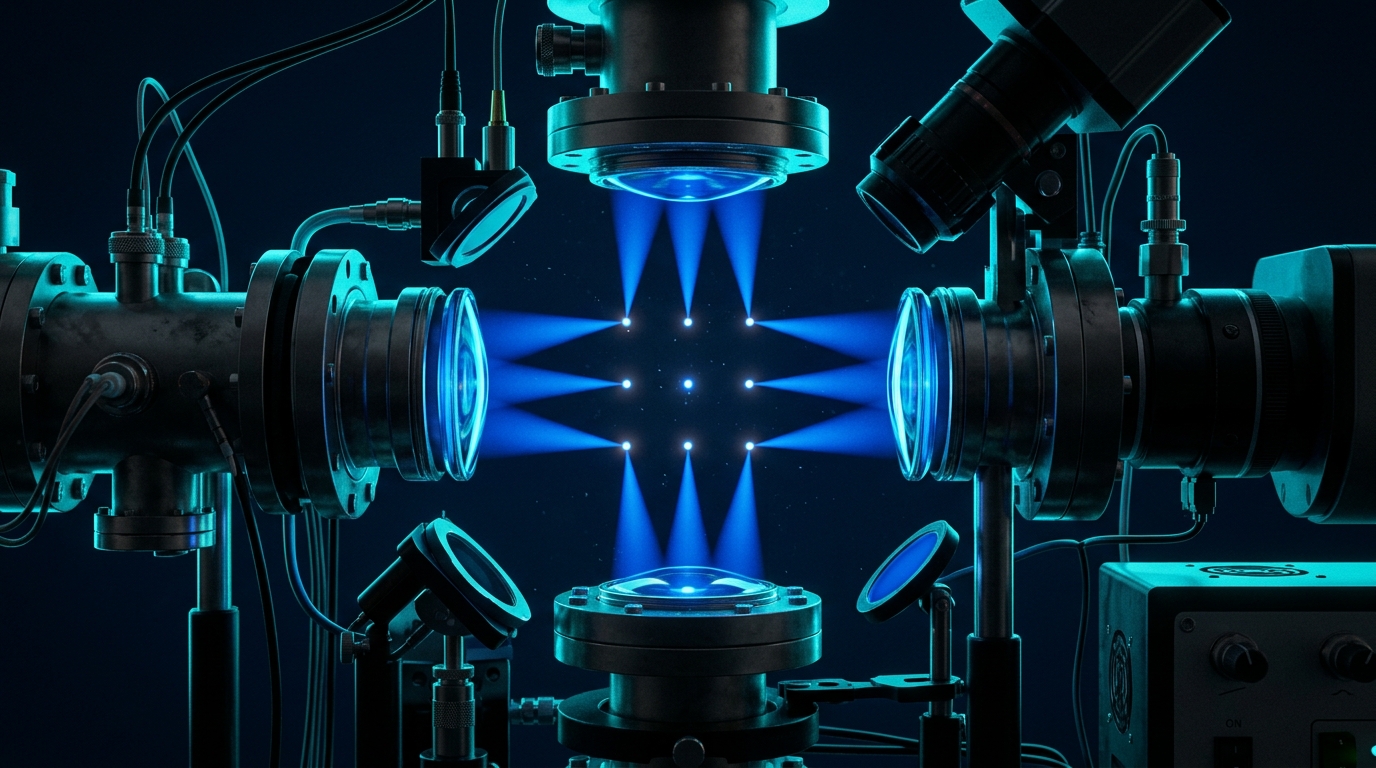
Taiyi Quantum, a Shanghai-based startup, has closed a RMB 300 million (approximately US$42 million) Pre-A financing round. The funding was co-led by Gaorong Ventures and IDG Capital, with participation from Huakong Fund, Yunqi Partners, Fortune Capital, Boyuan Capital, and SAIC Capital. The company is developing fault-tolerant quantum computers using ytterbium neutral atoms.
The round is one of the larger early-stage quantum hardware investments in China this year. Taiyi Quantum has not disclosed its valuation or specific technical milestones. The company states the capital will accelerate R&D on its neutral-atom platform and expand its team.
What They're Actually Building
Taiyi Quantum is building a quantum computer based on neutral ytterbium atoms. Neutral-atom quantum computing uses lasers—optical tweezers—to trap and manipulate individual atoms in a vacuum chamber. The atoms serve as qubits. Ytterbium is a two-valence-electron alkaline-earth-like atom, which gives it properties distinct from the alkali atoms (rubidium, cesium) used by most neutral-atom competitors.
The choice of ytterbium matters. It has a nuclear spin of 1/2, which provides a long-lived, decoherence-resistant qubit encoding in the nuclear spin state. It also has a metastable clock state that can be used for high-fidelity readout and potentially for quantum error correction. QuEra Computing, the current leader in neutral-atom quantum computing, uses rubidium. Atom Computing, another major player, uses strontium. Taiyi's ytterbium approach is technically distinct and, if executed, could offer advantages in gate fidelity and qubit connectivity.
Taiyi Quantum has not publicly disclosed its qubit count, gate fidelities, or error rates. Without these numbers, the company's technical position is unverifiable. The current state of the art in neutral-atom computing is QuEra's 256-qubit machine, which has demonstrated logical qubits using quantum error correction. Atom Computing has demonstrated a 1,225-atom array. Any claim of competitiveness must be measured against these benchmarks.
Winners and Losers
The immediate competitive threat is to other neutral-atom companies seeking capital. Taiyi Quantum's raise, backed by tier-1 Chinese VCs, signals that investors see room for multiple winners in the neutral-atom approach. QuEra and Atom Computing now face a well-funded entrant in the Chinese market, which operates under different export controls and government procurement dynamics.
IonQ and Quantinuum, which use trapped-ion architectures, are not directly threatened by this specific announcement. Their technology is more mature, with IonQ deploying systems on AWS, Azure, and Google Cloud, and Quantinuum achieving 99.8% two-qubit gate fidelity on its H2 processor. However, neutral-atom platforms are gaining ground. If Taiyi Quantum can demonstrate rapid scaling—a known advantage of neutral-atom systems—it could pressure trapped-ion companies on qubit count and cost per qubit.
The ecosystem beneficiaries are clear: laser manufacturers, vacuum system suppliers, and quantum software companies. More neutral-atom platforms mean more demand for the specialized components these systems require. For quantum cloud providers, a new Chinese neutral-atom backend could diversify the hardware options available to users, though geopolitical restrictions may limit access outside China.
The Bigger Picture
This deal fits into a pattern of accelerating quantum hardware investment in China. In 2025, Origin Quantum, a superconducting qubit company, raised a $150 million Series B. Baidu's Quantum Institute continues to develop its Qian Shi platform. The Chinese government has identified quantum computing as a strategic priority under its 14th Five-Year Plan, with reported state investment exceeding $15 billion across quantum technologies.
Globally, neutral-atom computing is attracting significant capital. QuEra raised $230 million in a 2024 round led by Google. Atom Computing secured $100 million in 2023. The neutral-atom approach is seen as promising because it offers high qubit counts with relatively simple fabrication—no lithography, no cryogenics for the atoms themselves—and inherent scalability through spatial light modulators that can generate thousands of optical traps.
The key technical challenge for all neutral-atom companies is gate fidelity. Trapping atoms is relatively easy. Performing high-fidelity two-qubit gates on them is hard. The Rydberg blockade mechanism used for entanglement introduces errors from laser intensity noise, atomic motion, and blackbody radiation. Taiyi Quantum's ytterbium platform will need to demonstrate two-qubit gate fidelities above 99.5% to be competitive. No public data confirms they are there yet.
The Signal
The signal here is that neutral-atom quantum computing is attracting serious, diversified investment across geographies. Taiyi Quantum's $42 million Pre-A round is not, by itself, a technical milestone. It is a financial event. The company has not disclosed qubit counts, gate fidelities, or a roadmap with dates. Until it does, this announcement is a funding signal, not a technical signal. The specific milestone that would validate Taiyi Quantum's claim to competitiveness is a demonstration of 100+ qubits with two-qubit gate fidelities exceeding 99.5% and a published error correction cycle. That is the bar QuEra has set. Taiyi Quantum has not yet cleared it.
In short: Taiyi Quantum's $42 million Pre-A round signals investor appetite for neutral-atom quantum computing in China, but the company has yet to disclose the technical milestones that would place it alongside QuEra or Atom Computing.
FAQ
Q: What does Taiyi Quantum do?
Taiyi Quantum is a Shanghai-based company building fault-tolerant quantum computers using ytterbium neutral atoms. Neutral-atom qubits are trapped by laser tweezers in a vacuum and manipulated via Rydberg excitation to perform quantum gates. The company's Pre-A funding will support R&D and team expansion. No public technical benchmarks are available as of July 2026.
Q: How does ytterbium neutral-atom computing compare to rubidium or strontium?
Ytterbium offers a nuclear spin-1/2 qubit with long coherence times and a metastable clock state for high-fidelity readout. Rubidium, used by QuEra, is simpler to work with but lacks the nuclear spin degree of freedom. Strontium, used by Atom Computing, also has nuclear spin and clock transitions. Ytterbium's two-valence-electron structure provides more spectral lines for cooling and state manipulation, potentially enabling higher gate fidelities, but it requires more complex laser systems.
Q: Is quantum computing ready for enterprise use?
No. As of mid-2026, no quantum computer has demonstrated a clear, commercially relevant advantage over classical computers for a real-world problem. Systems from IBM, Google, IonQ, and QuEra are used for research and algorithm development. Logical qubits—error-corrected qubits that can run deep circuits—remain an active research target. Enterprise adoption is years away, with most estimates pointing to the 2030s for fault-tolerant systems capable of running commercially valuable algorithms.
Q: What is Taiyi Quantum's business model?
Taiyi Quantum has not publicly detailed its commercial strategy. The standard model for quantum hardware companies is to provide cloud access to their systems, either directly or through partners like AWS or Alibaba Cloud. Some companies also sell on-premises systems to research institutions and national labs. Given the Chinese market's structure, Taiyi Quantum may prioritize government and state-owned enterprise contracts before pursuing international cloud deployment.
Q: What quantum computing milestones matter most in 2026?
The key milestones are: (1) demonstration of logical qubits with error rates below the physical qubit threshold, (2) scaling to 1,000+ physical qubits with high fidelity, (3) execution of a quantum algorithm that outperforms classical methods on a problem of practical interest, and (4) deployment of quantum computers in production environments, not just research labs. QuEra, Quantinuum, and IBM have all reported progress on logical qubits. No company has yet achieved a definitive quantum advantage for a commercially relevant problem.