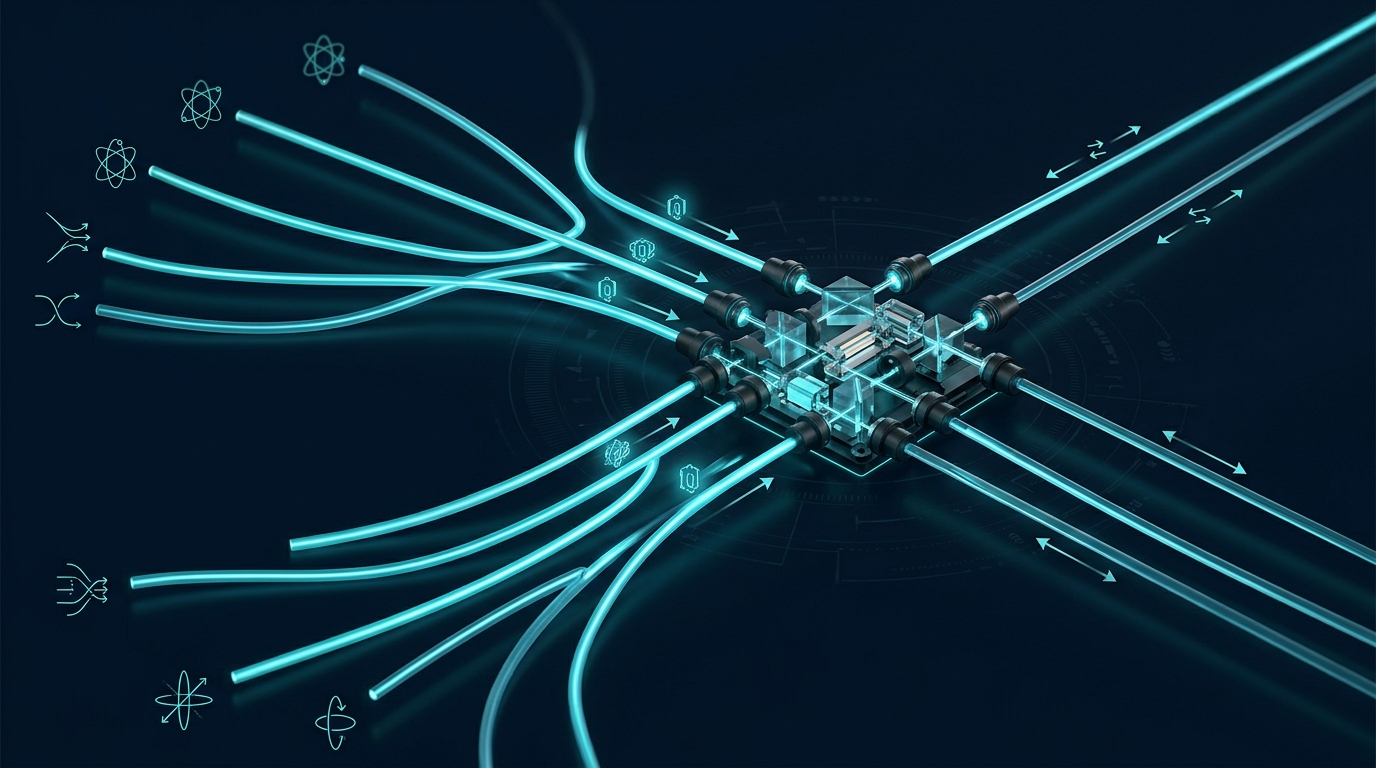
Researchers from NTT Inc. and the University of Tokyo have published a security proof that pushes the secure key fraction of quantum conference key agreement (QCKA) past the 20% threshold. The paper, posted to arXiv on July 5, 2026, demonstrates that introducing two-way classical communication in the post-processing phase lifts a known limitation that had constrained the efficiency of multi-party quantum-secured key distribution. No experimental demonstration accompanied the result.
What They’re Actually Building
QCKA allows three or more users to establish a shared, information-theoretically secure secret key over untrusted quantum and classical channels. It extends the point-to-point model of quantum key distribution (QKD) to the conference setting. Until now, the most efficient QCKA protocols using one-way classical reconciliation hit a hard ceiling: the secure key rate could not exceed 20% of the raw key rate under reasonable assumptions on noise and loss. The new work proves that two-way classical communication—where parties exchange additional error-correction data bidirectionally—can breach that bound.
The authors, led by Shun Kawakami of NTT Network Innovation Laboratories, formalize the security within the composable framework against general attacks. The advance matters because raw key material is precious in quantum networks; every percentage-point gain in the key fraction directly extends the reachable distance and the allowable number of participants. NTT already operates QKD testbeds in Japan and has folded the two-way protocol into its broader quantum-networking toolkit.
Winners and Losers
NTT (9432.T) strengthens its position as a leading integrator of quantum-secure communications. Its competitors in the QKD space—Toshiba, ID Quantique, QuantumCTek—all have active multi-party key distribution research, but none have publicly demonstrated a similar two-way protocol overcoming the 20% bound. If the result is validated experimentally, operators building metropolitan quantum networks gain a more efficient primitive for secure teleconferencing, distributed-ledger consensus, and 6G backhaul encryption.
Classical conference-key solutions, including those based on public-key cryptography, are long-term losers as quantum threats advance, but the immediate impact is muted: QCKA remains a research-stage technology. Startups selling point-to-point QKD may face pressure to show a credible multi-party roadmap. On the ecosystem side, photonic-integration and single-photon-detector suppliers benefit from the increased complexity that two-way reconciliation imposes on hardware.
The Bigger Picture
Multi-party quantum cryptography is emerging as a distinct subfield alongside point-to-point QKD. Standards bodies such as the ITU-T and ETSI have begun preliminary work on group key agreement use cases. In 2025, a European consortium including Thales and the University of Geneva demonstrated a three-user QCKA over 50 km of deployed fiber, but with a secure key fraction below 15%. The NTT result suggests that two-way classical communication can economically reclaim margin that would otherwise force shorter links or fewer parties.
Japan’s Quantum Leap Flagship Program has targeted a quantum-secure network backbone by 2028. NTT’s IOWN (Innovative Optical and Wireless Network) concept, which envisions photonics-based computing and communication, aligns with integrating such protocols. The paper arrives as venture investment in quantum-networking startups, while still modest compared to quantum computing, is growing: $320M was deployed globally in 2025 across 14 deals, according to PitchBook.
The Signal
This is a genuine theoretical step, not a PR exercise. The 20% ceiling was widely accepted in the QCKA literature as a fundamental limit for one-way reconciliation, analogous to the 11% secret-fraction bound in continuous-variable QKD before two-way techniques were introduced there. Breaking it with a rigorous, composable security proof opens the design space for real-world implementations. The signal is that QCKA is shedding its dependence on idealized one-way post-processing and maturing toward deployable protocols. The next necessary milestone: an experimental demonstration over deployed fiber that holds the key rate above the 20% floor.
“By adding two-way classical communication, the NTT team proved QCKA secure key rates can exceed the 20% bound, a step toward practical multi-user quantum networks.”
In short: Quantum conference key agreement moves beyond a 20% efficiency ceiling, thanks to a new security proof from NTT and the University of Tokyo that exploits two-way classical channels.