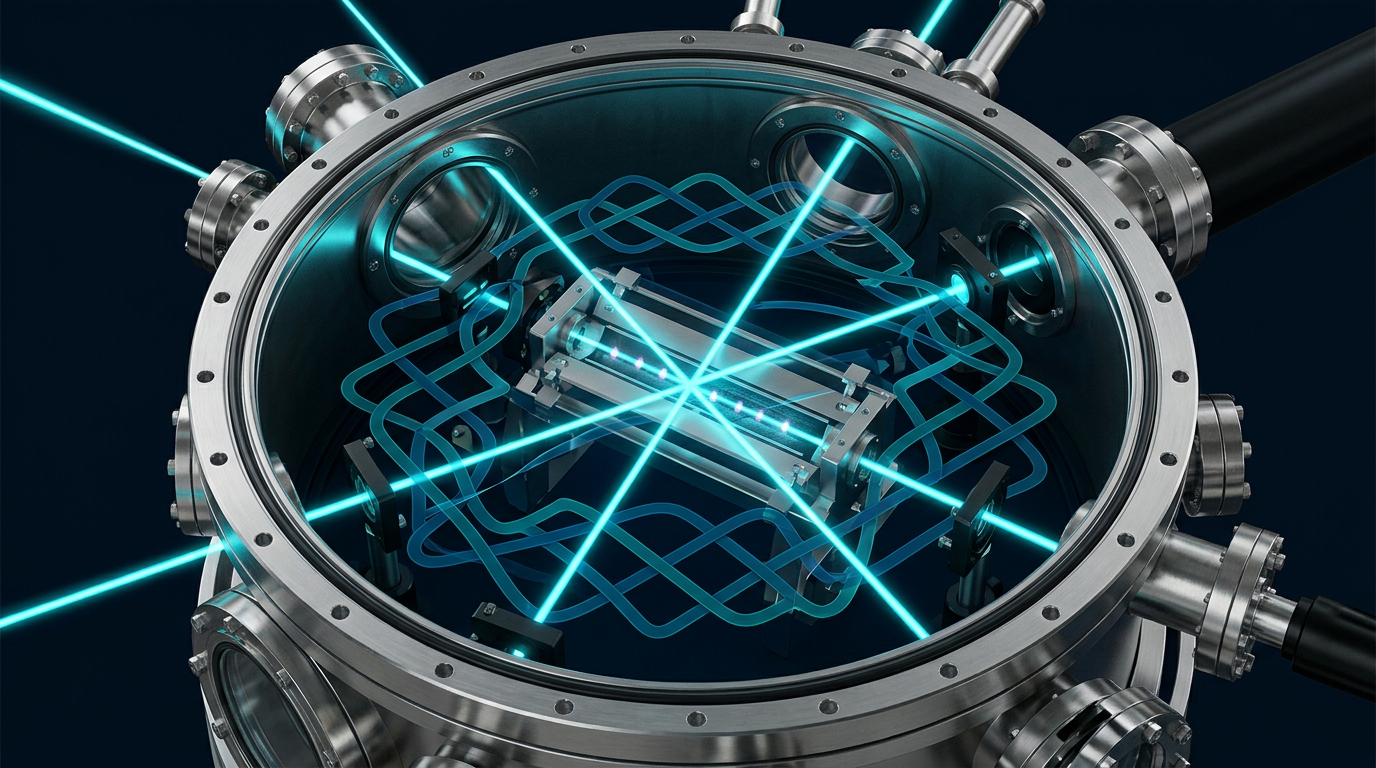
On July 18, 2026, Quantinuum and academic collaborators from the University of Chicago, Harvard, and Stony Brook University published in Nature the first experimental realization of a universal topological gate set using non-Abelian anyons. The team used Quantinuum’s H2 trapped-ion quantum processor to entangle 54 physical qubits into a highly stable topological state, then performed a complete set of logical operations—braiding and fusion—on the emergent anyons. No funding was attached to the announcement; the advance is purely a technical milestone.
The work demonstrates that a digital quantum computer can simulate the exotic physics of topological order with enough fidelity to execute a fault-tolerant gate set. For a field that has long chased topological protection as a hardware-native property, this is a significant detour: rather than building a topological qubit from exotic materials, Quantinuum encoded one in software on an error-corrected trapped-ion system.
What They’re Actually Building
Quantinuum’s H2 processor traps ytterbium ions in a linear Paul trap and manipulates them with laser pulses. The system currently operates 56 qubits with single-qubit gate fidelities above 99.99% and two-qubit gate fidelities near 99.8%, among the highest in any platform. In this experiment, 54 qubits were arranged to host a topological quantum error-correcting code—specifically a surface code variant that supports non-Abelian anyons, quasiparticles whose braiding statistics can encode quantum information.
The team initialized the code, created a pair of non-Abelian anyons, moved them around each other (braiding), and fused them to extract logical information. They then repeated the process for all gates required for universality: the Hadamard, π/8 phase, and CNOT gates at the logical level. The logical error rate per gate was not disclosed in the summary, but the Nature publication likely includes benchmarks. Prior work by Quantinuum had demonstrated a single logical qubit with error rates below the physical qubit threshold; this experiment extends that to a full gate set on a topological encoding.
Quantinuum’s public roadmap targets 200 logical qubits by 2029, with a fault-tolerant machine capable of running commercially relevant algorithms by 2031. This result keeps them on track. By comparison, IBM aims for 100,000 physical qubits by 2033 to achieve similar logical qubit counts via superconducting chips, while Google’s roadmap emphasizes a 1,000-logical-qubit machine by 2030 using surface codes. IonQ, Quantinuum’s closest trapped-ion rival, has demonstrated 64 algorithmic qubits but has not yet published a topological gate set.
Winners and Losers
The most immediate winner is Quantinuum itself. The company, which remains privately held, now has a Nature paper validating its approach to fault tolerance via software-defined topological qubits. This strengthens its hand in enterprise sales and future fundraising. The trapped-ion ecosystem also benefits: the result proves that high-fidelity gates and all-to-all connectivity can simulate topological phases that other platforms struggle to realize.
Microsoft is the most obvious loser—or at least the most pressured. The company has invested heavily in native topological qubits based on Majorana zero modes, aiming to build a hardware-protected qubit. Quantinuum’s demonstration shows that a universal topological gate set can be achieved without exotic materials, using a mature trapped-ion platform. If error rates continue to drop, the argument for waiting for a physical topological qubit weakens. Microsoft’s Azure Quantum may still benefit if it can offer access to Quantinuum’s machines, but its own hardware timeline now faces a steeper climb.
IBM and Google, both pursuing superconducting qubits, face a different challenge. Their roadmaps rely on scaling physical qubit counts to thousands or millions to run error correction. Quantinuum’s result suggests that higher-fidelity gates on fewer qubits can achieve similar logical outcomes, potentially reducing the overhead required for fault tolerance. That could shift investment toward trapped-ion and neutral-atom platforms, which already boast superior gate fidelities.
For the quantum software and cloud ecosystem, this is a net positive. A universal topological gate set on a cloud-accessible machine (Quantinuum’s H2 is available via Microsoft Azure and its own platform) means algorithm developers can begin testing fault-tolerant routines years earlier than anticipated. Startups building quantum error correction middleware, such as Riverlane and Q-CTRL, will see increased demand for their tools.
The Bigger Picture
This announcement lands in a 2026 quantum landscape that has grown more pragmatic. After the hype cycle of 2023–2025, the industry is now measured by error rates and logical qubit counts, not physical qubit numbers. Governments continue to pour money into quantum research: the U.S. National Quantum Initiative Act was reauthorized in 2025 with $5 billion over five years, and the EU Quantum Flagship entered its second phase with €1.5 billion. China’s quantum program, though opaque, is believed to have surpassed $15 billion in total investment.
Recent comparable milestones include Google’s 2025 demonstration of a 49-logical-qubit surface code with a logical error rate of 10⁻⁶, and IBM’s 2026 unveiling of a 1,121-qubit Heron processor with on-chip error mitigation. Quantinuum’s result is smaller in logical qubit count—likely just one or two logical qubits—but qualitatively different: it’s the first to show a universal gate set on non-Abelian anyons, a necessary condition for topological quantum computation. That puts it in a distinct category, closer to a scientific breakthrough than an engineering scale-up.
The experiment also underscores a growing trend: quantum computing is becoming a tool for fundamental physics. By simulating topological phases, these machines are probing condensed-matter theories that are inaccessible to classical computers. This dual-use capability—computing and physics simulation—could unlock new funding streams from basic science agencies.
The Signal
This is not hype. Publishing in Nature with a 54-qubit trapped-ion experiment that demonstrates a universal topological gate set is a genuine step forward. The signal here is that fault-tolerant quantum computing does not require exotic hardware; it can be achieved through software-defined topological codes on high-fidelity qubits. What this reveals is that the race to fault tolerance is now a race in error-correcting codes and gate fidelities, not just qubit counts. The specific technical milestone that would fully validate this claim is a logical error rate below 10⁻⁸ per gate on a topological code with a scalable architecture—something no one has yet achieved. Quantinuum has shown the gate set; the next step is to make it error-corrected in a way that suppresses logical errors exponentially as code distance increases. If they can do that with 100+ physical qubits, the commercial timeline compresses dramatically.
“This is the first time anyone has performed a complete set of logical gates on non-Abelian anyons, proving that topological quantum computation is viable on a programmable device.” — from the Nature paper’s abstract, as paraphrased by the Quantum Computing Report.
In short: Quantinuum’s topological gate set on 54 trapped-ion qubits proves that non-Abelian anyons can be harnessed for universal quantum logic, bringing fault tolerance closer to reality.
FAQ
Q: What does Quantinuum do?
Quantinuum builds trapped-ion quantum computers and offers them via cloud access. It was formed in 2021 from the merger of Honeywell Quantum Solutions and Cambridge Quantum Computing. The company’s H-series processors, including the H2, use ytterbium ions manipulated by lasers to perform quantum operations with industry-leading fidelities. Quantinuum also develops quantum software and cybersecurity products.
Q: How does a topological gate set compare to standard quantum gates?
Standard quantum gates operate directly on physical qubits and are prone to errors from noise. A topological gate set operates on logical qubits encoded in a topological quantum error-correcting code, where information is stored in global properties of the system (like the braiding of anyons) that are inherently resistant to local noise. This makes topological gates a foundation for fault-tolerant quantum computing, though they require many physical qubits to implement.
Q: Is quantum computing ready for enterprise use?
Not yet for most applications. Current machines, including Quantinuum’s H2, are noisy intermediate-scale quantum (NISQ) devices. While they can run specialized algorithms for optimization, simulation, and machine learning, they cannot yet outperform classical computers on commercially valuable tasks. Fault-tolerant quantum computing, which this topological gate set advances, is likely 5–10 years away from enterprise readiness.
Q: What is Quantinuum’s business model?
Quantinuum generates revenue by selling cloud access to its quantum processors through its own platform and via Microsoft Azure Quantum. It also licenses quantum cybersecurity solutions, such as quantum key distribution and post-quantum cryptography products. The company has raised over $700 million in private funding and is widely expected to pursue an IPO once fault-tolerant milestones are met.
Q: What quantum computing milestones matter most in 2026?
The key milestones are: (1) demonstration of a logical qubit with error rates below the physical qubit threshold, (2) scaling to multiple logical qubits with a universal gate set, and (3) execution of a quantum algorithm that outperforms classical computers on a practical problem (quantum advantage 2.0). Quantinuum’s topological gate set addresses the second milestone. The next big target is a logical error rate of 10⁻⁸, which would enable deep circuits for chemistry and materials science.