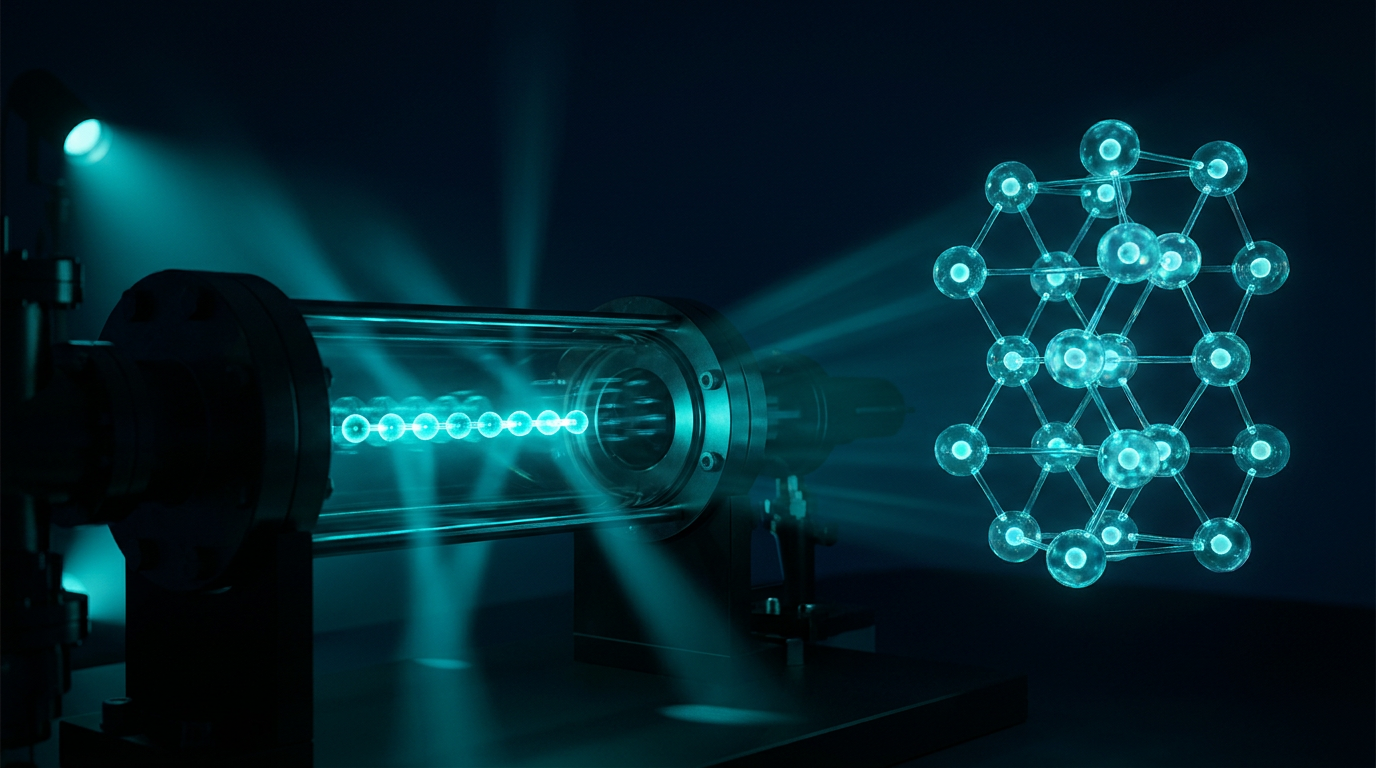
Two papers landed within sixteen days of each other in summer 2026, and together they redraw the line between what classical supercomputers do best and what a quantum algorithm should eventually do better. Both target the same physics: preparing quantum systems in thermal equilibrium, the so-called Gibbs state that describes a hot cup of coffee at the atomic scale. The first paper sharpens a classical algorithm that already gets the answer right. The second paper asks a quantum computer to do the same job, and finds the hardware only partly cooperates.
The timing is not coincidental. Computing Gibbs states for interacting quantum systems is a stubborn problem. Classical methods such as path integral Monte Carlo scale poorly with the number of particles and with how strongly those particles interact, while quantum hardware lacks the circuit depth to reach thermal equilibrium from scratch. The June 2026 arXiv preprint, paper [arXiv:2607.08787], proposes a Brownian bridge sampler for coherent-state path integral Monte Carlo, a classical algorithm that becomes numerically exact for bosonic fluids like helium-4. Sixteen days later, Quantum Zeitgeist reports that researchers at IonQ used a variational quantum algorithm on trapped-ion hardware to prepare Gibbs states for the transverse-field Ising model, training circuit parameters in classical simulation and verifying the output with state tomography. This matters because both efforts now converge on the same benchmark problem. The classical algorithm defines the target. The quantum algorithm defines the gap.
How It Works
Path integral Monte Carlo Quantum Monte Carlo treats a quantum particle as a ringlet of classical copies, linked end-to-end by a chain that wiggles randomly through a thermal bath. For a fluid of identical bosons such as helium-4, the coherent-state formulation handles particle permutations cleanly and produces numerically exact thermodynamics at finite temperature. The new work, posted to arXiv on 26 June 2026, introduces a Brownian bridge that ties the ringlet's endpoints together more tightly. The construction reduces the variance of the Monte Carlo estimator, which lets the simulation reach lower temperatures without exploding in compute cost.
"We apply it to the numerically exact calculation of the thermodynamic properties of the Helium fluid on a plane at low non zero temperature."
The IonQ experiment takes the opposite route. Instead of sampling a thermal distribution on classical hardware, the variational quantum algorithm encodes a Gibbs state directly on a trapped-ion processor Trapped Ion Quantum Computing. The team chose a transverse-field Ising model, a chain of spins where each spin wants to align with its neighbors but is tugged sideways by a magnetic field, and used a parameterized quantum circuit, the workhorse of NISQ-era hybrid quantum classical computation, to approximate the thermal state. A classical optimizer adjusted the circuit parameters in simulation, the parameters were uploaded to the IonQ machine, and state tomography measured the fidelity of the output. This is variational quantum algorithm design in its purest form: a shallow quantum ansatz steered by a classical loop, with quantum speedup expected only as system size grows.
Think of it as two teams racing the same hill on different vehicles: the classical side has a road bike with continuously improving tires, while the quantum algorithm team has a four-wheel-drive prototype that handles rough terrain better but lacks the cadence on smooth pavement.
Who's Moving
IonQ (NYSE: IONQ) is the lead commercial actor in the variational quantum algorithm demonstration. The company operates the IonQ Forte and IonQ Tempo systems, both trapped-ion platforms with all-to-all qubit connectivity, a feature superconducting systems struggle to match. IonQ is one of the few publicly traded pure-play quantum hardware vendors in the United States, alongside Rigetti Computing (NASDAQ: RGTI) and D-Wave Quantum (NYSE: QBTS). Major competitors in the broader hardware race include International Business Machines Corporation (NYSE: IBM) with its 1,121-qubit Condor processor and Heron r2 chip, Alphabet Inc.'s (NASDAQ: GOOGL) Google Quantum AI lab, and Quantinuum, the Honeywell-controlled trapped-ion venture that launched its H2 system in 2024. The classical benchmark comes from the arXiv preprint's authors, whose institutional affiliation is recorded in the paper metadata. The IonQ quantum algorithm implementation was carried out by IonQ's research team in collaboration with external academic partners, a structure that has become standard for the sector.
Why 2026 Is Different
The classical algorithm now sets the bar that quantum hardware must clear. The transverse-field Ising model in the IonQ experiment is small enough, roughly ten to twenty qubits, that classical exact diagonalization still wins on fidelity. The helium simulation in the arXiv paper is small enough, tens of atoms, that path integral Monte Carlo converges in hours on a workstation. Quantum advantage in this regime will not arrive in 2026. Within 12 months, error-corrected logical qubits Quantum Error Correction and longer circuit depth will push the variational quantum algorithm into the 30-to-50 qubit range. Within three years, fault-tolerant trapped-ion systems with hundreds of physical qubits will compete with classical methods on problems of genuine industrial interest, such as the thermal properties of high-temperature superconductors. Within five years, the first commercial quantum advantage claims for finite-temperature simulation will likely emerge from a combination of hardware improvements and better variational ansätze. The global quantum software market is projected by multiple analyst firms to exceed $4 billion in annual revenue by 2030, with thermal simulation among the earliest commercial use cases.
In short: a 2026 quantum algorithm run on IonQ trapped-ion hardware now benchmarks against a new classical Monte Carlo refinement for bosonic thermal states, with the contest opening at 30 qubits.
Frequently Asked Questions
What is a Gibbs state? A Gibbs state is the quantum mechanical description of a physical system in thermal equilibrium with a heat bath at a given temperature. It assigns probabilities to energy eigenstates according to the Boltzmann factor, with lower-energy states being more likely. For a system of N interacting quantum particles, computing the Gibbs state exactly is exponentially hard in N, which is why both classical Monte Carlo and the variational quantum algorithm target it. The Gibbs state is the starting point for nearly every thermodynamic calculation in chemistry and condensed matter physics.
How does path integral Monte Carlo compare to variational quantum algorithms? Path integral Monte Carlo is a classical stochastic method that becomes numerically exact for bosons at finite temperature, with compute cost that scales roughly as the cube of the number of particles for simple fluids. Variational quantum algorithms are hybrid quantum classical methods that use a parameterized quantum circuit as an ansatz, optimized by a classical loop, and currently run on NISQ hardware with shallow circuit depth. PIMC wins on accuracy today. The quantum algorithm wins only when the system is large enough that classical sampling fails and the quantum circuit is deep enough to express the state.
When will quantum Gibbs state preparation be commercially useful? Industry timelines converge on the 2028 to 2030 window for the first useful demonstrations. IonQ's roadmap targets fault-tolerant systems with thousands of logical qubits by 2029. International Business Machines Corporation's quantum-centric supercomputing vision targets similar milestones. Useful commercial advantage in thermal simulation likely arrives a year or two after fault-tolerant milestones, putting the practical horizon at 2030 to 2032.
Which companies are leading in quantum Gibbs state preparation? IonQ leads in published variational quantum algorithm demonstrations on trapped-ion hardware. International Business Machines Corporation competes through superconducting systems and the Qiskit quantum software stack. Alphabet Inc.'s Google Quantum AI pursues both superconducting hardware and software via the Cirq framework. Quantinuum pursues trapped-ion hardware with the InQuanto chemistry platform. Smaller players include Rigetti Computing in superconducting hardware and Pasqal in neutral-atom systems.
What are the biggest obstacles to quantum Gibbs state preparation? Three obstacles dominate. First, circuit depth on current NISQ hardware caps the system size at roughly 20 to 30 qubits before noise overwhelms the signal. Second, the variational ansatz may not be expressive enough to approximate the true Gibbs state even on a perfect quantum computer running the quantum algorithm. Third, classical benchmarks such as the new Brownian-bridge path integral Monte Carlo are themselves improving, which raises the bar for any quantum advantage claim.