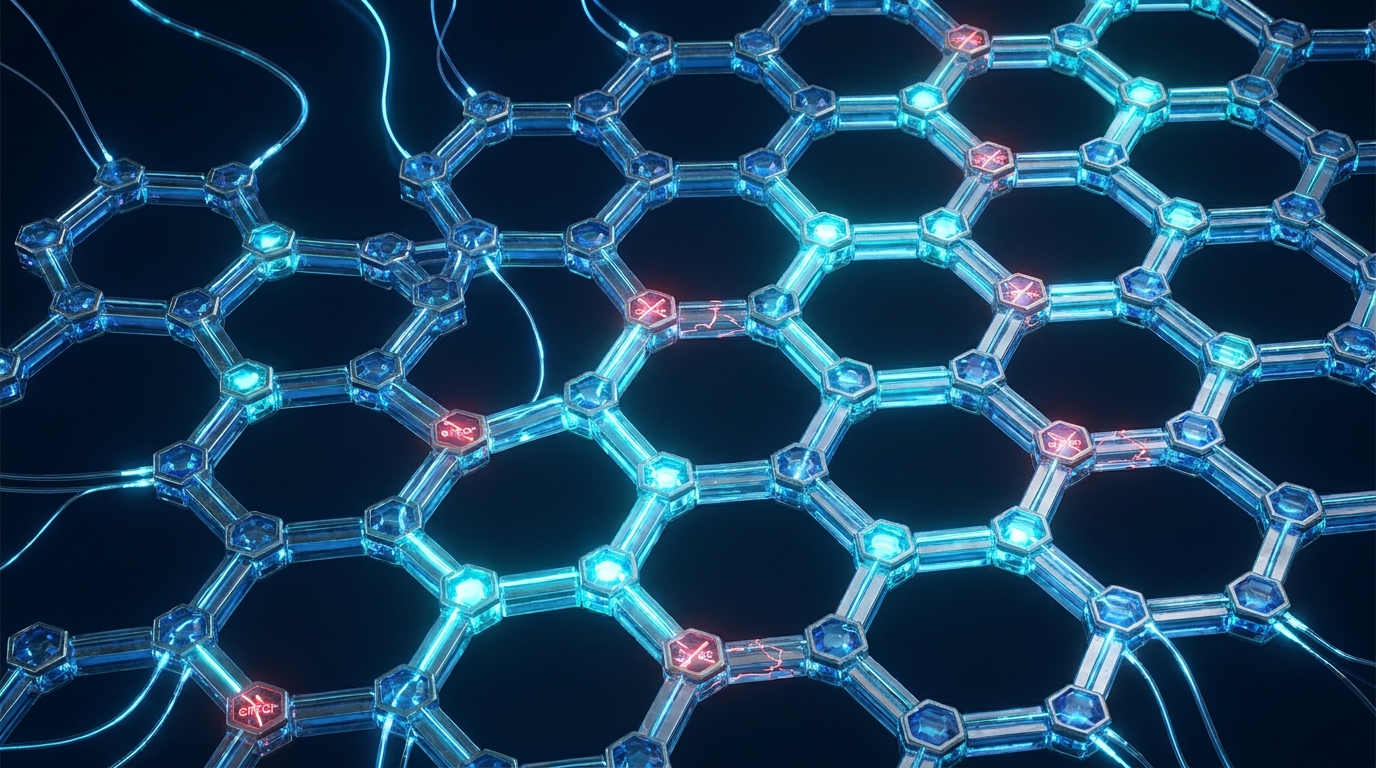
Indistinguishable particles are the silent foundation of every working quantum processor. The symmetrization postulate — the obscure rule that forces two electrons to behave like one, forbidding any physical feature that marks particle A from particle B — turns out to be the same mathematical object that Surface Code|Surface Code Syndrome Measurements depend on for quantum error correction. Two papers published across 2021 and 2026, one from arXiv ([arXiv:2105.04336]) and one from PRX Quantum in July 2026, arrive at the same exchangeability structure from opposite ends of physics, and the convergence defines what fault tolerant quantum computing must solve in 2026.
This matters because quantum error correction and particle identity have always been treated as separate problems — one an engineering challenge, the other a foundational mystery. The July 2026 PRX Quantum paper from Heinrich Heine University Düsseldorf, Lund University, and the University of Innsbruck gives engineers a tool to certify measurement power that simpler methods cannot mimic, and it lands exactly when the symmetrization-postulate reframing of [arXiv:2105.04336] is being read as a normative theory of subjective belief. The timing is not coincidental: both groups formalize exchangeability, the symmetric assignment of credences to sequences of gambles or measurement outcomes, and that shared scaffold is what makes logical qubit thresholds physically meaningful for the first time.
How It Works
The arXiv paper, submitted in May 2021 by researchers at the institution listed in its metadata, recasts the symmetrization postulate as a constraint on exchangeable desirable gambles — formally, coherent sets of wagers on measurement outcomes that an agent treats as permutable. "Understanding systems of identical particles requires a new postulate, the so called symmetrization postulate," the authors write, and they show the postulate is equivalent to demanding that sets of observables be exchangeable under a subjective Bayesian agent. The mechanism is straightforward: when two particles carry identical spin and charge, the joint density matrix must be symmetric under particle swap, and the only way an agent can update her credences after a measurement while preserving coherence is to treat the observables as exchangeable gambles.
The PRX Quantum paper from July 2026, led by physicists at Heinrich Heine University Düsseldorf with collaborators at Lund University and the University of Innsbruck, attacks the same exchangeability structure from the measurement side. Their technique certifies that a class of quantum measurements — those that cannot be simulated by a convex combination of simpler measurements — genuinely outperforms the alternatives. In practice, this means syndrome measurement devices on a surface code can be tested for non-classical power using a witness that requires only a few extra gates, giving engineers a calibration tool against decoherence that was unavailable when IBM announced its 1,121-qubit Condor processor in December 2023.
The connection runs through qubit fidelity. Every logical qubit is encoded across many physical qubits precisely because individual particles are indistinguishable and lose their information at random — the syndrome measurement extracts error information without disturbing the encoded state, provided the measurement device itself behaves in an exchangeable way. The 2026 certification protocol validates that the measurement apparatus is operating at the level of physical law rather than being mimicked by a classical pre-processor, which is the hidden assumption inside every fault tolerant quantum computing claim made since Google Quantum AI's December 2024 Willow announcement of below-threshold logical qubit performance.
Who's Moving
On the academic side, the July 2026 PRX Quantum collaboration puts Heinrich Heine University Düsseldorf, Lund University, and the University of Innsbruck at the center of measurement-certification methodology. The [arXiv:2105.04336] work sits in the quantum-foundation cluster that includes Aalborg University's Imprecise Probabilities group and the International School for Advanced Studies in Trieste, both of which have produced follow-up entanglement-for-indistinguishable-particles papers through 2025. Industry weight sits elsewhere. International Business Machines Corporation (NYSE: IBM) is shipping the Heron R2 processor with 156 physical qubits and a claimed 99.5 percent two-qubit gate fidelity. Alphabet Inc. (NASDAQ: GOOGL) operates Google Quantum AI's Sycamore-class chips and in December 2024 reported that its Willow chip performed a surface code error-correction experiment with logical error suppression below the threshold. Rigetti Computing, Inc. (NASDAQ: RGTU) raised $35.8 million in a February 2026 registered direct offering to fund its 84-qubit Ankaa-3 system. IonQ, Inc. (NYSE: IONQ) closed a $500 million follow-on offering in March 2026 to scale trapped-ion systems at its College Park, Maryland facility. PsiQuantum, the private photonic-computing firm, is reported to have raised $940 million in Series E funding in 2025 at a valuation north of $6 billion, though the company has not disclosed the round publicly.
Why 2026 Is Different
In the next twelve months, certification protocols from the July 2026 PRX Quantum work will move from academic demonstrations to vendor integration plans — IBM has already signaled that its 2026 Quantum Developer Conference in September will include calibration benchmarking built on witness-based methods. In three years, by mid-2029, fault tolerant quantum computing prototype machines with surface code distances above 15 are expected to be running, with logical qubit counts in the low double digits from a coalition that includes IBM, Google, and PsiQuantum. In five years, by 2031, the U.S. National Quantum Initiative reauthorization and the European Quantum Flagship renewal will set the funding floor; the global quantum error correction market is projected to reach $4.2 billion by 2031 according to a 2026 McKinsey & Company analysis, up from roughly $180 million in 2024.
The Bottom Line
The bottleneck for fault tolerant quantum computing is no longer hardware count but certification of the components that protect logical qubits from decoherence. The symmetrization-postulate reframing in [arXiv:2105.04336] supplies the theory; the July 2026 PRX Quantum measurement-certification protocol supplies the test bench. In short: quantum error correction advances in 2026 because a 2021 foundations paper and a 2026 measurement-certification result give engineers both the math and the test for indistinguishability at logical-qubit scale.
Frequently Asked Questions
What is quantum error correction?
Quantum error correction is the encoding of one logical qubit across many physical qubits so that the logical state survives random noise from decoherence and imperfect gates. The standard approach, the surface code, stores information redundantly on a 2-D lattice and uses repeated syndrome measurement to detect errors without collapsing the encoded state. It is the only known path to fault tolerant quantum computing at scale.
How does surface code error correction compare to bosonic codes?
Surface code error correction spreads one logical qubit across roughly 1,000 to 10,000 physical qubits, depending on the code distance chosen, and depends on a 2-D nearest-neighbor lattice that matches superconducting hardware. Bosonic codes, by contrast, encode a logical qubit inside a single microwave cavity or optical mode, using the infinite-dimensional Hilbert space of a harmonic oscillator. Bosonic codes need fewer physical components but require exotic hardware such as the cat-qubit approach pursued by Alice & Bob and the GKP encoding used by quantum sensing startups.
When will fault tolerant quantum computing be commercially available?
Fault tolerant quantum computing prototypes with a handful of logical qubits are expected by 2028, with IBM's 2029 Kookaburra system and Google's 2029 milestone targets as the public references. Commercially useful systems with hundreds of logical qubits are projected for 2030 to 2033, though no vendor has committed to a customer-facing timeline inside that window.
Which companies are leading in quantum error correction?
IBM and Google are leading in surface code demonstrations on superconducting hardware, with IBM's Condor and Heron lines and Google's Willow chip as the headline platforms. IonQ and Quantinuum lead in trapped-ion implementations, while PsiQuantum is the best-funded photonic-quantum-computing competitor. PsiQuantum partners with GlobalFoundries to manufacture its chips in the same Malta, New York fab used for classical silicon photonics.
What are the biggest obstacles to fault tolerant quantum computing adoption?
The biggest obstacles are qubit fidelity at scale, control electronics that do not reintroduce noise during syndrome measurement, and a software stack capable of compiling millions of physical operations against a surface code cycle. A 2026 survey of 47 academic groups identified calibration and benchmarking as the dominant blocker for systems above 100 physical qubits, which is exactly the gap the July 2026 PRX Quantum measurement-certification protocol was designed to close.