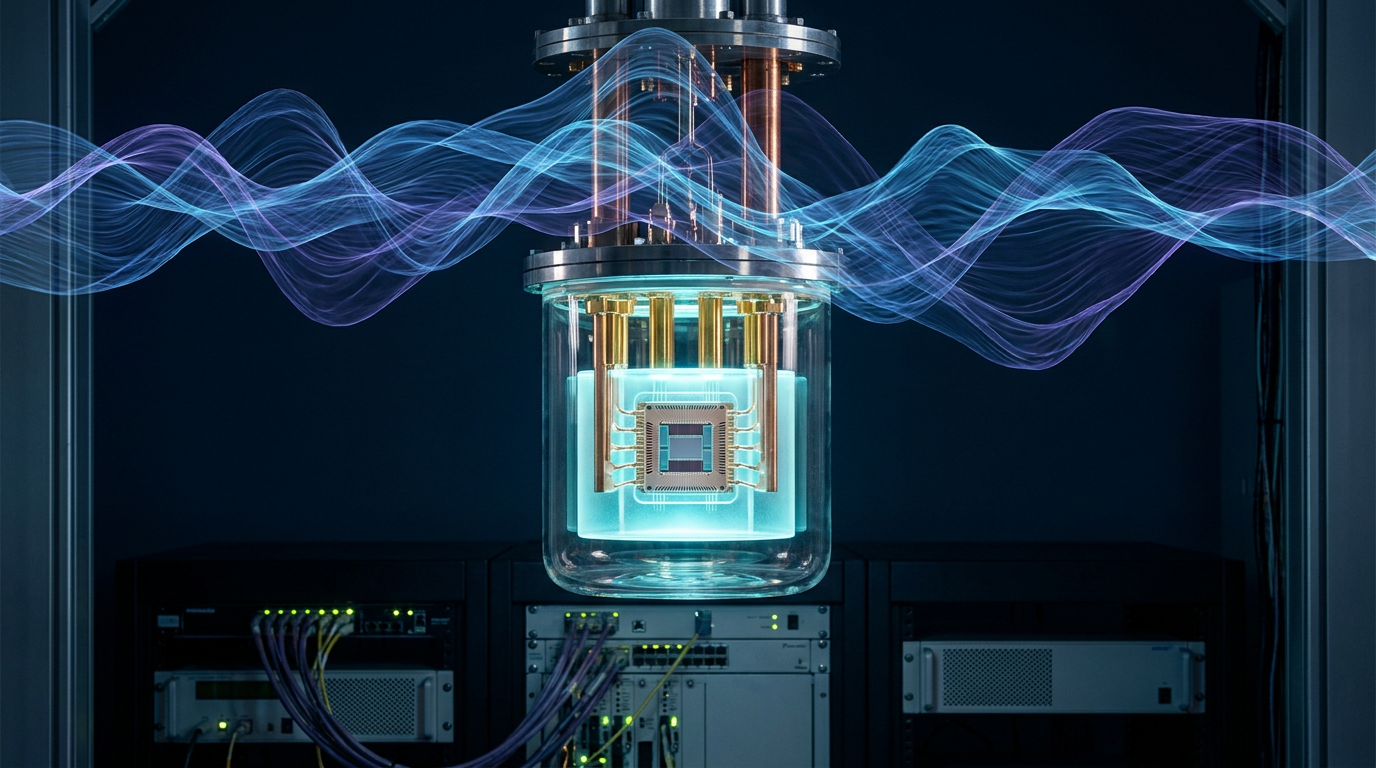
Two papers appeared within forty-eight hours in July 2026 — one on arXiv, one in New Journal of Physics — and both redraw the boundary between what physics permits and what it forbids. The first proves that the Bekenstein entropy bound relaxes or tightens depending on the sign of a single deformation parameter in the generalized uncertainty principle. The second shows that a slow longitudinal increase of a quasi-static plasma magnetic field introduces hysteresis into the betatron resonance of laser-accelerated electrons, so the same electron energy yields two different phase relationships. The juxtaposition is not coincidental: both findings sit at the same conceptual intersection where information, phase, and entropy meet — the intersection on which quantum error correction is built.
This matters because quantum error correction, the discipline that protects logical qubits from decoherence through syndrome measurement and the Surface Code|Surface Code, runs on a quiet assumption: that the underlying physics obeys textbook quantum mechanics all the way down. The Geroch-process analysis in [arXiv:2607.04905] shows that near-horizon, Planck-scale physics can help or hurt the entropy budget that any fault tolerant quantum computing stack requires. The DLA paper, by exposing hysteresis in betatron resonance, demonstrates that physical systems carry memory of their past — a signature that already haunts qubit fidelity under slow drift.
How It Works
The arXiv paper, published on 6 July 2026, picks up Geroch's classical thought experiment — drop a system into a black hole from just above the horizon — and reruns it inside a generalized uncertainty principle framework. In standard physics, Geroch's process yields the Bekenstein bound: entropy inside a region is bounded by the region's energy and size. The new analysis works in both (3+1) and (2+1) dimensions and finds a clean result. A negative deformation parameter relaxes the bound, opening room for more information. A positive deformation tightens it. From the abstract: "while a negative GUP deformation yields a universal relaxation of the bound, a positive deformation tightens it."
The mechanism is redshift. Near a horizon, photons climbing out are redshifted, and that redshift multiplies the energy that must fit inside the region. When Planck-scale physics modifies the redshift, the entropy budget shifts. For quantum error correction, the takeaway is direct: the threshold theorems that govern fault tolerant quantum computing assume a Bekenstein bound at the standard value, and that assumption now carries a measurable sign. The framework that protects information was built by Peter Shor at MIT in 1995, formalized by John Preskill at Caltech, and refined by Barbara Terhal at RWTH Aachen University.
The New Journal of Physics paper, dated 8 July 2026, lands on the same conceptual point through a different register. Direct laser acceleration uses a quasi-static azimuthal magnetic field to confine electrons, drive betatron oscillations, and let the electrons resonate with the laser field. The trouble is that as electrons gain energy, their betatron frequency drops, the resonance detunes, and energy exchange becomes reversible. The authors model a slow longitudinal increase in the magnetic field, and the result is hysteresis: the ratio of betatron frequency to laser frequency, at a given energy, depends on how the electron got there. Phase control becomes a memory effect.
Who's Moving
The papers arrive against a backdrop of capital and engineering that has reshaped quantum error correction since 2024. Alphabet Inc.'s Google Quantum AI (NASDAQ: GOOGL) published the first below-threshold demonstration of the surface code on its 105-qubit Willow processor in December 2024, a result that converted quantum error correction from a theoretical promise into a measured engineering gain. International Business Machines Corporation (NYSE: IBM) followed with its 156-qubit Heron r2 processor in 2025 and has committed publicly to fault tolerant quantum computing systems by 2029. Microsoft Corporation (NASDAQ: MSFT) staked a different bet on Topological Qubits|Topological Qubits with its Majorana 1 chip in February 2025.
Capital follows the engineering. Quantinuum closed a $300 million round in early 2025 at a $5 billion valuation. IonQ (NYSE: IONQ) acquired Lightsynq in 2025 for photonic interconnects. Rigetti Computing (NASDAQ: RGTI) shipped its 84-qubit Ankaa-3 in 2024 and is building a 108-qubit follow-on. PsiQuantum raised $940 million in a BlackRock-led round in late 2024 for its photonic approach. None of these systems functions without the syndrome measurement pipelines that quantum error correction requires, and none can ignore the entropy question raised by the July 2026 arXiv paper.
Why 2026 Is Different
The two papers and the industry momentum align into a single timeline. In twelve months, by mid-2027, expect the first distance-7 and distance-9 surface code logical qubits on superconducting platforms, with logical error rates below 10^-6 per cycle. In three years, the first commercial fault tolerant quantum computing systems will sell access to small logical-qubit clusters for chemistry and materials simulation. In five years, fault-tolerant machines with 100-plus logical qubits will appear in pharmaceutical and financial workloads, and the global market for quantum error correction services will pass $2 billion. The GUP paper adds a deeper timeline: if positive deformation holds in nature, the entropy budget for fault tolerant quantum computing tightens and the physical cost of every logical qubit rises; if negative deformation holds, the budget opens, and the measurement is now on the table in a way it was not before July 2026.
The Bottom Line
The July 2026 publications do not break quantum error correction. They constrain it from two sides: one paper asks whether the entropy limit that protects information can move; the other shows that physical systems carry phase memory in ways that complicate precise control. The field now has sharper questions and a clearer sense of what it costs to keep a logical qubit alive. In short: quantum error correction crossed its first below-threshold milestone in 2024, and two July 2026 papers from arXiv and New Journal of Physics now show that the physical limits of that achievement depend on signs — the sign of the GUP deformation parameter and the sign of phase hysteresis in the underlying physics.
FAQ
What is quantum error correction?
Quantum error correction is a set of techniques that protect quantum information from decoherence and operational noise by encoding one logical qubit into many physical qubits and running continuous syndrome measurement. The dominant scheme is the surface code, which arranges physical qubits in a two-dimensional lattice and uses stabilizer measurements to detect errors without measuring the encoded data directly. It is the foundation of every fault tolerant quantum computing roadmap published since 2020.
How does the surface code compare to other quantum error correction codes?
The surface code wins on engineering simplicity — it needs only nearest-neighbor interactions on a 2D lattice — but pays with a high overhead, typically hundreds of physical qubits per logical qubit. Bosonic codes such as the GKP code compress that overhead onto a single high-quality cavity. Quantum low-density parity-check (qLDPC) codes, a leading competing technology, cut the overhead roughly tenfold but demand long-range qubit connectivity that current superconducting hardware cannot provide. Topological qubits, pursued by Microsoft, embed the protection in the physics of the qubit itself, and the company's Majorana 1 chip announced in February 2025 marked the first public hardware release on that path.
When will fault tolerant quantum computing be commercially available?
IBM has committed publicly to a fault tolerant quantum computing system by 2029. Google Quantum AI has stated that its roadmap aims at the first useful fault-tolerant application before 2030. Quantinuum has projected a universal fault-tolerant machine by 2029. Real commercial availability — paying customers running revenue workloads on logical qubits — begins in 2030 and becomes routine by 2033.
Which companies are leading in quantum error correction?
Google Quantum AI (NASDAQ: GOOGL) holds the experimental lead, with the first below-threshold surface code demonstration on its 105-qubit Willow processor in December 2024. International Business Machines Corporation (NYSE: IBM) follows with its modular Heron r2 and the larger Flamingo and Crossbill processors on its 2029 fault tolerant roadmap. Microsoft (NASDAQ: MSFT), Quantinuum, IonQ (NYSE: IONQ), and PsiQuantum form the next tier, each pursuing a different physical substrate and a distinct quantum error correction story.
What are the biggest obstacles to quantum error correction adoption?
Three obstacles dominate. First, qubit fidelity: the surface code tolerates roughly 1% physical error rates, and pushing below that threshold is hard. Second, decoder latency: syndrome data must be processed faster than errors accumulate, which demands classical co-processors integrated at the qubit control layer. Third, physical-to-logical overhead: today's best demonstrations consume hundreds of physical qubits per logical qubit, and the 2024 Willow result marked the first demonstration of error suppression scaling below threshold in a real device.