Pasqal, the French neutral-atom quantum computing company headquartered in Paris and Massy, signed a non-binding Memorandum of Understanding on July 8, 2026, with MegazoneCloud, South Korea's largest cloud managed service provider, to distribute Pasqal's quantum hardware through MegazoneCloud's enterprise cloud infrastructure. The agreement covers joint application testing in materials science and optimization workloads, but the announcement discloses no deployment date, hardware specifications, contract value, or purchase commitments. The MoU is a framework, not a procurement contract.
What They're Actually Building
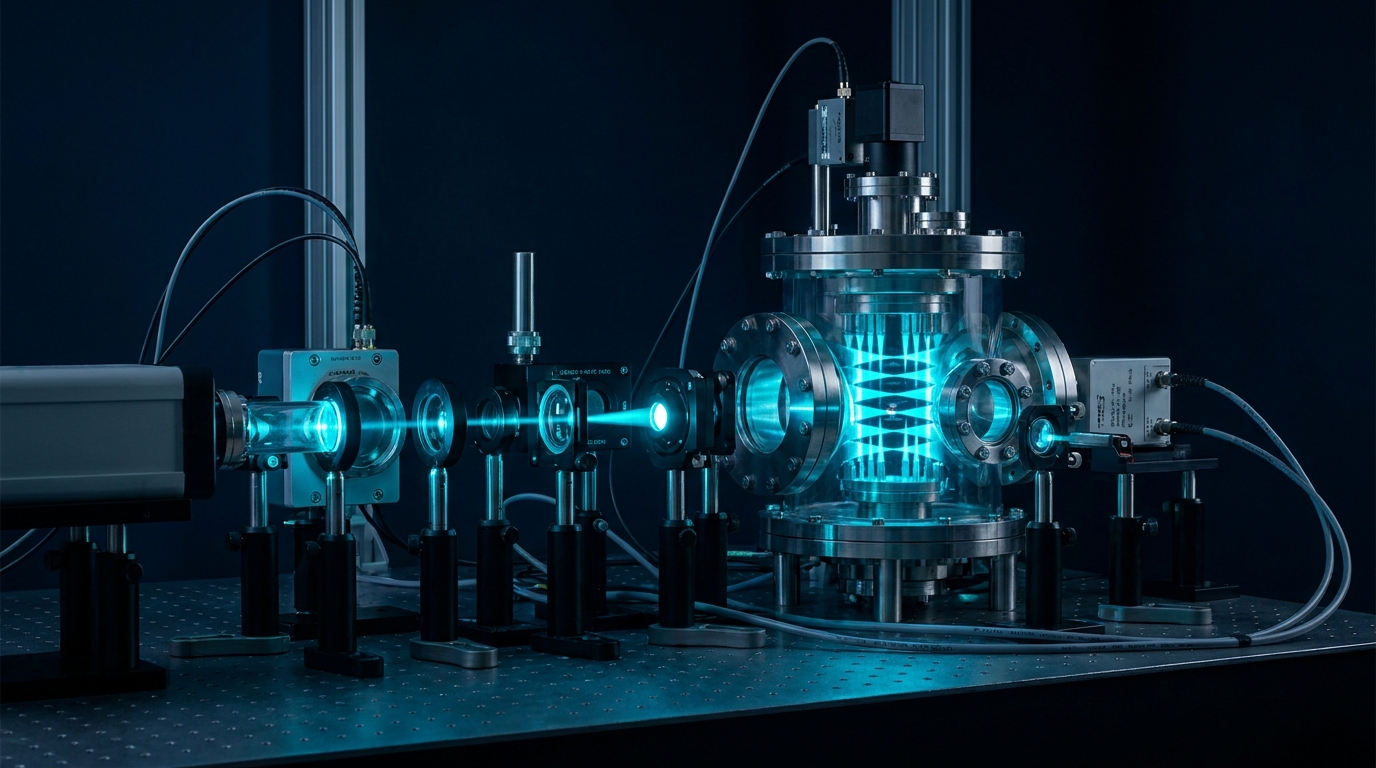
Pasqal builds quantum processors using arrays of neutral rubidium or cesium atoms held in optical tweezers — tightly focused laser beams that trap individual atoms in programmable 2D and 3D geometries. Quantum gates are executed via Rydberg interactions, where atoms excited to high-energy Rydberg states shift the energy levels of neighbors, enabling two-qubit entanglement. The architecture operates at room temperature, in contrast to superconducting systems that require millikelvin dilution refrigeration, and supports both analog quantum simulation and digital gate-based computing.
Pasqal was founded in 2019 out of research at Institut d'Optique and CNRS. Its publicly disclosed milestones include a 200-qubit analog processor in 2023 and the "Orion" alpha system announced in 2025, aimed at 1,000+ atoms. The company's stated 2026 roadmap targets the first logical qubits with active error correction. QuEra Computing, its closest peer in the neutral-atom modality, has demonstrated a 256-qubit system (Aquila) and signed multiple government and academic partnerships. Atom Computing, a third neutral-atom competitor, scaled to 1,180 qubits in 2023 and, with Microsoft, demonstrated a logical qubit in late 2024 — a milestone Pasqal has not yet publicly matched in a peer-reviewed setting. Infleqtion (formerly ColdQuanta) is the fourth notable neutral-atom player, with a smaller installed base but active defense and sensing work.
In the broader modality competition, IBM's superconducting roadmap targets a 200-qubit Kookaburra system in 2026 and 100,000-qubit systems by 2033; Quantinuum's H2 trapped-ion system reports a 56-qubit device with all-to-all connectivity; IonQ's Tempo roadmap targets 100+ algorithmic qubits by 2026. Neutral-atom vendors argue their qubit count, connectivity flexibility, and lack of cryogenic infrastructure give them structural advantages at scale, though published two-qubit gate fidelity has lagged: Pasqal's 2024 benchmarks reported around 98%, against Quantinuum's published 99.87%. Logical-qubit demonstrations and error-correction overhead also remain unproven for Pasqal against IBM and Google's superconducting logical-qubit claims.
Winners and Losers
The MoU is most directly threatening to neutral-atom rivals QuEra, Atom Computing, and Infleqtion, none of whom have a stated South Korean distribution agreement. IBM, which has cultivated Korean research partnerships through Yonsei University and the government's K-Quantum Initiative, faces a new vector of competition in enterprise cloud — though IBM's installed quantum hardware footprint and software ecosystem (Qiskit) remain far deeper. IonQ's 2024 acquisitions and Quantinuum's high-fidelity trapped-ion claims are less directly affected, but both have signaled interest in Asia-Pacific enterprise channels.
MegazoneCloud benefits regardless of which quantum hardware ultimately wins. As a managed-service layer, it positions itself as Korea's quantum distribution fabric, similar to how it captured the largest share of AWS reselling in the country. South Korean enterprise customers — particularly in semiconductors, batteries, and advanced materials, the country's three flagship industrial sectors — gain a neutral-atom option without having to negotiate directly with Pasqal. Concrete near-term workloads most likely to be tested include lithium-ion battery electrolyte optimization, semiconductor lithography process tuning, and shipbuilding logistics, all of which Korean conglomerates (LG Energy Solution, Samsung, HD Hyundai) have flagged as quantum-relevant in public statements.
The investment angle is more cautious than promotional coverage suggests. MoUs are not revenue. Pasqal's publicly disclosed funding exceeds €100M (~$108M) as of 2023, but the company has not disclosed 2026 revenue, hardware-as-a-service pricing, or unit economics. The signal for VCs is that neutral-atom distribution channels are forming, but Korean enterprise willingness to pay for quantum hardware access at premium rates over classical HPC remains unproven.
The Bigger Picture
The 2026 quantum industry is in what analysts call the "early fault-tolerant" phase: logical qubit demonstrations across modalities are landing (Google, Microsoft/Atom Computing, Quantinuum), but no vendor has shipped a system that demonstrably outperforms classical hardware on a commercial workload. Government investment remains the largest demand-side driver — South Korea committed ₩2.4 trillion (~$1.8B) to quantum through 2031 under the K-Quantum Strategy, and the EU Quantum Pact continues to subsidize hardware deployment across member states.
Comparable distribution deals include IBM's 2024 partnership with Japan's National Institute of Advanced Industrial Science and Technology (AIST) to install a 127-qubit Eagle-class system, and IonQ's 2025 agreement to provide trapped-ion access to Singapore's National Quantum Computing Hub. Pasqal's own earlier moves include a 2023 partnership with Saudi Arabia's Aramco for analog quantum simulation of materials and a 2024 collaboration with IBM on quantum-centric supercomputing workflows. The MegazoneCloud MoU fits a recognizable pattern: a foreign quantum vendor pairing with a regional cloud heavyweight to access a national market the vendor cannot serve directly.
The Signal
The signal here is a step toward commercial maturity for neutral-atom quantum computing in Asia-Pacific, not a technical breakthrough. MoUs are easy; converting them into recurring revenue requires shipping hardware, integrating it into managed cloud SLAs, and running benchmarks Korean enterprises can publish. The specific milestone that would validate this announcement is a deployed Pasqal system physically accessible through MegazoneCloud's infrastructure, with at least one Korean enterprise customer disclosing a quantum-enhanced result — whether in lithium battery chemistry, DRAM defect optimization, or logistics routing — that classical HPC could not reproduce in equivalent wall-clock time and cost.
In short: Pasqal's July 2026 MegazoneCloud MoU is a neutral-atom distribution play in South Korea, not a technical milestone — and its value will be measured by which Korean enterprise actually publishes a quantum-derived result first.