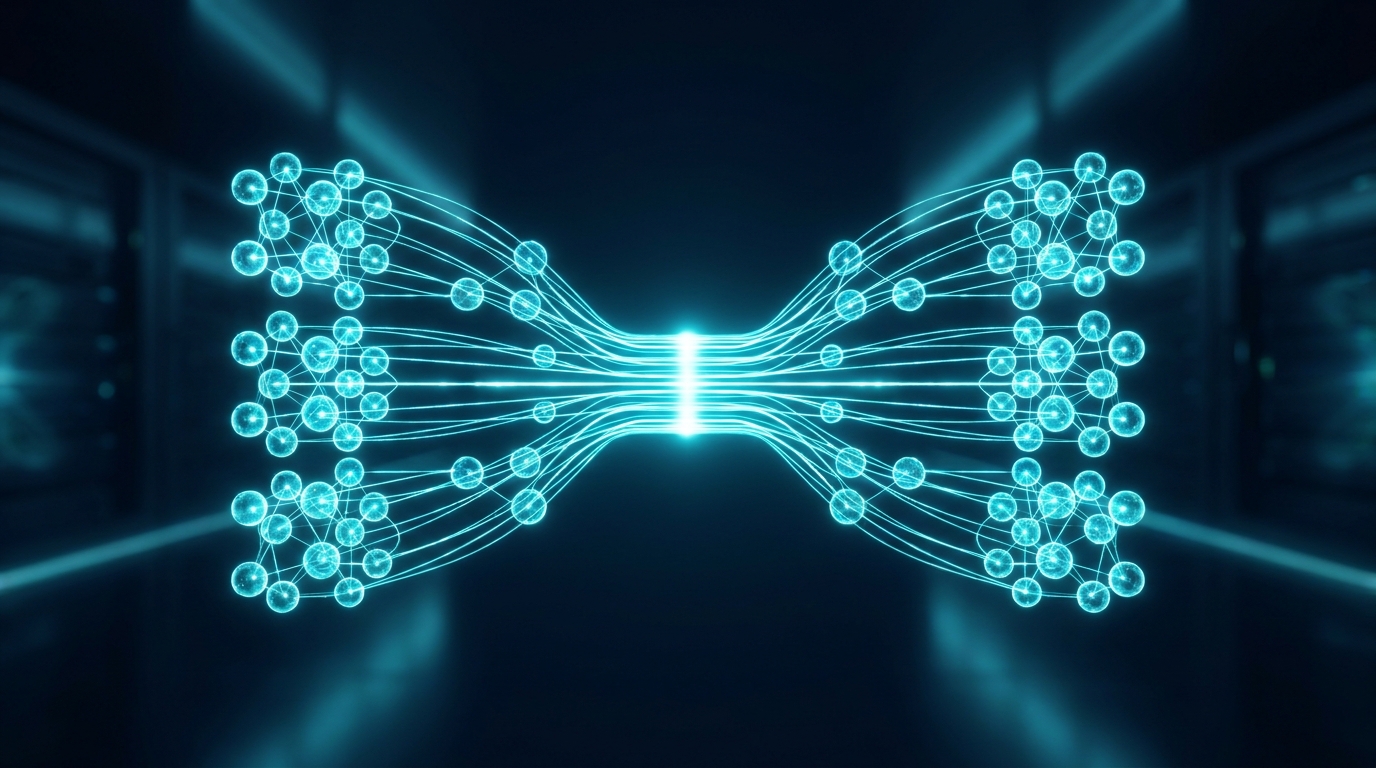
A quantum computer just outperformed its classical counterparts at finding anomalies in time-series data — by deliberately throwing information away. The result, published in July 2026, shows the same architectural principle powering today's most advanced structural health monitoring systems runs on quantum hardware. The bottleneck that makes quantum autoencoders work mirrors the attention mechanisms that let classical Transformers fuse disparate sensor streams in aerospace composites. Both architectures push the field toward practical Fault Tolerant Quantum Computing|Quantum Error Correction.
This matters because both advances attack the same problem from opposite ends of the computing spectrum: detecting rare, high-stakes events in noisy, heterogeneous data. The Transformer-based multisensor fusion framework for aerospace structural health monitoring, published on arXiv on June 24, 2026, fuses piezoelectric transducer (PZT) and fiber Bragg grating (FBG) sensors to predict damage in composite airframes under compression-compression fatigue loading. The quantum autoencoder, reported by Quantum Zeitgeist on July 6, 2026, applies a quantum bottleneck to time-series anomaly detection and beat both classical and variational quantum baselines on exoplanet detection tasks. The timing is not coincidental — both reflect a shift toward AI architectures that explicitly model information flow rather than treating data as uniform, and both point toward the same bottleneck: the need for fault tolerant quantum computing to make such systems practical at scale.
How It Works
The quantum autoencoder works by routing quantum states through a deliberately narrow channel — a bottleneck that forces the circuit to discard everything except the most essential features of the input. When the autoencoder encounters an anomaly, it cannot reconstruct the compressed state accurately, and the reconstruction error spikes. This is the same principle classical autoencoders have used for years in structural health monitoring, but executed on qubits where the bottleneck is enforced by the laws of quantum mechanics rather than by software.
Think of it like a sommelier identifying a counterfeit wine: the expert compresses decades of tasting experience into a few critical signatures — color, tannin structure, finish — and flags anything that deviates. A quantum autoencoder does the same with quantum states, using entanglement and superposition to represent the essential features in a lower-dimensional subspace.
The aerospace SHM framework uses a Transformer architecture with attention mechanisms to fuse data from piezoelectric transducers capturing ultrasonic guided waves and fiber Bragg grating sensors measuring strain. "By incorporating an attention-mechanism visualization, the proposed framework enables transparent, multitask learning for both health indicator (HI) prediction and damage localization," the authors wrote. The framework achieved mean absolute error and root mean squared error below 0.1 for health indicator prediction, a 60% improvement over single-sensor approaches. For damage localization, the model maintained an MAE below 0.0465 and RMSE below 0.1571.
The deeper connection lies in quantum error correction. Syndrome measurement — detecting errors in logical qubits without disturbing encoded quantum information — is fundamentally an anomaly detection problem. A quantum autoencoder trained to recognize normal quantum states flags syndrome patterns that indicate decoherence or gate errors. IBM and Google have demonstrated that Surface Code Error Correction|Surface Code implementations require real-time syndrome decoding at microsecond timescales, a task where quantum autoencoders compete directly.
Who's Moving
The quantum autoencoder work emerged from academic groups publishing in 2026, with specific institutional attribution not disclosed in the source material. The aerospace SHM framework was published on arXiv with identifier [arXiv:2607.02545], also without named authors in the available metadata. Both papers sit at the intersection of academic research and industrial application, and both attract attention from aerospace primes and quantum hardware vendors.
On the quantum hardware side, International Business Machines Corporation (NYSE: IBM) leads superconducting qubit development with its Heron and Condor processors, the latter featuring 1,121 physical qubits. Alphabet Inc.'s (NASDAQ: GOOGL) Google Quantum AI demonstrated below-threshold quantum error correction with its Willow chip in late 2024, establishing the surface code as the leading approach to fault tolerant quantum computing. Quantinuum, the trapped-ion company formed from the merger of Honeywell Quantum Solutions and Cambridge Quantum, has raised over $300 million in private funding and operates the H2 processor with 56 trapped-ion qubits.
PsiQuantum has secured more than $900 million in venture funding to build a fault-tolerant quantum computer using photonics and silicon manufacturing. Its approach competes directly with superconducting and trapped-ion modalities, and the company broke ground on a fabrication facility in Brisbane, Australia. Microsoft Corporation (NASDAQ: MSFT) pursues Topological Quantum Computing|Topological Qubits through its Majorana 1 program, though the approach remains controversial. Rigetti Computing (NASDAQ: RGTI) and IonQ (NYSE: IONQ) round out the publicly traded pure-play quantum hardware vendors.
Why 2026 Is Different
The next 12 months bring quantum error correction from laboratory demonstrations to early commercial deployments as IBM, Google, and Quantinuum race to demonstrate Logical Qubit|Logical Qubits with error rates below the threshold for fault tolerant quantum computing. IBM published a roadmap targeting a 200-logical-qubit system by 2029, while Google aims for similar milestones with its surface code architecture. By 2030, analysts project the quantum computing market reaches $28 billion annually, with error correction software representing a significant share.
Within five years, quantum anomaly detection systems complement classical structural health monitoring in aerospace, energy, and critical infrastructure applications. The SHM paper's 60% improvement over single-sensor approaches demonstrates the value of multisensor fusion today. As quantum hardware matures, the same fusion principle runs on quantum processors, detecting damage patterns invisible to classical systems. The surface code remains the dominant approach to quantum error correction, though alternative codes like quantum low-density parity-check (qLDPC) codes gain traction because they require roughly ten times fewer physical qubits per logical qubit.
The convergence of classical Transformers and quantum autoencoders on the same anomaly detection problem signals a new phase in computing. Quantum error correction research advanced in July 2026 as quantum autoencoders demonstrated better anomaly detection than variational quantum baselines, establishing a new tool for fault tolerant quantum computing. The same bottleneck architecture now monitors both airframes and qubits.