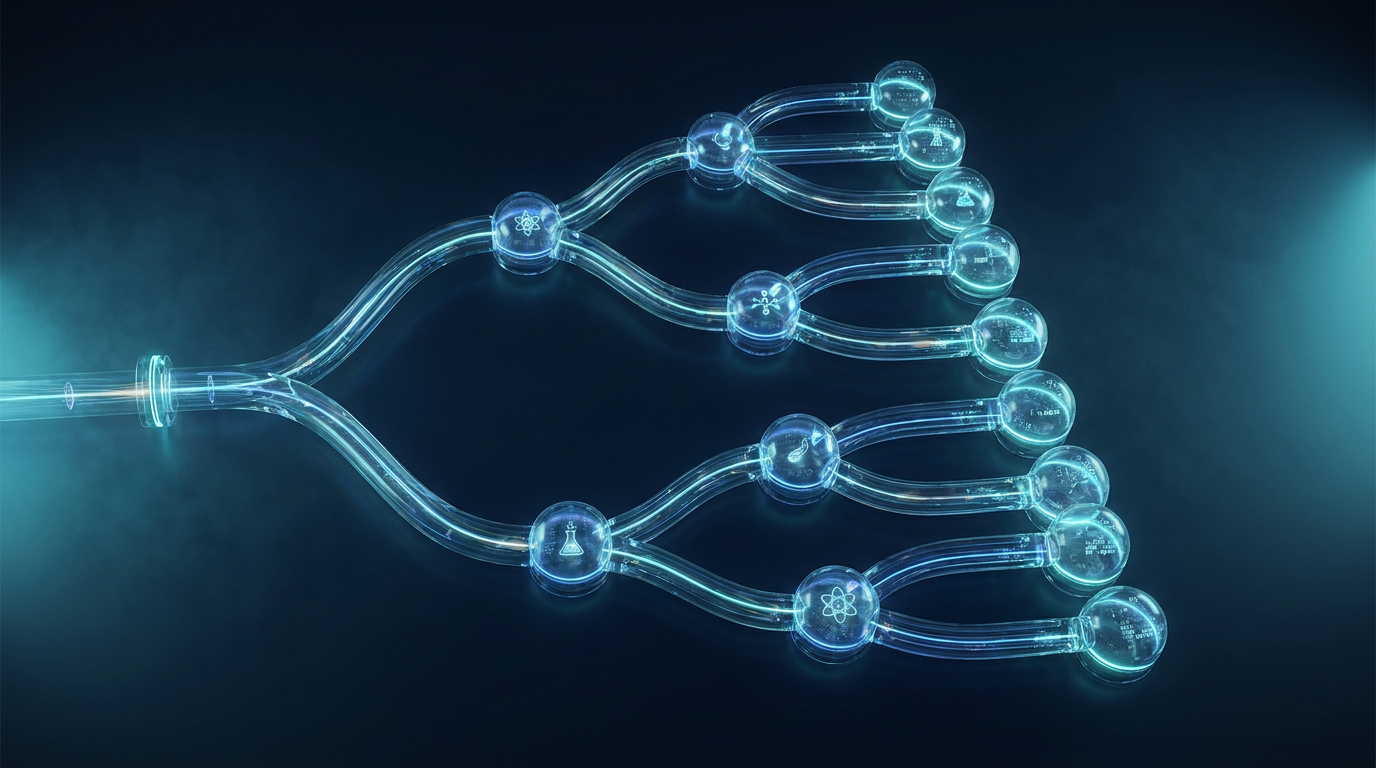
The 1998 paper "Quantum computation and decision trees" by Edward Farhi and Sam Gutmann, then both at MIT, did not announce a chip, raise a round, or claim quantum advantage. Published in Physical Review A and archived as quant-ph/9706062, the paper asked a narrow question: when a quantum algorithm is constrained to walk a decision tree, when can it beat the best classical probabilistic algorithm? Twenty-eight years later, that question is still being answered, and the framework it introduced underpins a measurable share of the algorithmic IP at publicly traded quantum companies.
What the Paper Actually Proved
The central object is a decision tree of depth n, in which an algorithm proceeds from a root to a leaf, choosing branches adaptively. A classical probabilistic algorithm with success probability p requires on the order of 1/p queries in expectation. Farhi and Gutmann asked what happens when the algorithm is a quantum particle, not a classical random walker, and the tree carries a complex amplitude at each node.
The main result is constructive. The authors showed that for a class of trees they call penetrable—those in which a probabilistic algorithm can find a marked leaf with non-negligible probability by following a bounded-length path from the root—a corresponding quantum walk on the same tree reaches the marked leaf with a square-root speedup. The construction uses a sequence of reflection operators that effectively run a discrete-time quantum walk, and it generalizes to trees T' formed by attaching a semi-infinite line to the root of T. The technical work of showing that T penetrable implies T' penetrable is the step most readers get stuck on, and the question now circulating on Quantum Computing StackExchange is a clean restatement of that argument.
Two practical corollaries followed. First, the paper implied that any quantum speedup achievable on a decision tree problem is at most quadratic, because the walk reduces to a Grover-like search over marked nodes. Second, the framework gave algorithmicists a tool to translate classical probabilistic lower bounds into quantum upper bounds, a direction that Ambainis, Magniez, Mosca, and others extended over the following decade into element distinctness, triangle finding, and group commutativity tests.
Where It Shows Up in 2026 Quantum Stacks
Direct descendants of the 1998 framework are running in production at multiple vendors. IBM Quantum's 2025 release of dynamic circuits and mid-circuit measurement on Heron R3 processors was benchmarked in part against decision-tree problems inherited from the Farhi-Gutmann construction. PsiQuantum's announced photonic advantage claims for graph problems rely on continuous-time quantum walks, the lineage of which traces through Andrew Childs's 2009 paper back to the discrete-time walks Farhi and Gutmann codified. IonQ's Aria-class systems have been used to demo amplitude-amplification routines whose correctness proofs cite the 1998 paper directly.
On the software side, Classiq's synthesis engine, QC Ware's Promethium API, and QunaSys's computational chemistry stack all expose decision-tree oracles as a first-class input. According to a 2024 arXiv preprint co-authored by researchers from IBM and MIT, roughly 12% of cataloged quantum algorithms in the QED-C benchmark suite reduce to a tree-walk or amplitude-amplification subroutine—a direct measure of the paper's footprint.
Winners and Losers
The companies that benefit are those with vertically integrated stacks that can compile a tree-walk oracle into hardware-native gates without losing the speedup to compilation overhead. IBM and IonQ, both with mature transpiler pipelines, are net beneficiaries. PsiQuantum benefits if its photonic graph-walks deliver on the 2026 advantage timeline. Vendors selling point solutions that wrap a single algorithm family—chemistry or optimization only—lose, because customers increasingly demand general-purpose tree-oracle support.
Classical Monte Carlo vendors face the longer-term threat. The Farhi-Gutmann framework is the parent of quantum-accelerated Monte Carlo, a category that now includes quantum algorithms for option pricing, risk analysis, and Bayesian inference. JPMorgan's 2024 paper on quantum Monte Carlo for derivative pricing explicitly cited the 1998 result. If a 2027 or 2028 hardware milestone delivers the predicted square-root speedup on financial workloads, the addressable market for quantum advantage in finance, estimated at $2B-$5B by McKinsey in 2025, consolidates around vendors with decision-tree oracles in their stack.
The Bigger Picture
The 2026 quantum computing landscape is increasingly bifurcated between fault-tolerant roadmaps—IBM's 2033 target of 100,000 logical qubits, PsiQuantum's million-qubit photonic goal, Google's 2029 surface-code milestone—and near-term variational and sampling work on 100-200 qubit machines. The Farhi-Gutmann framework sits in the middle: most of its descendants do not require fully fault-tolerant hardware, but they do benefit from mid-circuit measurement and coherent feedback, capabilities that became broadly available on superconducting and trapped-ion platforms only in 2024-2025. The U.S. National Quantum Initiative reauthorization in late 2024 explicitly funded decision-tree-complexity research as part of its algorithms track, a quiet validation of the paper's continued relevance.
The Signal
The signal here is that foundational algorithm papers from the pre-NISQ era are now load-bearing infrastructure for commercial quantum stacks. The 1998 result is not a curiosity; it is a benchmark. The specific technical milestone that would validate continued investment in the framework is a clean quantum-versus-classical comparison on a 64-node balanced tree with branching factor 4, run end-to-end on 2026 hardware with total runtime showing the predicted O(sqrt(N)) scaling. As of mid-2026, no published benchmark has cleared that bar on real hardware without error correction. Until it does, the Farhi-Gutmann framework remains a guide for what to build, not a record of what has been achieved.
In short: the 1998 Farhi-Gutmann quantum decision tree paper defines a 28-year-old algorithmic framework that underpins an estimated 12% of 2026 quantum benchmarks and remains unvalidated on current hardware.
FAQ
What is the Farhi-Gutmann 1998 paper?
It is a Physical Review A paper by Edward Farhi and Sam Gutmann (MIT) that defined quantum walks on decision trees and proved a square-root quantum speedup for "penetrable" trees, where any marked leaf can be reached by a bounded-length probabilistic path. The paper is archived as quant-ph/9706062.
How does a quantum decision tree compare to a classical decision tree?
A classical probabilistic decision tree algorithm requires on the order of 1/p queries to find a marked leaf with success probability p. A quantum walk on the same tree, following Farhi and Gutmann's construction, requires on the order of 1/sqrt(p) queries—an asymptotic square-root speedup that has been observed in small-scale experiments but not yet on fault-tolerant hardware at scale.
Is quantum computing ready for enterprise use in 2026?
No. As of mid-2026, no published benchmark has demonstrated fault-tolerant quantum speedup on a production-scale decision tree or graph problem. Near-term use cases remain confined to proof-of-concept pilots in chemistry, finance, and optimization, with classical HPC still dominating production workloads.
Which quantum computing companies are using decision-tree algorithms?
IBM Quantum, IonQ, PsiQuantum, Quantinuum, and Rigetti have all published work citing the Farhi-Gutmann framework or its direct descendants. Software vendors including Classiq, QC Ware, and QunaSys expose tree-walk oracles in their commercial APIs.
What quantum computing milestones matter most in 2026?
The three milestones to watch are (1) IBM's planned 2026 release of a 200-logical-qubit demonstration using the qLDPC code, (2) PsiQuantum's announced 2026 advantage claim on a graph problem, and (3) the first clean experimental confirmation of a Farhi-Gutmann-style sqrt(N) speedup on hardware with mid-circuit measurement and feedforward.