Taiyi Quantum Technology Co., Ltd. closed a 300 million yuan (~$44 million USD) strategic financing round on June 26, 2026, the Shanghai-based neutral-atom hardware developer confirmed. The round was heavily oversubscribed and follows a 100 million yuan angel round closed in March 2026, bringing total capital raised since the company's January 2026 founding to roughly 400 million yuan (~$58 million USD). Taiyi—alternatively styled Taiyi Liangsheng (太仪量生)—will deploy the capital to scale manufacturing of ytterbium-171 neutral-atom quantum computers and to expand headcount across physics, photonics, and software engineering.
What They're Actually Building
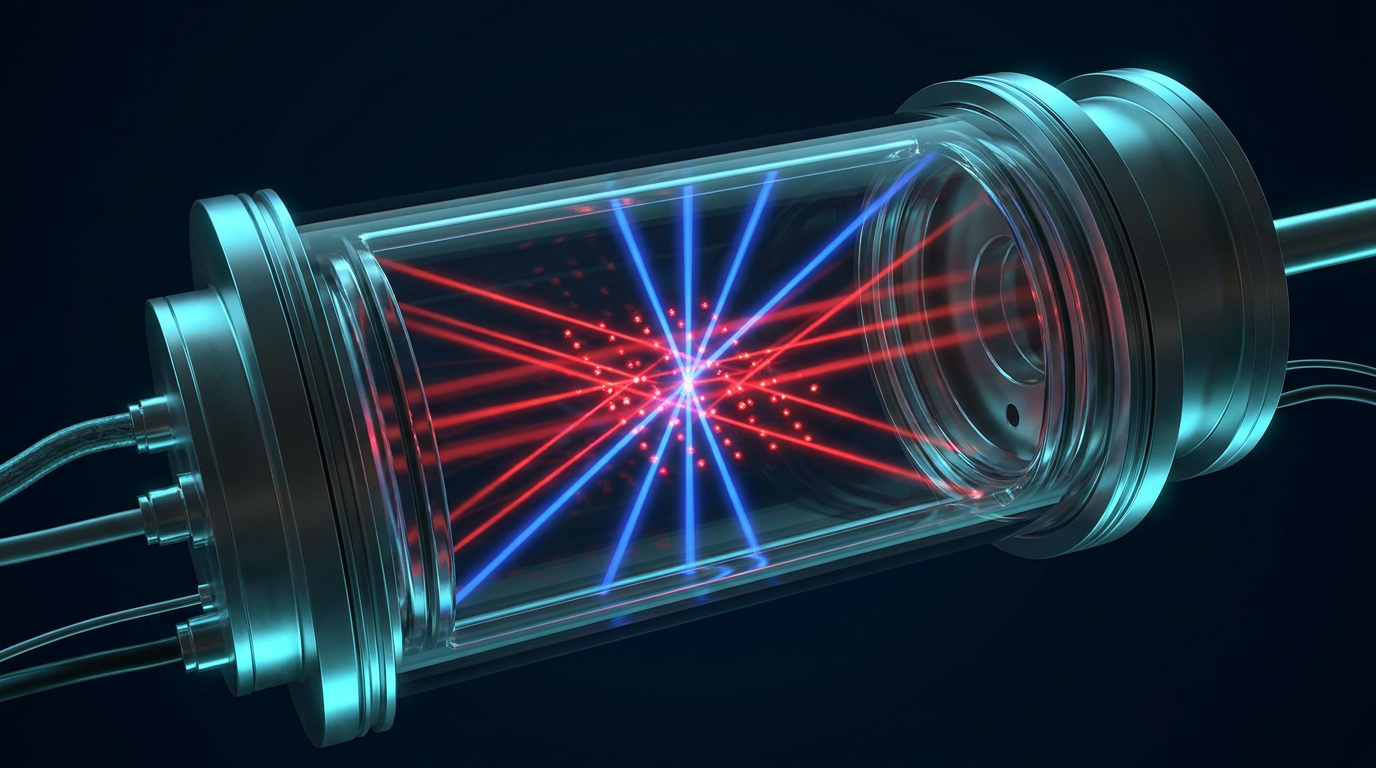
Taiyi is developing a quantum computer based on arrays of neutral ytterbium-171 atoms held in optical tweezer lattices, with qubit states encoded in the atom's nuclear spin (I = 1/2) and a long-lived metastable ³P₀ clock state used for Rydberg-mediated two-qubit gates. The choice of Yb-171 is a deliberate technical bet: the isotope is the same one used in state-of-the-art optical atomic clocks, which means Taiyi inherits a mature laser, vacuum, and frequency-reference supply chain. Compared with rubidium and cesium—the workhorses for Pasqal and certain QuEra configurations—ytterbium offers narrower optical transitions, longer intrinsic coherence times, and the ability to use the same atom as both qubit and clock reference.
Where the company stands on the roadmap is the open question. Taiyi has not publicly disclosed a working qubit count, a logical-qubit demonstration, or a system-level error rate. Peers provide the calibration: QuEra announced a 256-qubit Aquila-class system in 2023 and has since demonstrated logical qubits on 10-qubit patches; Atom Computing deployed a 1,180-qubit strontium-87 system in 2023 under a Microsoft partnership; Pasqal has shipped 200-qubit Orion systems and is targeting 1,000+ qubits. Without disclosed benchmarks, Taiyi is a 2026 entrant that has not yet published the equivalent of a Heron-r2 specification sheet.
Winners and Losers
The most directly threatened name is QuEra Computing, which uses a similar ytterbium architecture and is headquartered in Boston with deep Chinese research roots. A sovereign-funded Chinese competitor on the same atomic platform puts pressure on QuEra's export-customer base in Asia. Atom Computing, which has standardized on strontium-87, faces less direct overlap but must watch the broader neutral-atom capacity expansion in China.
Beneficiaries include photonic component vendors (laser systems at 556 nm and 759 nm, ultra-high-vacuum cells, SLM-based beam steering), Chinese quantum software stacks, and the Shanghai municipal government's strategic-tech portfolio. China-based neutral-atom cloud users—academic labs and state-affiliated research institutes—gain a domestic procurement alternative at a moment when US export controls (effective 2024) restrict transfer of certain quantum cryogenics and control electronics to the PRC.
For the broader investment thesis, the deal does not change the neutral-atom moat. The defensible layer remains the combination of atomic-physics IP, optical-system engineering, and a software stack (compilers, error-correction codes) that abstracts the hardware. Taiyi's $58M cumulative raise is sufficient to reach first-generation hardware but below the threshold of QuEra's reported $80M+ and well below Pasqal's ~€130M total.
The Bigger Picture
Neutral-atom systems in 2026 are entering the logical-qubit era. Atom Computing and Microsoft published the first below-threshold logical-qubit demonstration in 2024, and QuEra followed with a 30 logical-qubit result in late 2025. The segment is roughly five years behind superconducting systems on raw qubit count but ahead on coherence times and on the cost-per-qubit scaling curve, where each additional atom requires only optical-trap reconfiguration rather than a new fabricated chip.
China's quantum funding posture has hardened since the 2024 US Bureau of Industry and Security controls. Origin Quantum (Hefei) remains the superconducting incumbent; Jiuzhang (USTC) operates photonic systems; Taiyi is among the first dedicated neutral-atom plays. The $44M round is modest by IonQ's standards (IonQ's 2025 cash position exceeded $400M) but materially large for a five-month-old Chinese hardware startup operating under capital and equipment constraints.
The Signal
The signal here is sovereign duplication, not technological breakthrough. Taiyi is mirroring a platform—ytterbium neutral atoms with Rydberg gates—that QuEra, Pasqal, and Atom Computing have already validated. What this reveals is the Chinese state's willingness to fund parallel capacity in every modality US and EU champions have prioritized, even when the marginal technology contribution is incremental. The specific technical milestone that would validate Taiyi's claim is a published two-qubit gate fidelity above 99% on a Yb-171 array of at least 64 atoms, ideally with a first logical-qubit memory demonstration within 18 months. Until that benchmark arrives, the round is a portfolio bet, not a physics result.
In short: Taiyi Quantum has raised roughly $58 million since January 2026 to commercialize ytterbium-171 neutral-atom quantum computers, making the five-month-old Shanghai startup the latest sovereign-funded entrant in a hardware race now led by QuEra, Atom Computing, and Pasqal.
FAQ
What does Taiyi Quantum do?
Taiyi Quantum Technology Co., Ltd., also known as Taiyi Liangsheng, is a Shanghai-based quantum hardware startup founded in January 2026. It builds quantum computers using arrays of neutral ytterbium-171 atoms held in optical tweezers, with qubit states encoded in nuclear spin and two-qubit gates performed via Rydberg interactions. The company is currently pre-revenue and focused on first-generation system delivery.
How does ytterbium neutral-atom quantum computing compare to alternatives?
Ytterbium-171 neutral atoms offer longer coherence times and narrower optical transitions than rubidium or cesium, and the same atomic species is used in the world's best optical atomic clocks. Compared with superconducting qubits (IBM, Google), neutral atoms do not require millikelvin cryogenics but currently lag in two-qubit gate speed. Compared with trapped ions (IonQ, Quantinuum), neutral atoms scale more easily to thousands of qubits but have historically had lower two-qubit fidelities.
Is quantum computing ready for enterprise use in 2026?
Not generally. No commercial quantum computer in 2026 has demonstrated fault-tolerant universal computation; current systems are used for research, benchmarking, and limited quantum simulation workloads. Enterprise adoption in 2026 is concentrated in pharmaceuticals (molecular energy estimation), materials science, and optimization pilots, typically via cloud access rather than on-prem hardware. The first fault-tolerant systems are not expected before 2029-2031.
What is Taiyi Quantum's business model?
Based on the funding structure and Chinese quantum-industry norms, Taiyi likely plans a hybrid model: direct sales of quantum computing systems to domestic research institutes and universities, plus cloud-access partnerships with Chinese supercomputing centers. Sovereign-aligned customers in defense and state-owned enterprises are plausible early buyers. Western cloud-distribution deals are unlikely given 2024 US export controls and equivalent Chinese restrictions on dual-use quantum exports.
What quantum computing milestones matter most in 2026?
Three benchmarks define the 2026 race: (1) demonstrated logical-qubit error suppression below the surface-code threshold, now achieved only in small-scale experiments by Microsoft/Atom Computing, QuEra, and Google; (2) two-qubit gate fidelity above 99.9% on systems of 100+ physical qubits; (3) end-to-end quantum advantage claims that survive peer review on problems with classical hardness guarantees. The company that first publishes on all three will define the fault-tolerant timeline.