Friction is a ghost in the machine of classical physics. Since the days of Leonardo da Vinci, scientists have struggled to explain why two surfaces sliding against each other lose energy. While we can measure the resistance of a sliding block or the heat generated by a car's brakes, the fundamental origin of this force remains one of the oldest unsolved puzzles in mechanics. Most existing models take a shortcut: they simply add a mathematical term for 'dissipation' to make the equations match reality. They assume energy disappears into a heat bath without explaining how that process actually begins at the atomic level. [arXiv:1708.03415]
The Core Finding
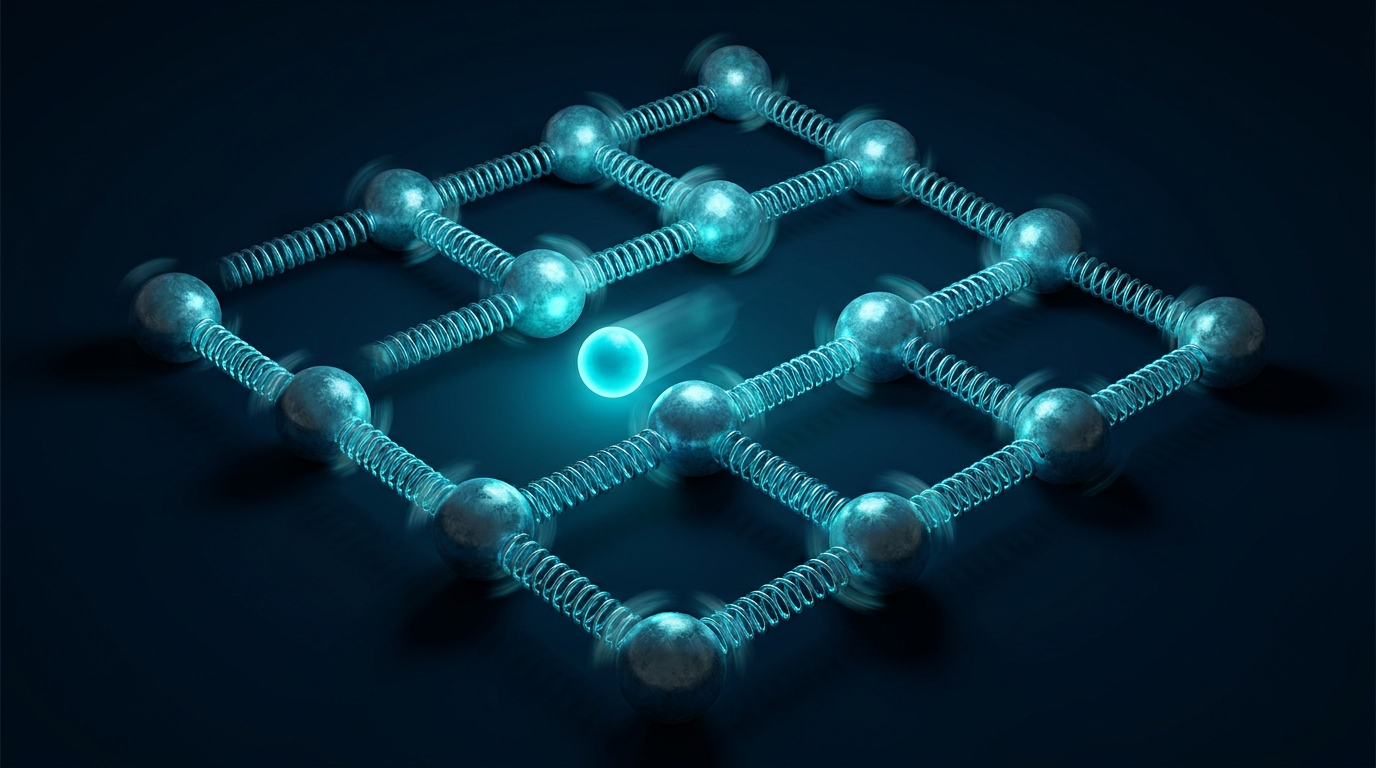
In a paper published on the arXiv, researchers have finally stripped away these mathematical crutches to see if friction can emerge on its own. They developed an improved version of the Tomlinson model—the standard framework for understanding atomic-scale friction—that functions without any pre-defined damping. Instead of telling the system to lose energy, they built a model consisting of a single atom sliding over a surface of other atoms, each held in place by its own independent harmonic potential. By solving the resulting Newton's equations numerically, the team discovered that friction-like behavior appears naturally as a result of the interaction between the slider and the substrate. As the abstract notes, the study focuses on the "mechanism of energy dissipation which can be thought as effective emerging friction." This approach proves that we do not need to 'invent' friction; it is a natural consequence of many-body dynamics.
The State of the Field
For decades, the Tomlinson model has been the workhorse of nanotribology, particularly for interpreting data from Atomic Force Microscopes (AFM). However, the original model and its subsequent iterations almost universally relied on an 'ad-hoc' dissipation term—a fixed value that represents energy lost to the environment. This was a necessary evil because, without it, simple models would conserve energy perfectly, never showing the 'drag' we recognize as friction. This new research changes the landscape by moving toward a self-contained system. By allowing the surface atoms to move and react to the slider, the energy is transferred from the slider's kinetic motion into the vibrations of the surface atoms, effectively simulating heat generation from first principles.
From Lab to Reality
This breakthrough unlocks a more precise way for physicists to simulate nanomachines and micro-electromechanical systems (MEMS). For engineers, understanding the 'emerging friction' means they can design materials with specific lubricant properties at the molecular level without relying on trial-and-error testing. For the manufacturing industry, this could lead to a revolution in wear-resistant coatings. The market for advanced lubricants and friction-reducing materials is a multi-billion dollar sector, and moving from empirical models to predictive, first-principles simulations allows for the rapid prototyping of carbon-nanotube interfaces or graphene-based sliders that could last decades without degradation.
What Still Needs to Happen
Despite the success of this numerical approach, two major hurdles remain. First, the current model is limited by its simplicity; it treats the surface as a 1D or 2D arrangement of independent oscillators. Real-world materials have complex crystal lattices where atoms are interconnected in three dimensions, a challenge that groups like those at the University of Basel are currently tackling with more intensive molecular dynamics. Second, the transition from classical Newton's equations to the quantum regime is still incomplete. To truly understand friction at the smallest scales, researchers must account for electronic friction—where energy is lost to electron excitations—a field currently being explored by theoretical groups at institutions like the Max Planck Institute. We are likely five to ten years away from a 'universal friction equation' that spans from the atomic to the macroscopic scale.