Friction is a force so ubiquitous that we often forget it remains one of the most stubborn mysteries in classical and quantum physics. Since the days of Leonardo da Vinci, scientists have struggled to explain exactly how the kinetic energy of a sliding object bleeds away into heat at the atomic level. While we can calculate the friction of a car tire or a tectonic plate using empirical formulas, these equations rely on a mathematical shortcut: ad-hoc dissipation. We simply tell the math that energy disappears, rather than showing how the atoms themselves handle the handoff. [arXiv:1708.03415]
The Core Finding
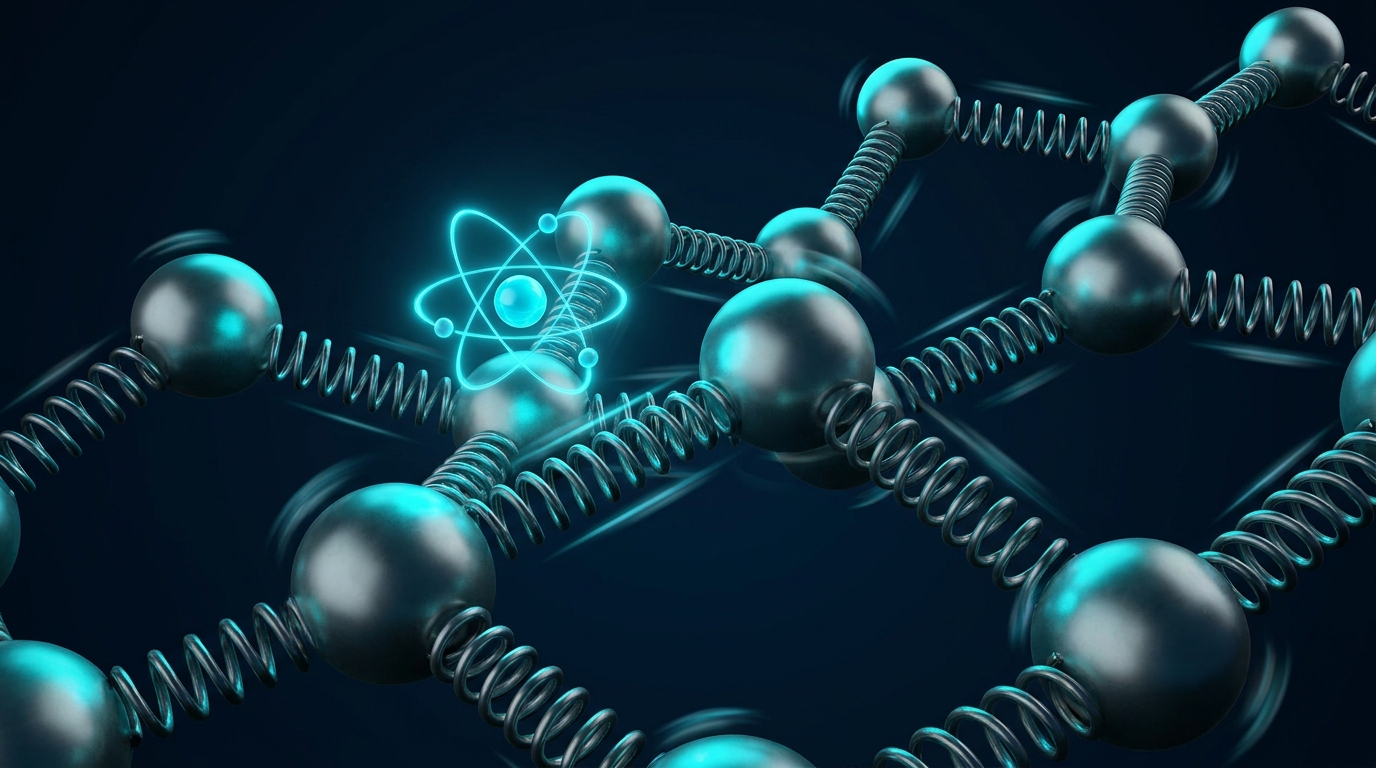
Researchers at the National University of San Luis have developed a refined version of the Tomlinson model that eliminates the need for these artificial damping terms. By simulating a single atom sliding over a periodic arrangement of surface atoms—each tethered by its own independent harmonic potential—the team allowed the physics of the interaction to dictate the energy loss naturally. This approach treats the surface not as a static background, but as a dynamic participant in the exchange of momentum. The study concludes that the mechanism of energy dissipation can be thought as an "effective emerging friction" arising solely from the Newtonian interactions between the slider and the substrate. Think of it like a person running across a floor covered in springs; the runner slows down not because of an invisible braking force, but because every step transfers energy into the oscillation of the springs beneath them. The team found that despite the apparent simplicity of the model, the resulting non-conservative lateral forces perfectly match the behaviors observed in Atomic Force Microscopy without requiring the researchers to manually insert a friction coefficient.
The State of the Field
Before this 2017 breakthrough, the standard for simulating atomic-scale friction was the Prandtl-Tomlinson model. Originally proposed in the early 20th century, this model describes a point mass dragged over a periodic potential. However, to make the math work, every previous iteration required a damping constant—a "gamma" factor—to represent the energy lost to the surrounding environment. Without this manual tweak, the sliding atom would simply gain infinite energy or behave like a perpetual motion machine. This new research changes the landscape by proving that if you model the substrate atoms as individual oscillators rather than a rigid landscape, the "quantum error correction" of the energy balance happens automatically through the coupling of the masses. This aligns with the broader push in computational physics to move away from phenomenological constants and toward first-principles simulations.
From Lab to Reality
For scientists, this model unlocks a new pathway for studying tribology—the science of wear and friction—at the nanoscale. It provides a cleaner framework for understanding how heat is generated in micro-electromechanical systems (MEMS), where traditional lubricants fail and friction can destroy a device in seconds. For engineers, this research suggests that we can improve the precision of atomic force microscopes by better accounting for the feedback loops between the probe tip and the sample surface. For investors, while this is fundamental research, it directly impacts the emerging market for nano-coatings and molecular manufacturing, a sector poised to redefine material durability in the coming decade. By accurately predicting how surfaces will wear down at the atomic level, companies can design materials that last significantly longer, reducing the multi-billion dollar annual cost of friction-related energy loss in industrial machinery.
What Still Needs to Happen
Despite the success of the numerical simulations, two major hurdles remain. First, the current model is limited to a one-dimensional sliding path, which does not account for the complex 2D lateral zig-zagging observed in real-world atomic friction. Researchers like those in the Carpick Group at the University of Pennsylvania are currently working on expanding these dynamical models into three dimensions. Second, the model assumes harmonic potentials for the substrate atoms, which is a simplification of the complex electron-cloud interactions that occur in real materials. Moving from these "spring-like" connections to full density functional theory (DFT) calculations will require significantly more computational power. We are likely five to ten years away from seeing these "no-dissipation" models integrated into standard engineering software, as the transition from single-atom models to multi-layered material simulations is computationally expensive.
Conclusion
This research proves that friction is not a fundamental force that must be added to our equations, but an emergent property of how atoms interact and vibrate. It strips away the mathematical crutches of the past to show the raw mechanics of energy loss. In short: the origin of friction force can be explained through a Tomlinson model improved with no ad-hoc dissipation by treating surface atoms as independent oscillators.