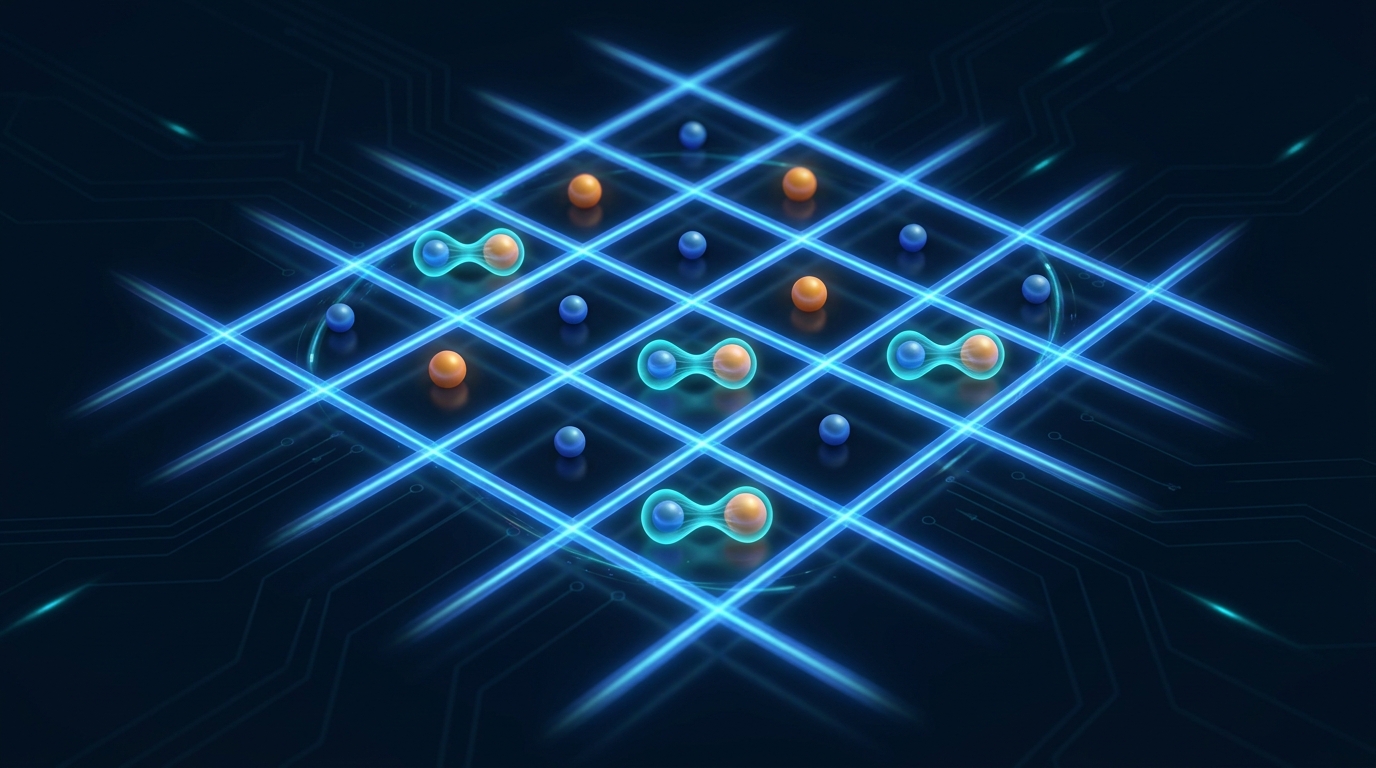
The boundary between a superfluid and a superconductor is not a wall, but a bridge built from the shared symmetry of a single quantum order parameter. In the pursuit of fault tolerant quantum computing, the ability to manipulate this parameter across different particle species provides a roadmap to stability that single-species systems lack. By engineering p-wave resonant dimers in two-dimensional Fermi-Bose mixtures, researchers are now able to suppress the three-body recombination processes that typically destroy fragile quantum states. This stabilization is the prerequisite for quantum error correction at the hardware level, moving beyond the limitations of standard decoherence-prone architectures. [arXiv:10.1103/PhysRevLett.121.263001]
The Connection
This matters because the transition from noisy intermediate-scale quantum devices to reliable processors requires a physical substrate that resists local perturbations by design. The timing is not coincidental; as industry leaders like International Business Machines Corporation (IBM) scale their hardware to over 1,000 qubits, the academic community is providing the mathematical and physical framework to unify disparate quantum states. By linking the macroscopic quantum order of Bose-Einstein condensates with the pairing mechanisms of superconductivity, we gain a unified description of coherent state dynamics. This synergy allows for the creation of stable, weakly-bound heterospecies molecules that serve as the building blocks for a new class of topological qubits.
How It Works
The core mechanism relies on the interaction between a Fermi gas and a Bose gas confined in a quasi-two-dimensional geometry. In this environment, the exchange of bosons between fermions creates an effective intermolecular attraction that researchers tune to a specific p-wave resonance. This attraction is analogous to a magnetic tether that keeps two different types of dancers in a precise, synchronized orbit without letting them collide. Unlike traditional s-wave interactions, these p-wave resonant dimers remain stable against the formation of higher-order clusters like trimers or tetramers, which usually lead to rapid state decay. Lead author Yusuke Nishida from the Tokyo Institute of Technology, alongside collaborators at the University of Tokyo, demonstrated that these molecules are "stable with respect to the recombination to deeply-bound molecular states and with respect to the formation of higher-order clusters."
The stability of these dimers is critical for maintaining qubit fidelity during complex gate operations. By suppressing the decay into deeply-bound states, the system preserves the quantum information encoded in the molecular configuration. This 2D Fermi-Bose mixture creates a platform where the surface code can be implemented with lower overhead, as the physical qubits themselves possess inherent protection against common noise channels. The resulting macroscopic quantum state behaves as a single, coherent entity, allowing for syndrome measurement without collapsing the entire computational manifold.
Who's Moving
The transition from theoretical p-wave dimers to physical hardware involves the world's most advanced quantum laboratories and commercial giants. International Business Machines Corporation (NYSE: IBM) remains the primary mover with its 1,121-qubit Condor processor, which serves as a testbed for these hybrid quantum states. Simultaneously, Quantinuum, backed by a $300 million investment from JPMorgan Chase & Co. and Mitsui & Co., is exploring trapped-ion analogs of these Fermi-Bose interactions. In the academic sector, the Massachusetts Institute of Technology (MIT) and the University of Colorado Boulder continue to receive significant funding from the National Quantum Initiative, which saw a $1.2 billion reauthorization in late 2025.
Microsoft Corporation (NASDAQ: MSFT) is also pivoting its Azure Quantum platform to support the simulation of these heterospecies molecules. Their focus on topological qubits aligns perfectly with the p-wave resonance research, as both aim to create qubits that are immune to local environmental noise. While Google Quantum AI, a subsidiary of Alphabet Inc. (NASDAQ: GOOGL), focuses on superconducting Sycamore processors, the industry is increasingly looking toward these hybrid molecular systems to solve the scaling bottleneck. The integration of these stable dimers into existing cryogenic frameworks is already underway at specialized facilities like the Yale Quantum Institute.
Why 2026 Is Different
The year 2026 marks the point where theoretical stability meets engineering reality. Within the next 12 months, experimentalists will demonstrate the first logical qubit formed from a Fermi-Bose dimer array, proving that the p-wave resonance prevents cluster-induced decoherence. Over the next 3 years, the focus shifts to integrating these dimers into standard 2D lattices for large-scale syndrome measurement. By 2029, the quantum computing market is projected to reach $5.3 billion, driven largely by the transition to fault-tolerant architectures. This timeline is no longer speculative; the physical stability of the p-wave dimer provides the necessary foundation for a 5-year roadmap toward a 10,000-qubit system capable of Shor's algorithm.
In short: Stable p-wave Fermi-Bose dimers provide the physical substrate for quantum error correction by suppressing three-body decay and enabling the creation of 100+ logical qubits on a single chip.