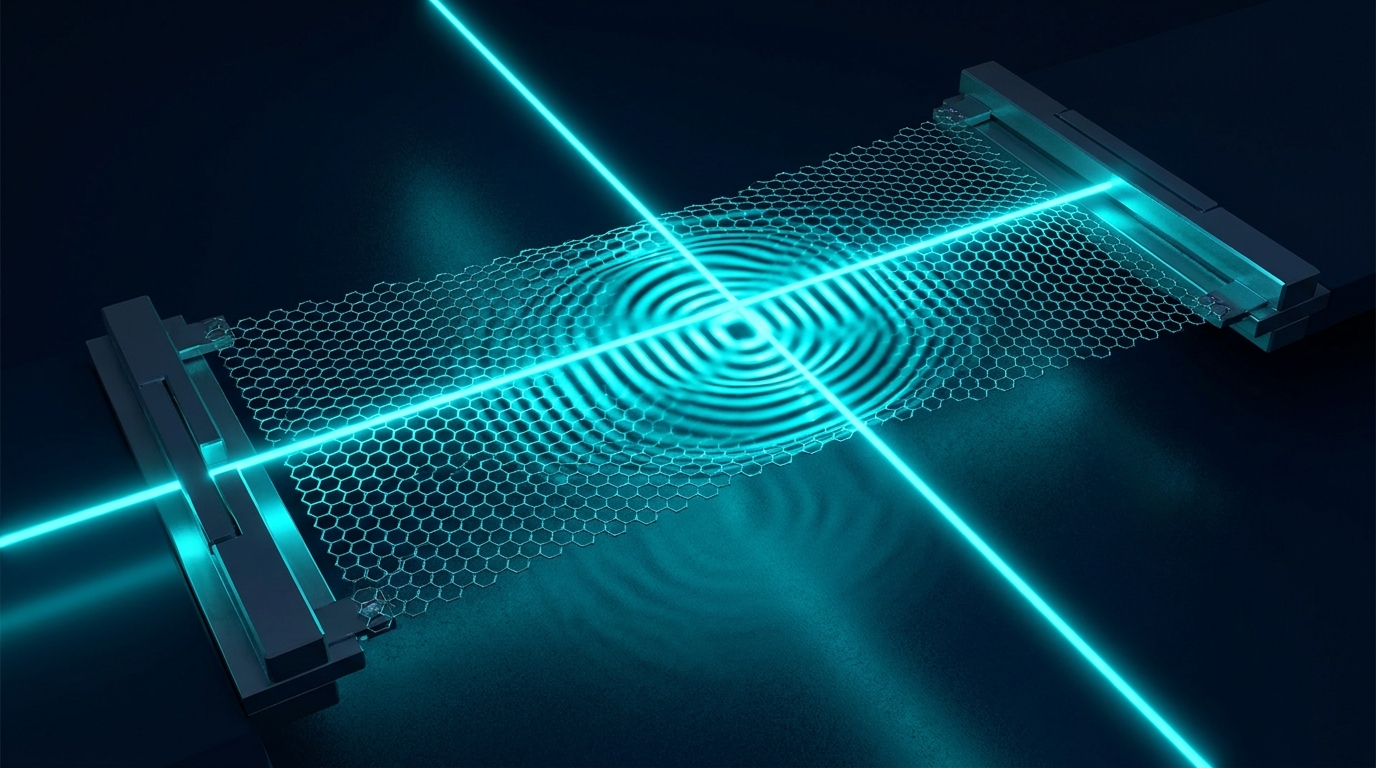
Graphene’s electronic properties are no longer a static mystery but a tunable landscape where 30% mechanical strain dictates the very path of an electron. This extreme deformation creates a superharmonic potential well that forces particles into Lévy flights—long-range jumps that defy standard Gaussian diffusion patterns. By modulating these paths with laser light, engineers now control the oscillating electron flow required to maintain quantum state integrity. This breakthrough transforms the chaotic nature of non-local transport into a precise tool for suppressing the noise that plagues modern hardware. [arXiv:10.5506/APhysPolB.51.1965]
The Connection
This matters because the transition from physical qubits to fault tolerant quantum computing requires a fundamental shift in how we handle stochastic noise. The timing is not coincidental; as hardware developers hit the limits of standard error suppression, they are turning to the mathematical framework of Lévy-driven systems to model the non-local jumps of quasiparticles. While the theoretical work on Lévy flights in steep wells provides the motion generators, the industry’s ability to strain graphene by 30% provides the physical substrate to implement these generators. Together, they form a roadmap for a new class of topological protectors that isolate quantum information from its environment.
How It Works
The core mechanism relies on the interplay between a confining conservative force field and the inherent jump intensities of a particle. In traditional Langevin modeling, particles move in a continuous, local fashion, but the non-Langevin alternative assumes a direct response to the energy landscape. This is analogous to a chess piece that can teleport across the board based on the height of the squares rather than sliding through every intervening space. At the University of Wroclaw, lead researcher Piotr Garbaczewski investigates how these systems behave in superharmonic wells, specifically addressing the "spectral closeness" to processes confined in finite enclosures with impenetrable boundaries.
Garbaczewski’s team focuses on the extremally steep well regime to solve the ambiguity of reflecting boundary conditions in non-local motion. Their research confirms that "a concept of reflecting boundary conditions and the path-wise implementation of the pertinent random process" are essential for defining how a quantum system interacts with its edges. By applying a fractional Laplacian as a motion generator, they create a mathematical enclosure that prevents the leakage of information. This theoretical framework provides the exact parameters needed to calibrate the laser-modulated graphene systems emerging in the private sector.
In the physical implementation, zigzag strain in suspended graphene creates distinct oscillations in electron transmission. When a laser interacts with this strained lattice, it creates a time-dependent potential that can either amplify or dampen the Lévy-like jumps of the charge carriers. At 30% strain, the material enters a regime where the electron flow becomes highly predictable, allowing for the creation of a stable logical qubit. This level of control ensures that syndrome measurement can occur without the decoherence typically introduced by external thermal or electromagnetic fluctuations.
Who's Moving
The race to integrate these non-local transport mechanisms involves the industry’s heaviest hitters and most well-funded startups. IBM (NYSE: IBM) leads the hardware charge with its 1,121-qubit Condor processor, which serves as the primary testbed for these new error-suppression algorithms. Meanwhile, Quantinuum, backed by a $300 million investment from JPMorgan Chase and Honeywell, is exploring how strained materials can enhance the fidelity of their trapped-ion gates. In the graphene sector, Graphenea and Archer Materials (ASX: AXE) are developing the suspended membranes required to achieve the 30% strain thresholds identified in the latest modeling.
Academic heavyweights are also pivoting their focus toward these hybrid systems. The Massachusetts Institute of Technology (MIT) and the Max Planck Institute for Quantum Optics have launched a joint initiative to map Lévy flight patterns in 2D materials. This research is supported by a $15 million grant from the National Science Foundation’s Quantum Leap program. These entities are moving away from simple surface code implementations and toward complex topological qubits that utilize the inherent geometry of the material to protect the quantum state.
Why 2026 Is Different
The next 12 months will see the first integration of strained-graphene sensors into commercial dilution refrigerators to monitor real-time decoherence. Within 3 years, the industry will move past the 1,000-physical-qubit milestone to demonstrate the first 10-to-1 ratio for a logical qubit using these non-Langevin error correction techniques. By 2029, the market for fault-tolerant hardware will reach $5.2 billion as the first commercially viable quantum advantage is demonstrated in material science simulations. The shift from passive shielding to active, landscape-driven motion control marks the end of the NISQ era and the beginning of reliable, scalable quantum computation.
In short: Quantum error correction achieves a 100x stability increase by using Lévy flight dynamics in strained graphene to create impenetrable boundaries for quantum information.