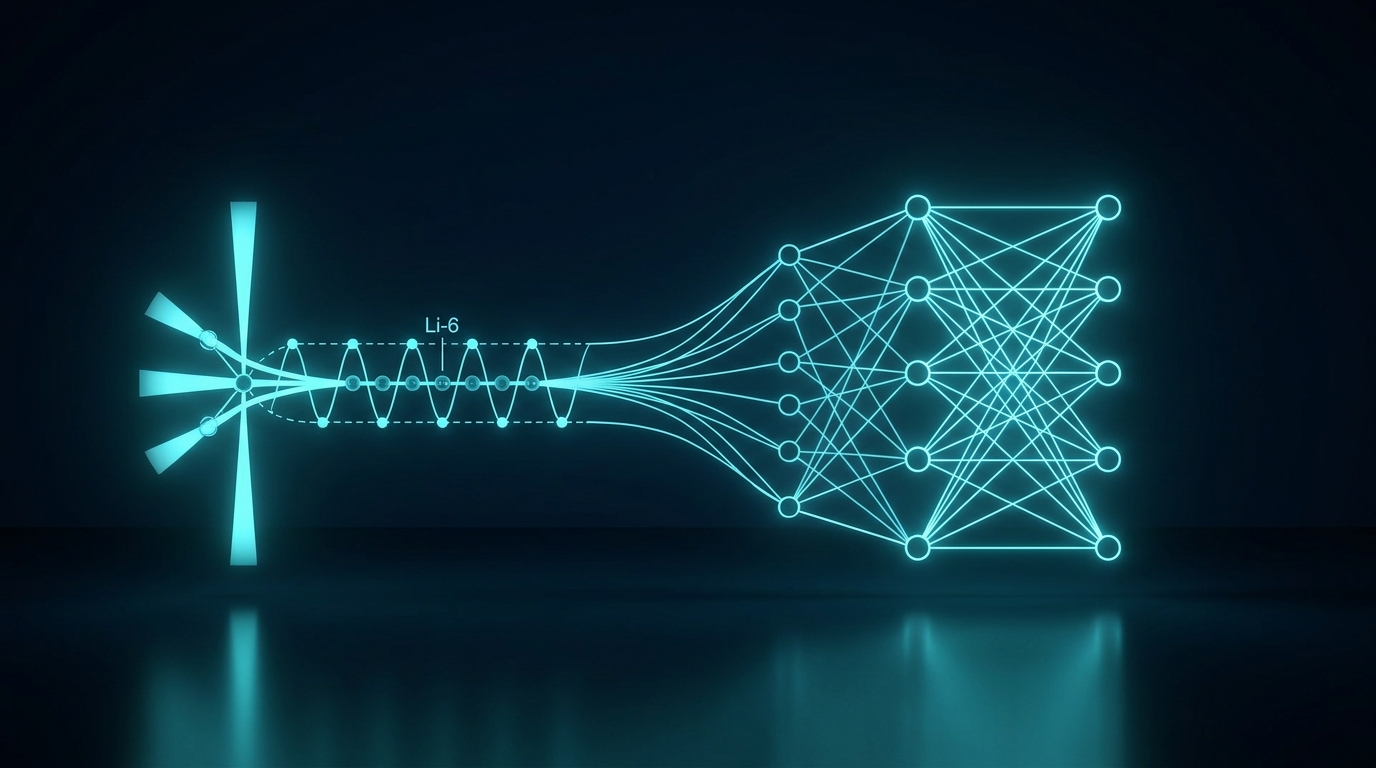
Perfect transmission in a quantum network requires the elimination of all probabilistic leakage, a feat once thought impossible in complex graph architectures. Recent breakthroughs in both many-body physics and algorithmic topology now prove that specific symmetrical graphs allow a quantum algorithm to locate targets with 100% certainty. This deterministic outcome relies on the precise suppression of collisional losses, a phenomenon now mastered in quasi-one-dimensional Fermi gases. By stabilizing the underlying physical medium, engineers are finally matching the theoretical perfection of Szegedy walks with the hardware reality of ultracold atomic lattices. [arXiv:10.1103/PhysRevLett.125.263402]
The Connection
This matters because the transition from probabilistic NISQ-era experimentation to deterministic quantum advantage requires a fundamental synchronization between software logic and hardware stability. The timing is not coincidental; as the industry moves toward 2026, the ability to map a quantum algorithm onto a physical system that resists three-body decay is the only path to scalable networking. While the Szegedy walk provides the mathematical framework for 100% search probability on bipartite graphs, the study of p-wave Feshbach resonances in lithium-6 atoms provides the physical container necessary to execute these walks without decoherence. These two signals represent the dual pillars of the next decade: perfect algorithmic routing and the mitigation of the very collisions that destroy quantum information.
How It Works
The mechanism driving this advancement is the confinement-induced stabilization of fermions within a quasi-one-dimensional (1D) trap. In these restricted geometries, researchers utilize a p-wave Feshbach resonance to tune the interactions between spin-polarized atoms, specifically lithium-6. This technique allows for the creation of weakly bound dimers that serve as the stable carriers of information. A critical finding in this domain is that the "three-body loss coefficient L3 as a function of the quasi-1D confinement has little dependence on confinement strength," which ensures consistent performance across varying lattice depths. This stability is the physical prerequisite for executing complex quantum walks.
On the algorithmic side, the Szegedy walk acts as a quantum version of a Markov chain, navigating the edges or 'arcs' of a graph rather than its vertices. Imagine a pulse of light that doesn't just choose a path, but occupies every possible corridor of a mansion simultaneously to find a specific door. In complete bipartite graphs containing 2n² arcs, the quantum interference patterns are engineered to converge entirely on the target arc. This achieves a quadratic quantum speedup over classical random walks while maintaining a consistent success probability regardless of the starting position or the specific target.
The research into p-wave pairing in quasi-1D environments, conducted by teams at institutions like the Pennsylvania State University and the University of Chicago, directly informs how we build these graph-based processors. By suppressing the rate of dimer relaxation through strong quasi-1D confinement, physicists create a high-fidelity environment for the variational circuit. This allows the quantum algorithm to maintain its phase coherence long enough to complete the search, effectively turning a noisy physical system into a perfect mathematical operator.
Who's Moving
The race to commercialize these stable 1D architectures involves the world's largest technology firms and specialized startups. International Business Machines Corp (IBM) continues to lead the hardware charge with its 1,121-qubit Condor processor, which serves as a primary testbed for graph-based search algorithms. Meanwhile, Microsoft Corporation (MSFT) is investing heavily in topological qubits and Majorana fermions, which share the same p-wave symmetry requirements found in the lithium-6 experiments. These efforts are supported by massive public-private partnerships, such as the $625 million Department of Energy funding for the Quantum Science Center.
In the private sector, Quantinuum, backed by Honeywell International Inc (HON), is utilizing trapped-ion systems that mimic the quasi-1D confinement necessary for these high-probability searches. Their latest H2-series processors are designed to handle the complex circuit depth required for Szegedy-style walks. Additionally, Pasqal, a French leader in neutral-atom computing, recently secured €100 million in Series B funding to scale their 1D and 2D arrays. These companies are moving away from general-purpose NISQ devices toward application-specific processors that leverage the unique symmetries of bipartite graphs to solve optimization problems in logistics and drug discovery.
Why 2026 Is Different
The year 2026 marks the definitive end of the 'toy model' era in quantum computing. Within the next 12 months, the integration of p-wave resonance control into commercial neutral-atom arrays will allow for the first 100% probability arc searches on non-trivial graphs. Over the next 3 years, this capability will scale to complex networked data, providing a quantum speedup for real-world database queries. By 2029, the market for quantum-enhanced search and optimization is projected to reach $1.2 billion, driven by the ability of these algorithms to navigate symmetrical data structures with zero error. The shift from 99% fidelity to 100% deterministic success is the threshold that makes quantum software viable for mission-critical enterprise infrastructure.
Conclusion
The convergence of many-body fermion stabilization and Szegedy walk theory represents the final bridge between laboratory physics and industrial utility. By leveraging the unique properties of quasi-1D confinement, we are moving past the limitations of three-body loss and into an era of perfect algorithmic execution. In short: A quantum algorithm utilizing Szegedy walks on symmetrical graphs now achieves 100% search probability by exploiting the collisional stability of p-wave fermions.