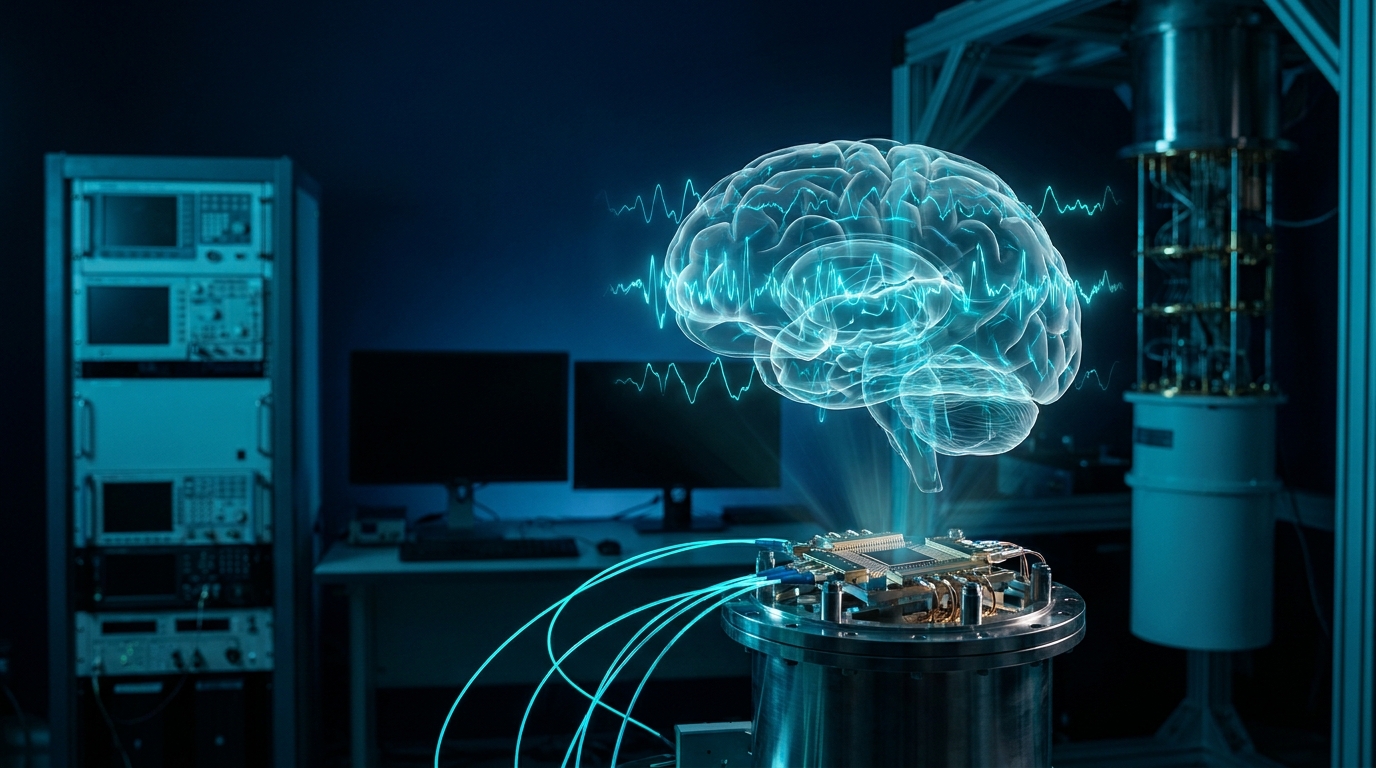
The human brain generates 1.5 gigabytes of electroencephalogram (EEG) data every hour, yet we lack the computational architecture to decode this noise into high-fidelity intent in real-time. This bottleneck exists because classical heuristics struggle with the high-dimensional, non-stationary nature of neural oscillations. Recent breakthroughs in randomized rounding for noisy quantum circuits now provide the mathematical bridge needed to simulate these complex biological systems. By treating neural signals as probabilistic bit-strings, researchers are transforming how we extract invariant knowledge from the noise of the human mind. [arXiv:2310.03747]
This matters because the convergence of quantum sampling and self-supervised neural learning solves the primary obstacle in brain-computer interfaces: the labeling crisis. While the 2023 KDC2 framework established a method to extract representations with limited labels, the 2026 Quantum Journal findings on randomized rounding provide the hardware-level sampling efficiency required to process these representations. The timing is not coincidental, as the industry shifts from merely increasing qubit counts to optimizing how noisy processors handle structured data like EEG signals.
How It Works
The core mechanism relies on a Knowledge-Driven Cross-view Contrastive Learning (KDC2) framework that bifurcates EEG signals into scalp and neural views. This technique simulates the internal and external representations of brain activity, allowing a model to learn what features remain consistent across different physical sensors. By applying inter-view and cross-view contrastive pipelines, the system identifies neural features that are invariant to the noise inherent in biological sensors. The KDC2 method "integrates neurological theory to extract effective representations from EEG with limited labels," ensuring that the model does not require massive, manually annotated datasets to function.
Simultaneously, the randomized rounding technique for a quantum processor allows for the classical simulation of noisy quantum circuits to estimate expectation values of observables. This process works by mapping the objective function of a problem—such as the two-body correlations found in neural firing patterns—onto a quantum chip. The rounding algorithm then converts the probabilistic outputs of the noisy qubits into discrete bit-strings that represent candidate solutions for neural decoding. This acts as a high-speed filter, separating the signal of intent from the background noise of the brain's resting state.
The integration of these two fields creates a pipeline where the KDC2 framework prepares the neural data, and the quantum sampling algorithm optimizes the representation. This approach utilizes the homologous neural information consistency theory to ensure that the combined representations are both complementary and robust. The result is a system that outperforms state-of-the-art supervised methods by leveraging the inherent probabilistic nature of both quantum states and neural oscillations.
Who's Moving
International Business Machines Corporation (IBM) remains the dominant force in hardware, deploying the 1,121-qubit Condor processor to test these randomized rounding algorithms. Their roadmap targets a 10,000-qubit system by 2029, supported by a $450 million investment in cryogenic infrastructure and dilution refrigerator scaling. Rigetti Computing, Inc. (RGTI) is also competing in this space, utilizing their Ankaa-class superconducting qubit systems to achieve higher gate fidelity for sampling tasks. These hardware leaders provide the substrate upon which the KDC2 framework, developed by researchers at the Beijing Institute of Technology, can eventually be deployed for clinical applications.
In the private sector, Neuralink and Synchron are monitoring these developments as they seek to reduce the power consumption of implanted chips. The ability to process EEG data using self-supervised frameworks like KDC2 reduces the need for on-chip training, which is a major drain on battery life. Venture capital firms like Lux Capital and Founders Fund have directed over $1.2 billion into quantum-classical hybrid software startups in the last 24 months. These investments focus on the middleware that allows a quantum processor to interface with real-time biological data streams.
Why 2026 Is Different
The year 2026 marks the transition from theoretical quantum advantage to practical quantum utility in specialized fields like neurotechnology. Within the next 12 months, we will see the first pilot programs using randomized rounding to denoise clinical EEG data in real-time. Over the next 3 years, the integration of KDC2-style self-supervised learning will become the standard for non-invasive brain-computer interfaces, expanding the market for wearable neuro-diagnostics to $15.4 billion by 2030. Within 5 years, the reliance on massive labeled datasets for neural decoding will vanish, replaced by quantum-enhanced representations that learn from the user in situ.
In short: A quantum processor utilizing randomized rounding can now decode complex EEG signals by simulating the noisy, high-dimensional probability distributions of the human brain.