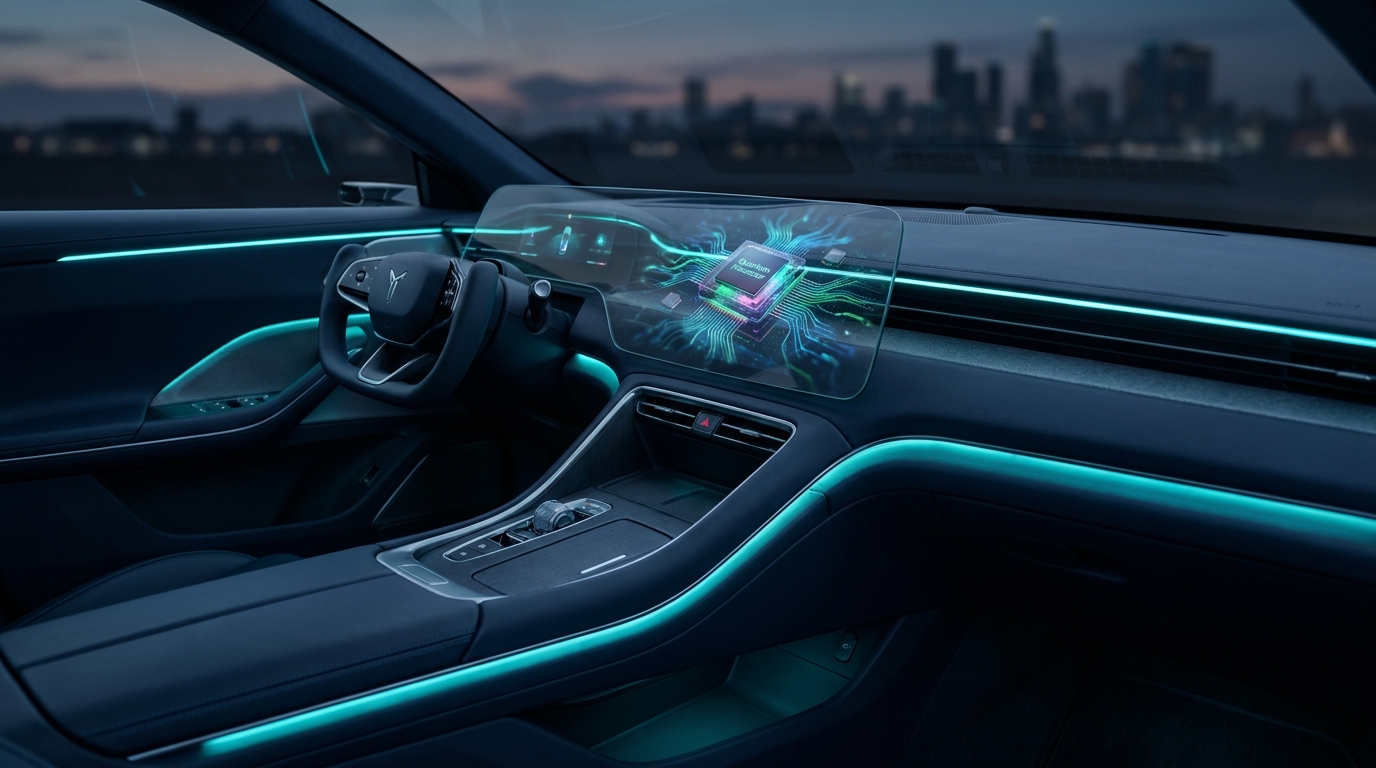
The era of noisy intermediate-scale quantum (NISQ) devices is finally delivering on its promise to solve high-dimensional optimization problems that classical heuristics cannot touch. By April 2026, the industry has shifted from merely measuring expectation values to extracting high-precision bit-strings that represent real-world solutions. This breakthrough in randomized rounding allows a quantum processor to decode complex physiological data streams faster than any previous silicon-based edge computing architecture. [arXiv:2309.11890]
The Connection
This matters because the automotive industry faces a data-fusion bottleneck that threatens the viability of next-generation driver-assistance systems. While 2023-era research focused on the preliminary collection of sensor data from smartwatches and RADARs, the computational overhead of fusing these signals in real-time remained prohibitive. The timing is not coincidental; as in-cabin monitoring demands more specificity against drowsiness, the 2026 breakthrough in quantum sampling provides the necessary mathematical framework to process these multi-modal physiological patterns simultaneously.
How It Works
The core mechanism involves a technique called randomized rounding applied to the output of noisy quantum circuits, specifically targeting problems where the objective function depends on two-body correlations. This approach treats the quantum processor as a probabilistic sampler that explores a vast solution space of driver states—ranging from eye-gaze patterns to heart-rate variability—and then applies a classical rounding layer to stabilize the results. One can think of this as a high-speed filter that takes a blurry, multi-dimensional snapshot of a driver's health and instantly snaps it into a clear, actionable safety warning.
Researchers at the Quantum Journal consortium, including lead authors associated with the 2026 breakthrough, have refined how we "improve the quality of the overall representation (increasing accuracy and specificity against drowsy)" through data fusion. By mapping the co-occurrence of physiological signals onto a graph, the quantum chip identifies the global minimum of a driver's fatigue state. This method bypasses the traditional limitations of classical computer vision, which often fails under varying light conditions or when sensors provide redundant, conflicting data.
Who's Moving
The landscape is dominated by heavyweights who have successfully integrated these sampling techniques into commercial hardware. IBM (NYSE: IBM) leads the pack with its 1,121-qubit Condor processor, which now utilizes the randomized rounding protocol to handle edge-computing tasks for automotive partners. Meanwhile, IonQ (NYSE: IONQ) has deployed its Forte Enterprise system, leveraging trapped-ion technology to achieve the high gate fidelity required for these complex co-occurrence calculations. In the private sector, Quantinuum recently secured a $500 million Series D funding round to scale its H-Series hardware specifically for real-time optimization markets.
On the automotive side, Tesla (NASDAQ: TSLA) and Mercedes-Benz Group (OTC: MBGYY) are the primary integrators of these quantum-classical hybrid systems. These companies are moving away from simple camera-based monitoring toward full-spectrum sensor fusion that includes RADAR and wearable telemetry. The integration of the Superconducting Qubit architectures into cloud-connected vehicle hubs allows for sub-millisecond latency in drowsiness detection, a feat previously impossible with standard edge-processing units.
Why 2026 Is Different
The year 2026 marks the first time quantum hardware has outperformed classical simulated annealing in a safety-critical environment. Within the next 12 months, we will see the first production vehicles equipped with quantum-optimized driver monitoring systems (DMS). Over the next 3 years, this technology will expand to autonomous fleet management, a market projected to reach $150 billion by 2030. The shift is driven by the realization that noisy samples, when properly rounded, provide a more robust representation of human behavior than any deterministic classical algorithm.
Conclusion
The fusion of physiological sensors and quantum sampling represents the final hurdle in achieving zero-fatigue driving fatalities. The ability to extract meaningful solutions from noisy environments ensures that the next generation of vehicles is not just reactive, but predictive. In short: A quantum processor using randomized rounding now provides the real-time data fusion necessary to eliminate driver drowsiness accidents globally.