Quantum computers are famously fragile. The very feature that gives them their power—the intricate entanglement of quantum states—is also their greatest weakness. When a quantum system interacts with its environment, a process known as decoherence, that delicate entanglement begins to dissolve. For decades, the central challenge of the field has been determining exactly how much noise a system can withstand before its quantum advantages vanish entirely. We have known that error correction codes can protect information, but the fundamental physical boundary between a 'quantum' state and a 'classical' one in the presence of noise has remained elusive. [arXiv:10.1103/PhysRevLett.132.170602]
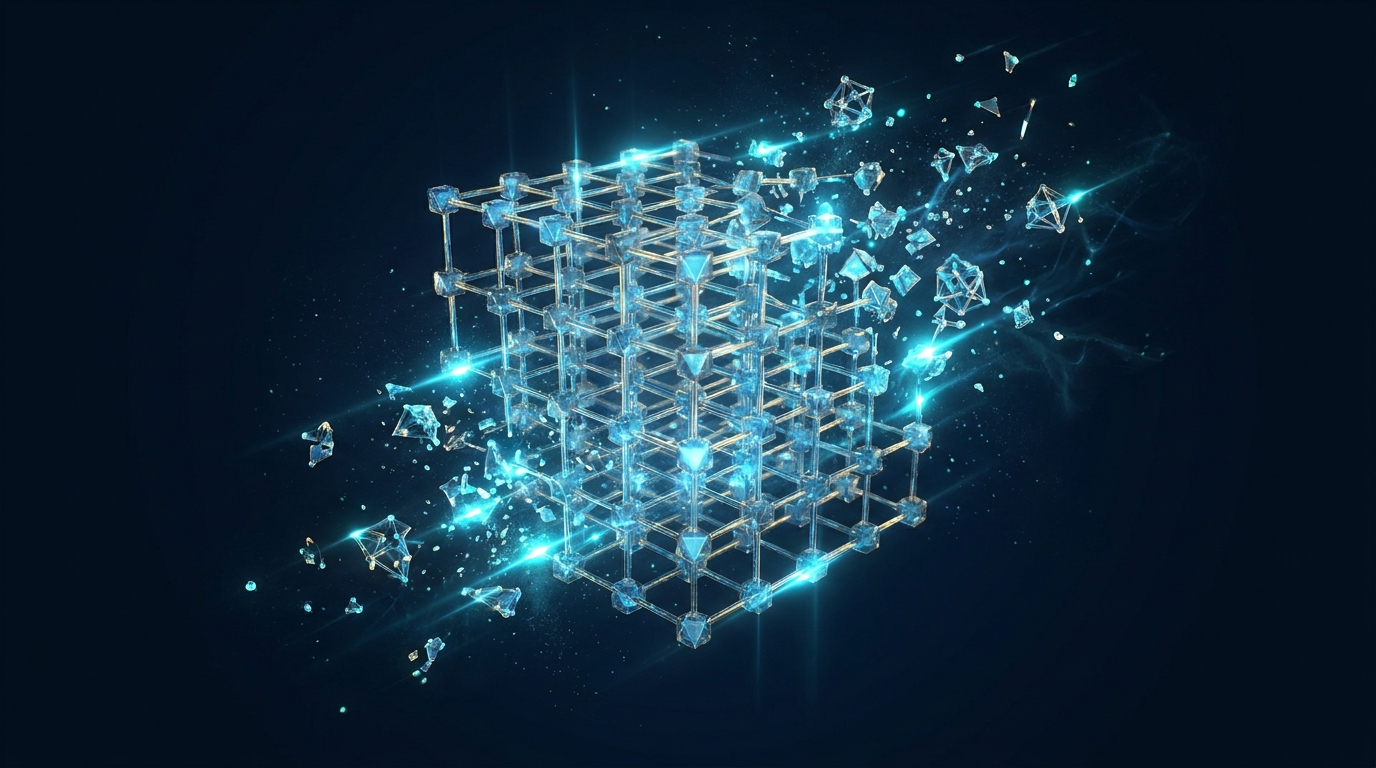
A team of researchers, publishing in Physical Review Letters in September 2023, has finally pinpointed this boundary. By studying topological states like the toric code and X-cube fracton models, they discovered that decoherence induces a specific type of phase transition. This isn't a transition between solid and liquid, but a 'separability transition'—a point where a complex, entangled quantum state becomes so fragmented that it can be described as a simple collection of short-range entangled pieces. This discovery provides a rigorous theoretical floor for the entire endeavor of building a fault-tolerant quantum computer.
The Core Finding
The researchers demonstrated that as local decoherence increases, a quantum system undergoes a sharp transition into a 'separable' state. This is a profound shift in how we view quantum noise. Instead of noise just making a calculation 'fuzzier,' it eventually hits a threshold where the underlying topological order—the very thing that protects the information—collapses. The study specifically focused on the 2D and 3D toric codes, which are the leading theoretical blueprints for building a stable logical qubit.
The team found that this transition is not arbitrary; it precisely coincides with the known thresholds for active error correction. In the 2D toric code subjected to bit-flip errors, the transition occurs at a critical probability $p_c$ that maps directly to the phase transitions in the random-field bond Ising model. Think of it like a bridge: as you remove individual planks (decoherence), there is a specific moment where the bridge can no longer support a traveler, regardless of how well they balance. The abstract notes that the researchers "provide evidence for the existence of decoherence-induced separability transitions that precisely coincide with the threshold for the feasibility of active error correction."
The State of the Field
Before this paper, the community understood error correction primarily through the lens of algorithms—if we run this specific code, can we fix the errors? This approach was pioneered by figures like Alexei Kitaev, who introduced the toric code in the late 1990s, and later refined by researchers at institutions like Caltech and IBM. However, these studies often treated the 'code' and the 'physics of noise' as two separate problems. We knew the limits of the codes, but we didn't fully grasp the fundamental physical state of the decohered matter itself.
What makes this new approach different is its focus on 'separability.' By proving that the point where a state becomes 'separable' (and thus classically simulatable) is the same point where error correction fails, the researchers have linked quantum information theory with statistical mechanics. This happens at a time when the quantum computing landscape is shifting from 'noisy intermediate-scale quantum' (NISQ) devices toward true fault-tolerant quantum computing. Understanding these transitions is no longer a theoretical exercise; it is a requirement for hardware design.
From Lab to Reality
For scientists, this work unlocks a new way to classify quantum phases. It suggests that 'topological order' isn't just a property of pure states in a vacuum, but a resilient phase of matter that can be defined by its resistance to becoming separable. This opens the door to researching new types of matter that might be even more robust against decoherence than the current surface code models. It provides a mathematical target for anyone designing new quantum memories.
For engineers, this research defines the 'red line' for hardware performance. If a system's local decoherence rate exceeds the $p_c$ identified in this paper, no amount of clever software or active error correction can save the data. This is particularly relevant for companies like Google and IBM, who are currently scaling up their superconducting qubit arrays. For investors, this clarifies the risk profile of the quantum error correction market, which is estimated to be a multi-billion dollar sector by 2030. It provides a metric to judge whether a hardware architecture is even capable of reaching the fault-tolerant era.
What Still Needs to Happen
Despite this breakthrough, significant hurdles remain. First, the current study focuses on 'local' decoherence—errors that happen to individual qubits independently. In real-world hardware, errors are often correlated, meaning one qubit's failure affects its neighbor. Researchers at the University of Sydney and other centers are currently grappling with how these correlated errors shift the separability transition. If correlations move the threshold significantly, current hardware designs might be further from the goal than we realize.
Second, while the paper identifies where the transition happens, it does not provide a 'low-overhead' way to stay on the right side of it. Current surface code implementations require hundreds or even thousands of physical qubits to create a single reliable logical qubit. The challenge now shifts to finding states that undergo this separability transition at much higher noise levels, or finding ways to manipulate the transition itself. This is a long-term research arc, likely requiring another decade of refinement before we see these principles applied in a commercial-grade quantum processor.
Conclusion
This research changes our understanding of quantum fragility by proving that the limit of error correction is a fundamental physical phase transition. It bridges the gap between the abstract math of information theory and the hard reality of condensed matter physics.
In short: Quantum error correction limits are defined by a separability transition where decoherence transforms a topological state into a collection of short-range entangled pieces.