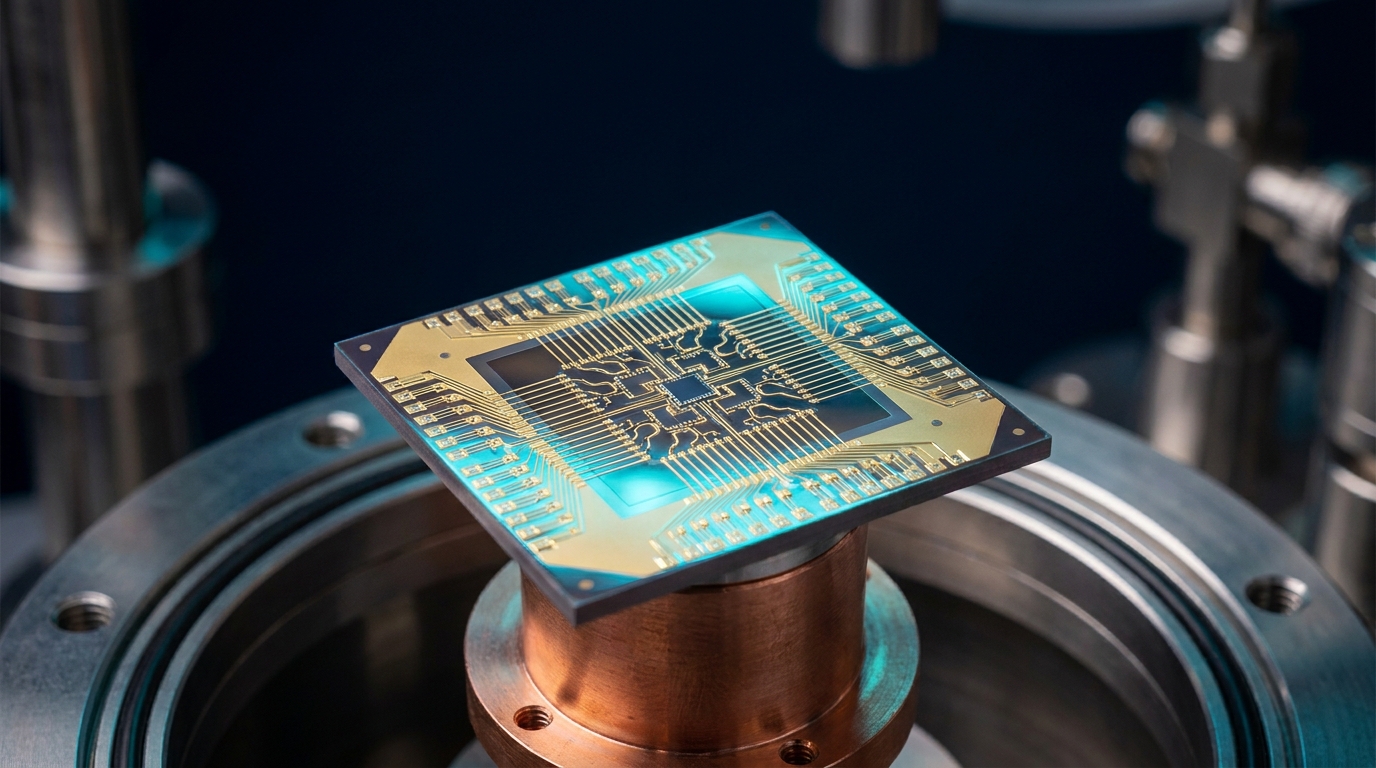
Munich-based Peak Quantum has closed a €2.2 million pre-seed funding round to accelerate the development of fault-resistant superconducting quantum processors. The round was led by Cloudberry Ventures, with participation from United Founders, QAI Ventures, and Golden. This injection brings the startup’s total financing to over €5 million as of April 2026.
What They're Actually Building
Peak Quantum is engineering superconducting quantum chips specifically designed for industrial applications where error rates currently prohibit commercial utility. While the company has not disclosed its current physical qubit count, its technical roadmap focuses on hardware-level error mitigation rather than purely software-based correction. This approach places them in the "noisy intermediate-scale quantum" (NISQ) plus category, aiming for high-fidelity gates that can survive longer coherence times.
The company’s strategy contrasts with industry giants like IBM, which is currently executing a roadmap toward 100,000 qubits by 2033, and Google, which focuses on surface code error correction. Peak Quantum claims its architecture reduces the overhead required for fault tolerance, though it has yet to publish peer-reviewed benchmarks demonstrating a logical qubit with lower error rates than its physical constituents. In the 2026 landscape, the technical hurdle is no longer just qubit count, but the gate fidelity threshold of 99.9% required for meaningful scale.
Winners and Losers
The primary competitors for Peak Quantum include established superconducting players like IQM Quantum Computers and Alice & Bob, as well as the hardware divisions of Rigetti and Oxford Quantum Circuits (OQC). If Peak Quantum successfully delivers a chip with superior native error resistance, it threatens the current dominance of larger firms that rely on massive qubit redundancy to achieve fault tolerance. Conversely, the Munich quantum ecosystem benefits from this capital infusion, strengthening the Bavarian "Quantum Valley" as a legitimate rival to Delft and Helsinki.
For the broader market, this development signals a shift in VC appetite toward specialized hardware startups that address the "error bottleneck." Cloud providers like AWS and Microsoft, which aggregate diverse quantum backends, are the ultimate beneficiaries of this fragmentation, as they can offer Peak’s specialized chips alongside gate-based and annealing systems without the R&D risk of building the hardware themselves.
The Bigger Picture
In April 2026, the quantum sector is characterized by a "flight to quality." The era of funding any startup with a dilution refrigerator is over. Peak Quantum’s €2.2 million round is modest compared to the $100M+ rounds seen in 2021, reflecting a more disciplined investment environment that demands specific technical milestones. This deal aligns with the European Union’s broader strategy to achieve technological sovereignty in deep tech, supported by initiatives like the EU Quantum Flagship.
Recent comparable deals include the €15M Series A for Nordic-based Quanscient and the $12M bridge round for New York’s Seeqc. These figures suggest that while the "Quantum Winter" of 2024-2025 has thawed, valuations remain grounded in hardware performance rather than theoretical potential. Peak Quantum must now move from the design phase to a demonstrated multi-qubit array that outperforms standard transmon architectures in coherence time.
The Signal
The signal here is the continued decentralization of the superconducting qubit supply chain. While IBM and Google maintain the lead in raw scale, the emergence of well-funded European boutiques like Peak Quantum suggests that the "standard model" of superconducting qubits is still open to architectural disruption. What this reveals is a bet by VCs that the first commercially viable fault-tolerant machine may not come from a 1,000-qubit brute-force approach, but from a 50-qubit system with superior intrinsic error suppression. The validation of this claim will require Peak Quantum to demonstrate a two-qubit gate fidelity exceeding 99.95% by the end of 2026.
"The path to industrial quantum utility is not paved with more qubits, but with better ones that can actually finish a calculation before decohering."
In short: Peak Quantum is betting that architectural innovation in superconducting circuits can bypass the massive scaling requirements currently hampering industrial quantum adoption.