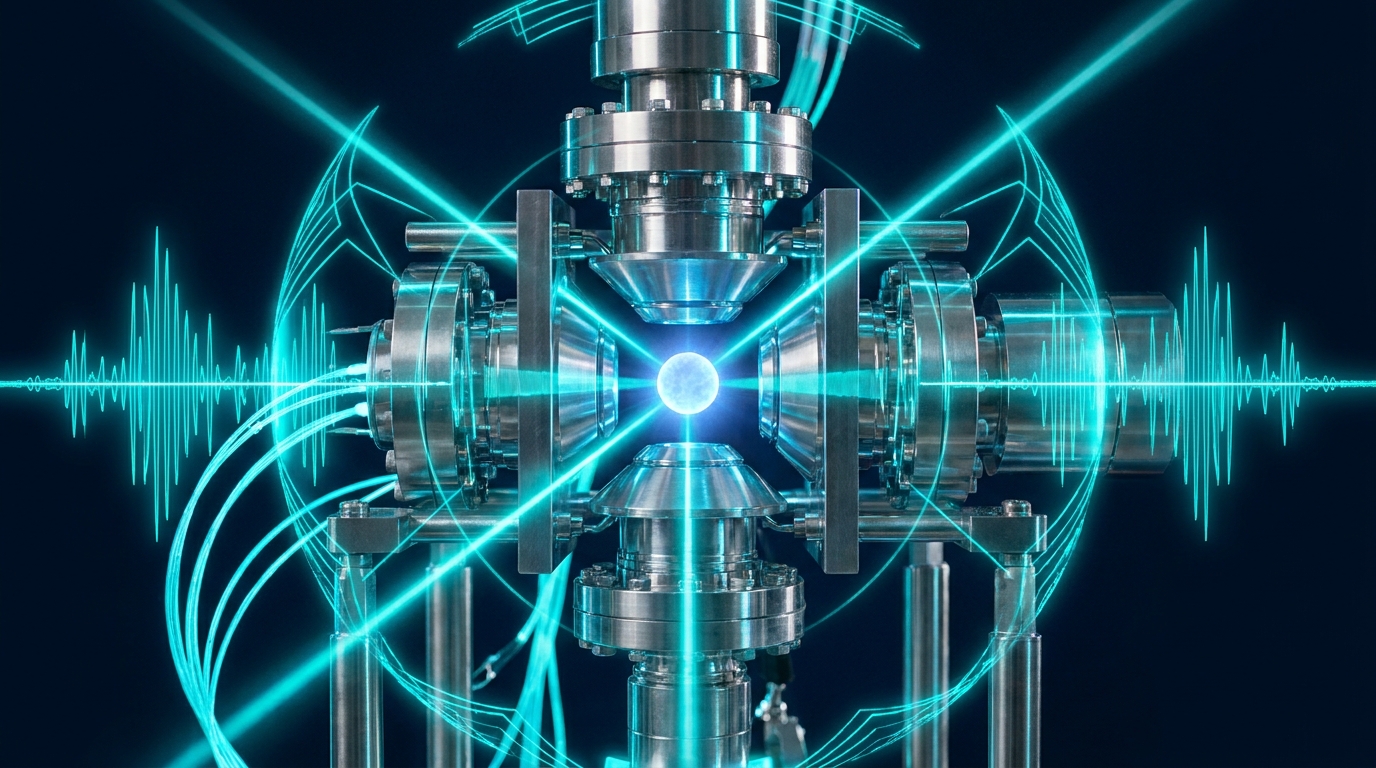
The search for dark matter remains the most profound game of hide-and-seek in modern physics. While we know it accounts for roughly 85 percent of the universe's matter, it refuses to interact with light, leaving scientists to hunt for the faint, rhythmic 'ticks' it might induce in the fundamental constants of nature. Researchers at the University of Delaware and collaborating institutions have identified a critical bottleneck: our best sensors, atomic clocks, are often too focused on narrow frequencies or drowned out by environmental noise to catch the fleeting signature of an ultralight dark matter wave. [arXiv:2302.12956]
The Core Finding
The research team has developed a sophisticated quantum algorithm designed to sharpen the vision of the next generation of timekeepers. By applying a new broadband dynamical decoupling protocol, the researchers demonstrate how to maximize a clock's sensitivity to dark matter while simultaneously filtering out the 'jitter' of background noise. This approach moves beyond traditional methods that only look for specific, pre-defined signals. Instead, the algorithm allows a sensor to scan a wider range of frequencies, effectively turning a narrow-beam flashlight into a powerful floodlight. As the authors state, this method can be used to "improve the sensitivity of a quantum sensor to a signal while suppressing sensitivity to noise." Through numerical simulations, the team proved that their algorithm maintains high precision even when accounting for the natural decoherence of dark matter waves, a factor that often ruins simpler quantum measurements.
The State of the Field
Until now, the hunt for ultralight scalar dark matter relied heavily on differential spectroscopy—comparing two clocks—or narrowband dynamical decoupling, which is highly sensitive but only at specific frequencies. These methods were pioneered by groups like those led by Derevianko and Pospelov, who established the theoretical framework for dark matter-induced variations in fundamental constants. However, the quantum software landscape is shifting from general-purpose computing toward specialized metrology. This paper bridges that gap by treating the atomic clock not just as a timekeeper, but as a variational circuit capable of being tuned for discovery. While the broader quantum computing industry focuses on error correction for gates, this work applies those same principles to sensing, leveraging the inherent stability of the thorium-229m isomer—a transition widely considered the future of nuclear clocks.
From Lab to Reality
For scientists, this breakthrough unlocks a path to using the proposed thorium nuclear clock as a laboratory-scale observatory. Because the thorium nucleus is roughly 10,000 times more sensitive to variations in the fine-structure constant than electronic transitions in standard atoms, this quantum algorithm provides the necessary software infrastructure to exploit that physical advantage. For engineers, this research suggests that the quantum software used to stabilize clocks could be integrated into GPS and deep-space navigation systems, which require extreme resistance to local noise. While the quantum metrology market is currently a niche segment of the broader quantum industry—estimated to reach $1.5 billion by 2030—algorithms like this are the essential 'operating systems' that will make these sensors commercially viable for mineral exploration or fundamental physics research.
What Still Needs to Happen
Despite the algorithmic progress, two major hurdles remain. First, the excitation of the thorium-229m isomer typically requires vacuum ultraviolet (VUV) lasers, which are notoriously difficult to operate with the precision needed for a clock. The researchers propose an alternative excitation method to bypass this, but it has yet to be fully realized in a laboratory setting. Second, the dark matter decoherence time—the window in which the dark matter signal remains coherent with the clock—places a hard limit on how long the quantum algorithm can run. Groups at PTB in Germany and NIST in the United States are currently racing to build the first functional thorium clock, but a fully integrated 'dark matter telescope' based on this paper's design is likely five to ten years away.
Conclusion
By reimagining the atomic clock as a programmable quantum sensor, this research provides a roadmap for detecting the invisible architecture of our universe. In short: the proposed quantum algorithm enables nuclear clocks to suppress environmental noise while maintaining broadband sensitivity to the elusive signals of ultralight dark matter.