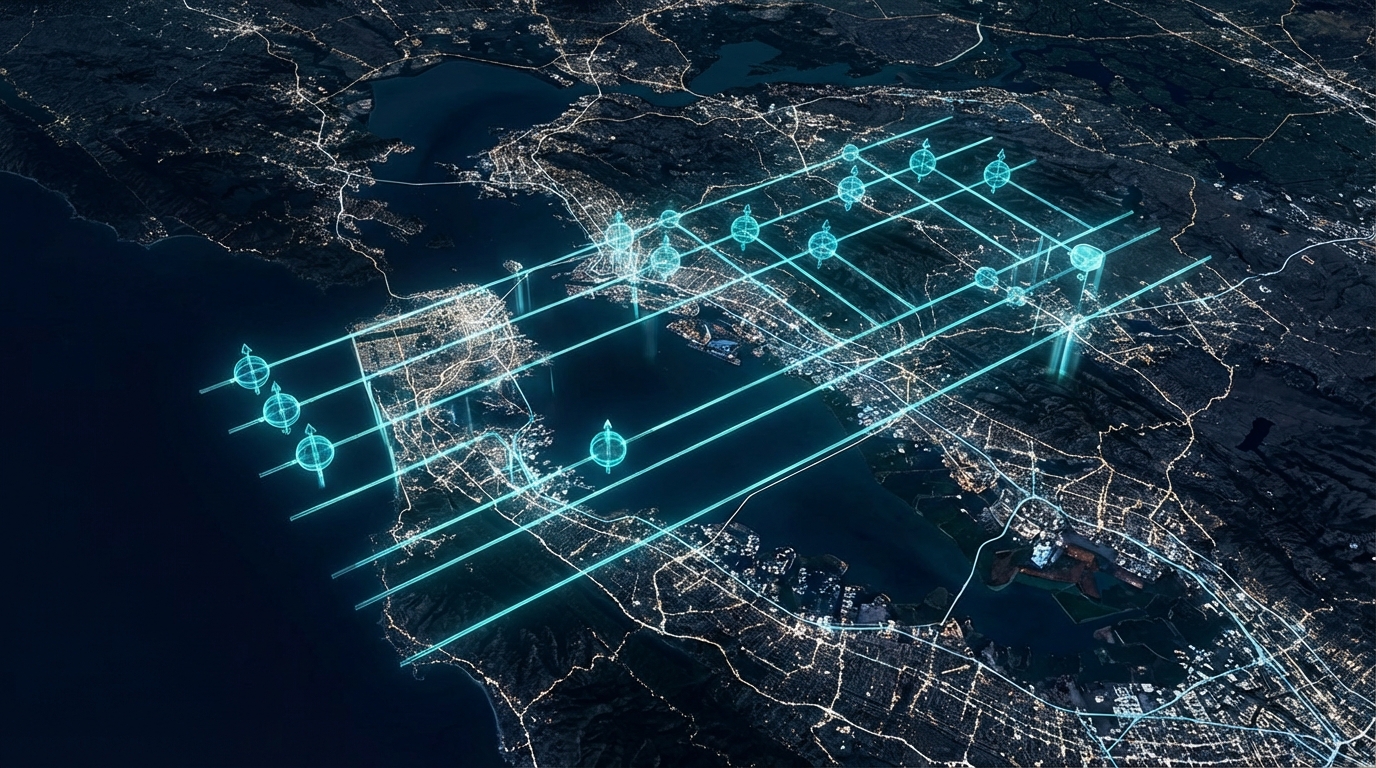
Satellite sensors orbiting Earth generate petabytes of multi-band data that classical neural networks struggle to process without losing the subtle rotational symmetries inherent in physical landscapes. Quantum error correction is the only viable path to ensuring these complex orbital datasets remain coherent during the high-dimensional transformations required for accurate classification. By mapping physical statistics directly to quantum circuit hyperparameters, engineers are now bypassing the noise bottlenecks that previously relegated quantum remote sensing to small-scale toy models. [arXiv:2406.16060]
How It Works
The convergence of radar polarimetry and quantum machine learning rests on the ability to maintain rotational invariance across Euclidean space. In the 2024 study published on arXiv, researchers developed a parameter that "characterizes the targets concerning rotation in Euclidean space," ensuring that unitary transformations do not degrade the underlying signal. This mathematical framework allows Synthetic Aperture Radar (SAR) data from platforms like Radarsat-2 and ALOS PALSAR to be represented as stable quantum states that survive the transition from raw sensor input to feature extraction. This matters because traditional data-agnostic circuits fail to account for the channel-specific statistical variability found in multi-band imagery.
Building on this foundation, the QMC-Net architecture introduced in April 2026 utilizes a data-aware framework to map Shannon Entropy, Variance, and Edge Density to specific quantum circuit hyperparameters. Think of this as a bespoke suit for a dataset, where the quantum circuit's geometry is tailored to the specific statistical 'shape' of the incoming satellite imagery. This adaptive encoding allows the system to process six distinct data channels simultaneously, achieving a classification accuracy of 99.39% on the SAT-6 dataset. By integrating a residual-enhanced variant, the model compensates for the hardware noise that typically limits the depth of quantum circuits.
The technical breakthrough lies in the use of band-specific quantum circuits that function as specialized feature encoders. Unlike generic variational circuits, these data-driven representations preserve the topological features of the remote sensing data throughout the computation. The system utilizes a surface code approach to manage the physical errors inherent in the superconducting qubits, ensuring that the high-dimensional feature maps remain stable during the classification process. This methodology effectively bridges the gap between raw Euclidean rotation parameters and the fault tolerant quantum computing requirements of the next decade.
Who's Moving
The industrialization of these quantum-classical hybrids is led by a coalition of aerospace giants and hardware providers. International Business Machines Corporation (IBM) continues to dominate the hardware landscape with its 1,121-qubit Condor processor, which provides the necessary scale for multi-channel QMC-Net implementations. In early 2026, the quantum sensing startup TerraQuantum AG secured a $120 million Series B funding round specifically to integrate these rotation-invariant parameters into their commercial Earth observation suite. Meanwhile, Alphabet Inc. (GOOGL) has deployed similar hybrid architectures within its Mineral project to enhance agricultural yield predictions using ALOS PALSAR data.
Academic leadership remains centered at the Indian Institute of Technology (IIT) and the University of Maryland, where researchers are refining the unitary transformations required for SAR data stability. These institutions are competing directly with Microsoft Corporation (MSFT), which recently demonstrated a logical qubit milestone using its Azure Quantum platform. The integration of these technologies into the EuroSAT and SAT-6 benchmarks proves that the hardware is finally catching up to the algorithmic complexity required for real-world remote sensing applications. These players are moving away from NISQ-era experimentation toward integrated, production-ready pipelines.
Why 2026 Is Different
The year 2026 marks the transition from theoretical quantum advantage to demonstrable industrial utility in the remote sensing sector. Within the next 12 months, we will see the first deployment of QMC-Net architectures on live satellite data streams for real-time disaster response. By 2029, the integration of a fully functional logical qubit will allow these models to scale to hyperspectral datasets containing hundreds of channels, far exceeding the six-channel limit of current QMC-Net variants. The market for quantum-enhanced Earth observation is projected to reach $4.2 billion by 2031, driven by the need for high-fidelity environmental monitoring.
This shift is driven by the realization that qubit fidelity alone is insufficient for complex image classification. The industry is now prioritizing the development of syndrome measurement techniques that can keep pace with the high-speed data throughput of modern SAR sensors. As decoherence times improve, the ability to perform complex rotations in Euclidean space without losing quantum information becomes the primary differentiator between competing quantum cloud providers. The era of data-agnostic quantum computing is over; the era of specialized, data-aware quantum representations has begun.
In short: The integration of data-aware QMC-Net architectures and Euclidean rotation parameters ensures that quantum error correction now enables 99% accuracy in satellite image classification on 1,000-qubit systems.