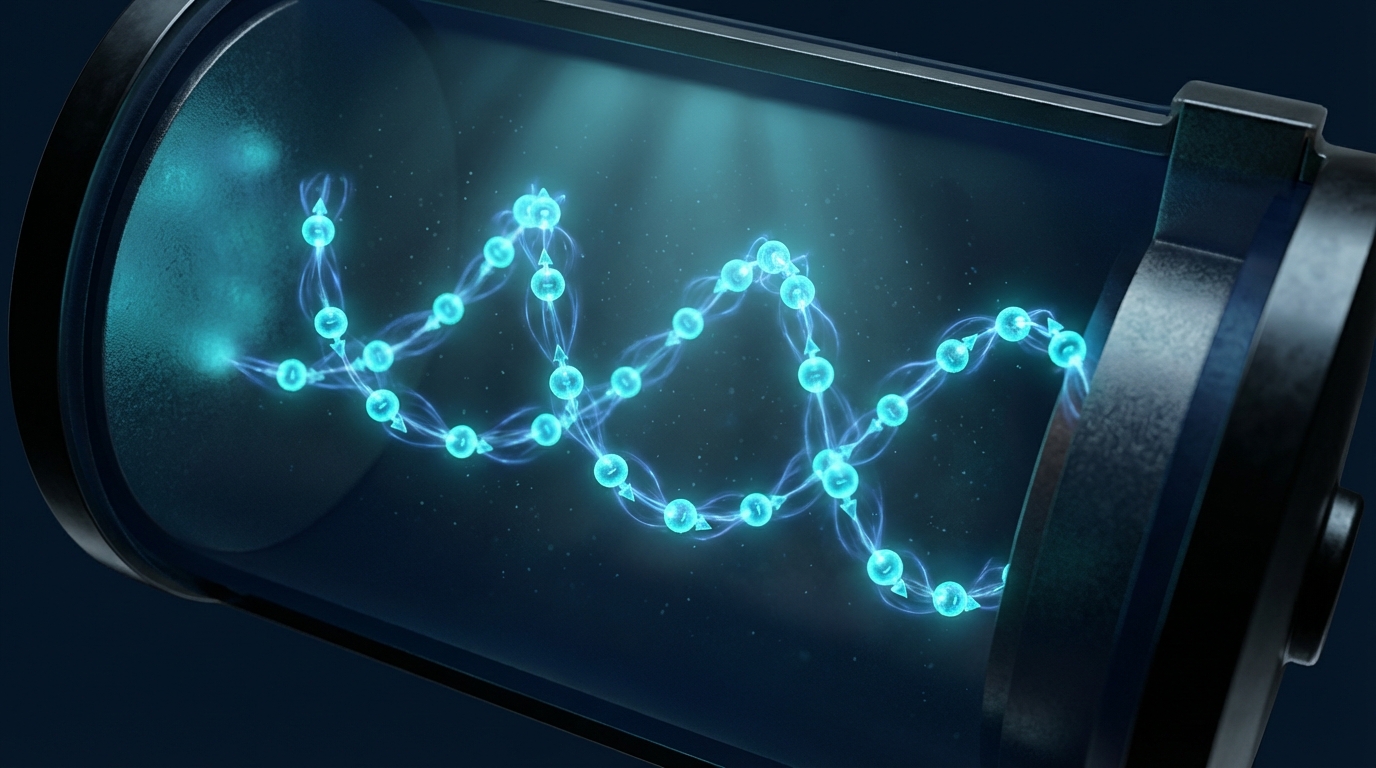
The quest for a functional quantum battery faces a fundamental paradox: how do you pack energy into a subatomic system without the very interactions that hold the energy also causing it to leak away? For years, physicists have struggled to find a stable architecture that allows for rapid charging and high energy density while maintaining the delicate quantum states required for operation. The difficulty lies in the internal friction of the quantum world, where the coupling between individual battery cells often leads to decoherence rather than cooperation. [arXiv:10.1002/qute.202400114]
Researchers at the Anhui University of Technology have now identified a specific mechanism that turns this challenge on its head. By utilizing the Heisenberg spin chain model—a mathematical framework used to describe how the spins of electrons interact in a solid—they have found a way to make these interactions work in favor of energy storage rather than against it. This discovery addresses the long-standing question of whether collective charging, where cells interact during the process, can truly outperform charging each cell in isolation.
The Core Finding
The research team focused on a specific type of magnetic interaction known as the Dzyaloshinskii-Moriya (DM) interaction. This interaction introduces a kind of "twist" or antisymmetry between the spins of neighboring electrons in a chain. By applying this model to a quantum battery (QB) framework, the study reveals that the DM interaction acts as a catalyst for efficiency. Specifically, the researchers found that this interaction significantly enhances the ergotropy—the maximum work that can be extracted from a quantum system—and the overall charging power of the battery.
Think of it like a row of rowers in a boat: without the DM interaction, each rower moves independently, often creating turbulent water that slows the others down; with the interaction, the rowers are physically linked by a mechanism that forces their strokes into a synchronized, high-power rhythm. The authors state that "the DM interaction can enhance the ergotropy and power of QBs, which shows the collective charging can outperform parallel charging regarding QB's performance." This suggests that the very complexity of quantum entanglement, often seen as a hurdle for quantum error correction, is the primary engine for energy density in these systems.
The State of the Field
Before this study, the field of quantum batteries was largely divided between theoretical models of isolated cells and complex many-body systems that were too unstable to provide reliable power. Previous work by researchers such as Alicki and Fannes laid the groundwork for the concept of extractable work in quantum systems, but applying these theories to realistic materials like Heisenberg spin chains remained elusive. The Heisenberg model itself is a staple of condensed matter physics, but its application to energy storage is a relatively recent frontier.
This breakthrough arrives at a critical juncture for the broader quantum computing landscape. As we move toward fault-tolerant quantum computing, the need for localized, high-efficiency power sources for quantum chips becomes paramount. Current systems rely on classical power delivery that introduces heat and noise, two enemies of a stable logical qubit. By proving that spin chains can store and release energy collectively, this research provides a blueprint for integrated quantum power units that could exist on the same substrate as the processors themselves.
From Lab to Reality
For scientists, this research unlocks a new path for exploring "quantum resources." The paper identifies first-order coherence as the vital ingredient for charging, while simultaneously warning that quantum steering—a specific type of non-local correlation—actually hinders energy storage. This distinction allows researchers to fine-tune material properties to maximize power while suppressing the specific types of entanglement that lead to energy loss. It moves the conversation from "can we build a quantum battery?" to "which specific magnetic materials will work best?"
For engineers and investors, the implications touch the burgeoning market for quantum hardware components. While the quantum error correction market is currently focused on software and gate-level logic, the physical infrastructure of the 2030s will require energy-efficient components that operate at millikelvin temperatures. Systems that utilize the DM interaction could lead to the development of solid-state quantum batteries that are more compact and faster-charging than any chemical alternative. This research directly impacts the development of specialized sensors and deep-space quantum communication devices where traditional battery weight and charging times are prohibitive.
What Still Needs to Happen
Despite the theoretical success, two major technical hurdles remain. First, the physical realization of a Heisenberg spin chain with perfectly tuned DM interaction requires extreme precision in material synthesis. Groups like those at the Max Planck Institute for Solid State Research are currently experimenting with thin-film magnetic materials that could host these interactions, but achieving the necessary stability at scale remains a challenge. Second, the "discharge" phase—extracting the energy without destroying the battery's quantum state—needs more robust experimental validation.
We are likely at least a decade away from a commercial quantum battery. The current research is a vital proof of concept, but it must now be translated from the language of spin chains into the language of device engineering. Future studies will need to address how these batteries perform when integrated with superconducting qubits or topological insulators, where the electromagnetic environment is significantly more chaotic than the idealized models used in this paper.
Conclusion
The study demonstrates that the complex magnetic twists of the Dzyaloshinskii-Moriya interaction are not just a curiosity of physics, but a functional tool for boosting the performance of next-generation energy devices. By leveraging collective quantum effects, we can move beyond the limits of classical thermodynamics. In short: the DM interaction enables collective charging in Heisenberg spin chains to significantly enhance the ergotropy and power of a quantum battery.