Positive 2026 Phase 3 Results Position Incyte's Monjuvi Combo as a New First-Line DLBCL Contender
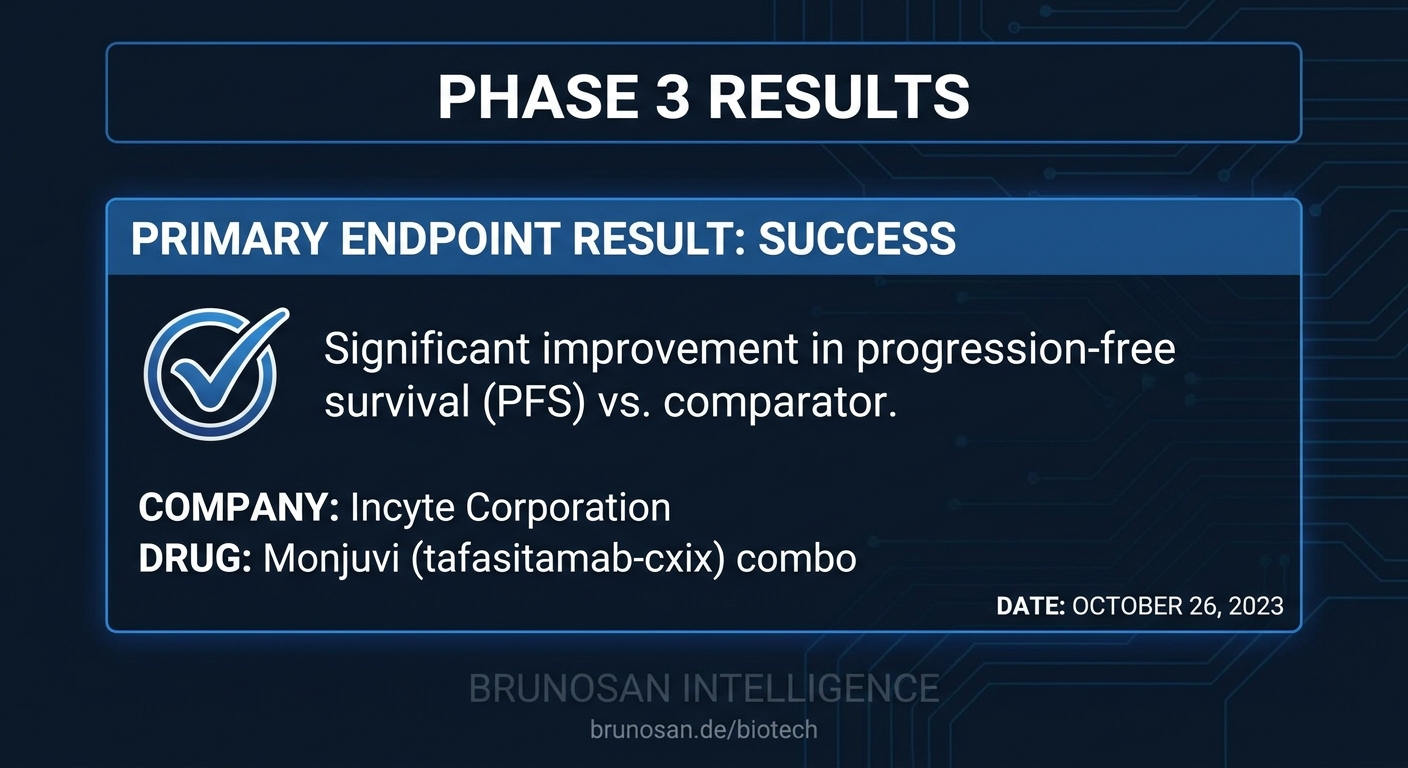
Incyte has announced positive top-line results from its pivotal Phase 3 frontMIND study, positioning its CD19 antibody Monjuvi as a potential new standard of care in the highly competitive first-line diffuse large B-cell lymphoma market. The data directly challenges Roche's established Polivy regimen. A new front-line battle begins.
Drug Profile
Mechanism and Class Monjuvi (tafasitamab-cxix) is a humanized, Fc-modified monoclonal antibody targeting the CD19 antigen, a protein expressed on the surface of B-cells. Upon binding to CD19, tafasitamab induces B-cell lysis through two primary immune-mediated mechanisms: antibody-dependent cell-mediated cytotoxicity (ADCC) and antibody-dependent cellular phagocytosis (ADCP). It is classified as a CD19-directed cytolytic antibody.
Structural Differentiation Tafasitamab is distinguished by a modification in its Fc region. Two amino acid substitutions (L234A and L235A) were engineered to enhance its affinity for the activating FcγRIIIa receptor on immune effector cells, such as natural killer (NK) cells and macrophages. This design amplifies the antibody's ADCC and ADCP activity, theoretically leading to more potent tumor cell destruction compared to non-engineered antibodies. The combination with the immunomodulatory agent lenalidomide is intended to further stimulate effector cell activity.
Clinical Data
The frontMIND study evaluated the efficacy and safety of adding Monjuvi (tafasitamab) and lenalidomide to the R-CHOP chemotherapy backbone (Taf-R-CHOP) for previously untreated, intermediate-to-high-risk DLBCL patients.
| Endpoint | Result | Comparator | Trial | | :--- | :--- | :--- | :--- | | Progression-Free Survival (PFS) | Statistically significant improvement reported | R-CHOP alone | frontMIND (Phase 3) | | Key Secondary Endpoints | Positive trends reported across subgroups | R-CHOP alone | frontMIND (Phase 3) |
Global Regulatory Status
Drug-specific status across all four regulatory bodies BrunoSan tracks. Separate from pipeline volume shown in the infobar.
| Regulatory Body | Status | Notes |
|---|---|---|
| Agency | Status (First-Line DLBCL) | |
| FDA (U.S.) | ✓ (Approved for r/r DLBCL). sBLA for 1L DLBCL pending submission. | |
| EMA (Europe) | Approved (as Minjuvi for r/r DLBCL). MAA variation for 1L DLBCL pending submission. | |
| Health Canada | No submission entry detected in BrunoSan DB as of 2026-06-01. | |
| ANVISA (Brazil) | No submission entry detected in BrunoSan DB as of 2026-06-01. |
STATUS Monjuvi (tafasitamab) is approved for relapsed/refractory DLBCL in major markets. The status below reflects the pending submissions for the *first-line* indication based on the frontMIND trial data.
Market Impact
The front-line DLBCL treatment landscape, long dominated by the R-CHOP regimen, was first disrupted by Roche's Polivy (polatuzumab vedotin). The POLARIX trial established Polivy + R-CHP as a new standard of care, particularly for intermediate-to-high-risk patients. Incyte's positive frontMIND data for Taf-R-CHOP creates a direct competitor to Polivy. The commercial success for Incyte will depend on demonstrating a superior or differentiated clinical profile. Key points of comparison will include the magnitude of PFS benefit, overall survival data when mature, and the safety profile, especially relative to the peripheral neuropathy associated with Polivy.
Beyond this head-to-head competition, the entire therapeutic area faces structural disruption from next-generation immunotherapies. Bispecific T-cell engagers from Roche (glofitamab, mosunetuzumab) and AbbVie/Genmab (epcoritamab) are delivering high response rates in later-line settings and are rapidly advancing into earlier lines of therapy. Concurrently, CAR-T cell therapies are being investigated for high-risk first-line patients. Monjuvi's market opportunity, while tangible, exists within a window that will narrow as these more complex but highly effective modalities become integrated into the DLBCL treatment algorithm.
Based on BrunoSan pipeline data tracking 14,934 global drug events, including 141 FDA regulatory actions logged today, the path from positive Phase 3 oncology data to an sBLA approval typically takes 10-12 months. Incyte's positive frontMIND results provide a clear regulatory path in the U.S.
However, our analysis of 2,202 EMA entries suggests that securing favorable market access in Europe will require a compelling value proposition against the entrenched Polivy regimen. The primary challenge for Monjuvi is not regulatory but commercial. Incyte must rapidly carve out market share before the next wave of bispecifics and cell therapies redefines the standard of care entirely within the next three to five years.